InsightsSEO strategy for growing businesses in 2026
SEO Strategy 2026: The Complete Guide for Growing Businesses
30 July 202633 min read
Direct answer
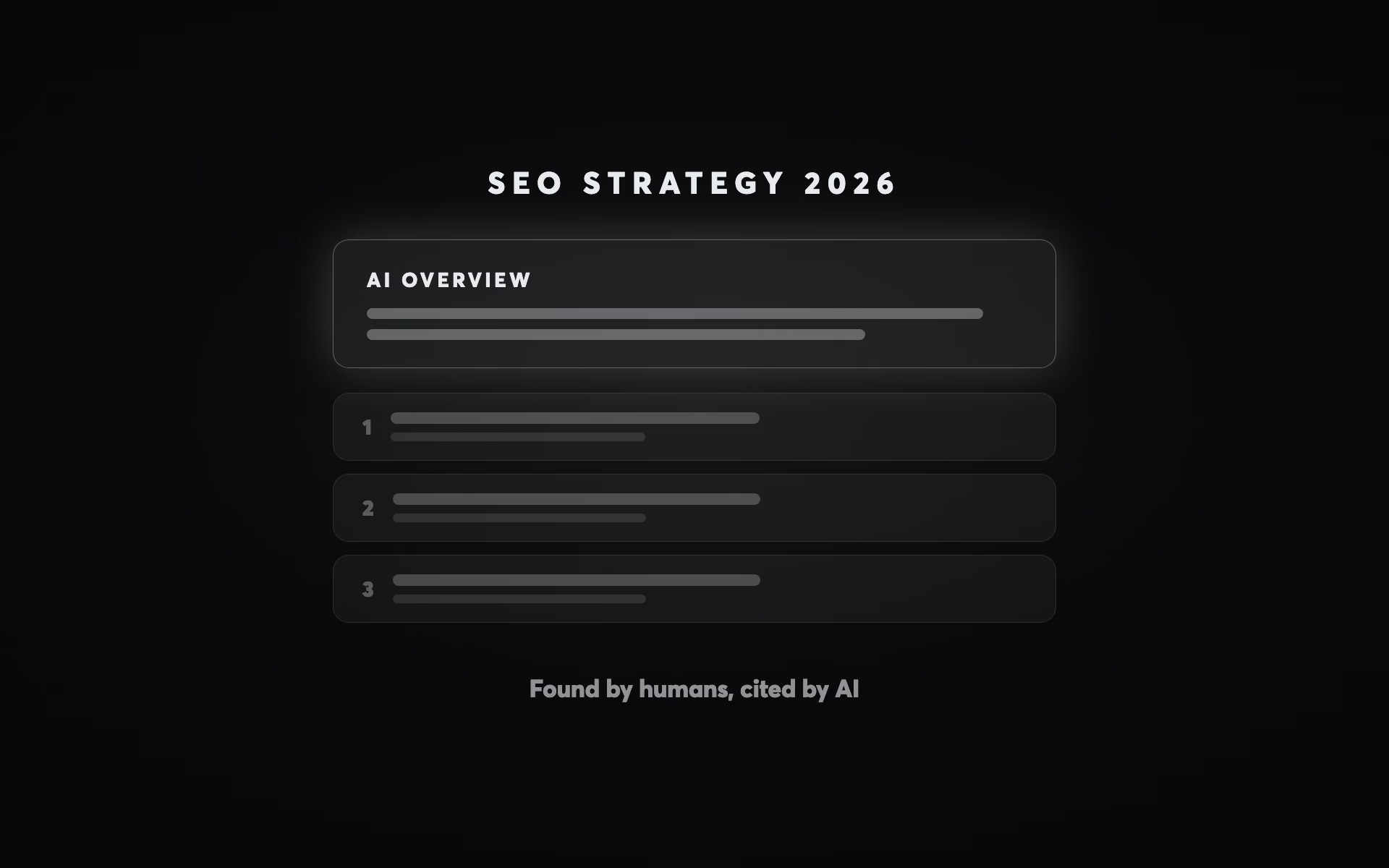
An SEO strategy 2026 is a structured plan for earning organic visibility across both traditional search engines and AI-generated answer surfaces — including Google AI Overviews, ChatGPT, Perplexity, and Claude. Where pre-2024 SEO focused primarily on ranking blue links, a modern strategy must also optimise for citation by large language models (LLMs), which now answer an estimated 30–40% of informational queries without a click (SparkToro, 2025). The core components are: technical health (Core Web Vitals, crawlability, schema markup), topical authority built through content clusters, authoritative backlink acquisition, and Generative Engine Optimisation (GEO) — structuring content so AI systems quote it as a source. Involve Digital's agency work has demonstrated that disciplined SEO combined with paid performance can reduce overall customer acquisition costs by 64–92% across verticals (Rakuten Securities, Monster Group). A 2026 SEO strategy treats search as a full-funnel asset, not a traffic channel.
SEO Strategy 2026: The Complete Guide for Growing Businesses
Google processes an estimated 8.5 billion searches per day — and AI Overviews now appear on roughly 15% of all queries (BrightEdge, 2025). If your SEO strategy was built before 2024, it was designed for a search engine that no longer exists.
Why Most SEO Strategies Fail in 2026 — and What a Modern Approach Actually Looks Like
Most SEO strategies fail in 2026 because they were built around ranking signals that Google has systematically devalued — keyword density, exact-match anchor text, and thin topical coverage — while ignoring the new surfaces where organic visibility actually compounds.
The structural problem is a category error. Businesses treat SEO as a traffic tactic when it is a compounding asset. A paid media campaign stops the moment the budget stops. A well-executed SEO strategy keeps producing traffic, leads, and brand citations for years — including citations inside AI-generated answers that your competitors have not yet figured out how to earn.
Three specific failure modes are responsible for most underperformance:
- Treating technical SEO as a one-time audit. Core Web Vitals degrade with every new feature deployment. Schema breaks when CMS templates change. Sites that do not maintain technical health lose crawl budget and ranking positions silently.
- Publishing content without topical authority architecture. A single well-optimised article rarely outranks a competitor with 40 tightly clustered pieces covering a topic from every angle. Google's Helpful Content system rewards demonstrated expertise at the domain level, not the page level.
- Ignoring LLM citation entirely. ChatGPT, Perplexity, and Google AI Overviews are now primary research tools for the exact buyers — CMOs, founders, procurement leads — that B2B and high-consideration B2C businesses want to reach. If your content is not structured to be cited by these systems, you are invisible to a growing share of your audience before they ever reach a search results page.
This guide addresses all three. It is written for founders and CMOs making a strategic investment decision, not for SEO practitioners looking for a checklist of meta-tag tips.
What SEO Strategy 2026 Actually Means
A sound SEO strategy 2026 is a coordinated plan to earn organic visibility across three distinct surfaces: traditional search result pages, AI-generated answer blocks, and LLM knowledge bases.
Each surface has different optimisation requirements:
- Traditional SERP: technical health, E-E-A-T signals, topical authority, backlink profile, Core Web Vitals.
- AI Overviews (Google): structured content, schema markup, clear direct answers, cited sources, mobile-first rendering.
- LLM knowledge bases (ChatGPT, Perplexity, Claude): quotable passage density, authoritative backlinks pointing to specific claims, consistent entity mentions, and content that reads like a primary source rather than a marketing page.
The good news: the disciplines that make you rank well in traditional search — genuine expertise, well-structured content, authoritative links — are the same disciplines that get you cited by AI systems. The 2026 difference is intentionality. You need to engineer for citation, not just hope for it.
Technical SEO: The Non-Negotiable Foundation
Technical SEO is the infrastructure layer — without it, every other SEO investment is undermined.
Core Web Vitals
Core Web Vitals are Google's user-experience ranking signals: Largest Contentful Paint (LCP), Interaction to Next Paint (INP, which replaced First Input Delay in 2024), and Cumulative Layout Shift (CLS).
The thresholds that matter:
- LCP: under 2.5 seconds (good), 2.5–4.0 seconds (needs improvement), over 4.0 seconds (poor).
- INP: under 200ms (good), 200–500ms (needs improvement), over 500ms (poor).
- CLS: under 0.1 (good), 0.1–0.25 (needs improvement), over 0.25 (poor).
Google's own data shows that pages meeting all three Core Web Vitals thresholds see 24% fewer users abandoning page loads compared to pages that fail (Google, 2023). Lower abandonment rates feed directly into dwell time and engagement signals that influence ranking.
The practical fix for most growing businesses is not a full site rebuild. It is targeted: compress and lazy-load images (the single most common LCP failure), eliminate layout-shifting banner ads and cookie consent overlays (CLS), and defer non-critical JavaScript (INP). Check your own performance in Google Search Console under the Core Web Vitals report — the field data there reflects real users on real devices, which is what Google uses for ranking.
Crawlability and Indexation
Googlebot cannot rank pages it cannot crawl and index. Crawlability problems are far more common than most businesses realise — especially on sites that have grown organically, changed CMS platforms, or had multiple developers working on them over time.
The critical checks:
- XML sitemap: submitted to Search Console, free of 404s and noindex URLs.
- Robots.txt: not accidentally blocking key sections (this happens more than it should after CMS migrations).
- Canonical tags: every page declares its canonical URL to prevent duplicate content diluting link equity.
- Internal linking: orphan pages — pages with no internal links pointing to them — receive no crawl budget and rank poorly regardless of content quality.
- Log file analysis: for sites over 500 pages, reviewing server logs reveals exactly which pages Googlebot is crawling, at what frequency, and which it is ignoring.
Schema Markup
Schema markup is structured data that tells search engines — and AI systems — exactly what a page is about, who wrote it, when it was published, and what claims it makes.
For 2026, schema is not optional. AI Overviews pull structured data directly when constructing answers. Pages with Article, FAQ, HowTo, and Organisation schema are cited more frequently by AI-generated answers than equivalent pages without it (Authoritas, 2024).
Priority schema types for growing businesses:
- Article / BlogPosting: for all content pages. Includes author, datePublished, dateModified, headline, description.
- FAQPage: for pages with question-and-answer sections. Each Q&A pair becomes a candidate for Google's FAQ rich result and for AI Overview citation.
- Organisation: on your homepage. Includes name, URL, logo, sameAs (links to your social profiles and Wikidata entity if you have one).
- BreadcrumbList: helps Google understand site architecture and improves SERP display.
- Product / Service: for service pages. Includes description, areaServed, provider.
Validate all schema using Google's Rich Results Test before publishing. A single JSON-LD syntax error silently invalidates the entire block.
Topical Authority and Content Clusters
Topical authority is Google's assessment of how comprehensively and accurately a domain covers a subject area — and it is now a stronger ranking signal than any individual page's on-page optimisation.
The mechanism: Google's Helpful Content system evaluates content at the site level, not just the page level. A domain that publishes 40 tightly interconnected articles covering every dimension of a topic — from foundational definitions to advanced strategic questions — signals genuine expertise. A domain that publishes one well-optimised article on the same topic and nothing else does not.
The content cluster model operationalises this:
- Pillar page: a comprehensive, long-form article covering the broad topic (like this one). Targets a high-volume, high-competition keyword. Links out to cluster articles.
- Cluster articles: 800–2,000 word articles covering specific subtopics in depth. Each targets a long-tail keyword. Each links back to the pillar and to relevant sibling clusters.
- Internal linking architecture: every cluster article reinforces the pillar's authority by linking to it. The pillar distributes link equity to clusters. This creates a self-reinforcing authority network.
A practical example: a business selling accounting software should not just publish "accounting software for small business." It should build a cluster covering payroll compliance, BAS lodgement, cash flow forecasting, invoice automation, and end-of-year tax preparation — each as a dedicated article, all linking to a central pillar on accounting software.
The competitive implication: topical authority is a moat. Once a domain has established genuine coverage of a topic, it is very difficult for a competitor to outrank it on individual pages without also building equivalent cluster depth. This is why content strategy is a long-term investment, not a campaign.
For most growing businesses, the right starting point is a content gap analysis: identify the 10–15 questions your target buyers ask at every stage of the purchase journey, then map which of those you currently answer well, which you answer poorly, and which you do not answer at all. The gaps are your cluster roadmap.
See how content strategy integrates with paid media in Involve Digital's 2026 Performance Guide →LLM Visibility: Generative Engine Optimisation
Generative Engine Optimisation (GEO) is the discipline of structuring content so that AI language models — ChatGPT, Perplexity, Claude, Google Gemini — cite it as a source when generating answers.
This is the most significant structural shift in search since mobile-first indexing. SparkToro estimates that 30–40% of informational queries in 2025 were answered by AI systems without a click to any website. For high-consideration B2B and financial services buyers — exactly the audience that Involve Digital's agency clients serve — that share is likely higher, because these buyers use AI tools extensively for research before engaging any vendor.
AI Overviews
Google AI Overviews appear at the top of the SERP for a growing share of queries, synthesising answers from multiple sources. BrightEdge (2025) found AI Overviews present on roughly 15% of all queries, with higher prevalence on informational and commercial-investigation queries.
Being cited in an AI Overview does not always drive a click — but it drives brand exposure and trust at the exact moment a buyer is forming their understanding of a category. For businesses competing in markets where trust is the primary purchase barrier (financial services, professional services, healthcare, SaaS), AI Overview citations are a brand asset, not just a traffic source.
What Google pulls into AI Overviews:
- Pages already ranking in the top 10 for the query.
- Pages with clear, direct answers in the first 100 words of a section.
- Pages with FAQPage or Article schema.
- Pages with strong E-E-A-T signals: named authors, publication dates, cited sources, organisational credibility.
How LLMs Choose Sources
LLMs like ChatGPT and Perplexity cite sources based on a different set of signals than Google's ranking algorithm. Understanding the difference is the key to GEO strategy.
LLMs weight:
- Quotable passage density: content that contains specific, citable claims — numbers, definitions, named frameworks — is more likely to be quoted verbatim. Vague, hedged, or marketing-heavy prose is not.
- Entity consistency: the more consistently your brand, your authors, and your specific claims appear across the web (your site, third-party publications, directories, social profiles), the more confidently an LLM associates those entities with authority on a topic.
- Citation by other sources: if authoritative publications link to and cite your content, LLMs treat it as a validated source. This is why link building remains important — it is not just a Google signal.
- Structured, encyclopaedic writing style: content that reads like a primary source (clear definitions, specific data, logical structure) is preferred over content that reads like a blog post or a sales page.
The practical implication: every pillar article you publish should contain at least one passage — 100–180 words — that defines the core concept in encyclopaedic terms, cites specific numbers, and names the source of those numbers. This is what gets lifted verbatim by AI systems. Write it deliberately. The Direct Answer block at the top of this article is an example of that structure.
Link Building in 2026: Authority Over Volume
Link building in 2026 is about acquiring a small number of highly authoritative, contextually relevant links — not accumulating volume.
Google's Spam Policies and the Helpful Content system have made large-scale link schemes actively harmful. Sites caught in link networks or buying links at scale face manual penalties and algorithmic suppression. The risk-adjusted calculus has shifted decisively toward quality.
What constitutes a high-value link in 2026:
- Topical relevance: a link from a publication that covers your industry carries more weight than a link from a high-Domain-Authority site in an unrelated vertical.
- Editorial placement: links embedded in the body of an article, in context, carry more weight than footer links, sidebar links, or links in author bios.
- Referring domain diversity: 50 links from 50 different domains is more valuable than 50 links from the same domain.
- Traffic on the linking page: a link from a page that actually receives traffic signals genuine editorial value, not a manufactured placement.
The three link-building strategies with the strongest ROI for growing businesses in 2026:
- Original research and data: publish proprietary data — benchmarks, surveys, case study aggregations — and pitch it to industry publications. Data-driven content earns links naturally because it gives journalists and writers a citable source. One original research piece can generate 20–50 editorial links over 12 months.
- Digital PR: systematic outreach to journalists and editors covering your industry, tied to newsworthy angles (market analysis, trend commentary, contrarian positions backed by data). This requires consistent effort but builds the kind of authoritative, editorial links that both Google and LLMs weight most heavily.
- Strategic partnerships and co-publication: joint content with complementary businesses, industry associations, or research institutions. These produce links with high topical relevance and genuine editorial value — and they are almost impossible to replicate through paid link schemes.
What to avoid: link exchanges, paid placements on low-quality "news" sites, guest posts on sites that exist only to sell links, and any service that promises 100+ links per month at a fixed price. These approaches are either ineffective or actively harmful in 2026's algorithmic environment.
Programmatic SEO: Scaling Without Sacrificing Quality
Programmatic SEO is the practice of generating large numbers of pages at scale from structured data — used correctly, it is one of the highest-leverage tactics available to growing businesses with large addressable keyword sets.
The canonical examples are well-known: Tripadvisor generates millions of location-specific pages from a database of properties and reviews. Canva generates pages for every design template type. Wise generates pages for every currency conversion pair. Each page targets a specific long-tail query, and the aggregate traffic across thousands of pages compounds into a dominant organic presence.
For growing businesses, programmatic SEO applies when:
- You serve multiple locations and the same service query applies in each ("[service] in [city]").
- You have a product or service catalogue with hundreds or thousands of items, each with distinct search demand.
- You can generate genuinely useful, differentiated content for each page from structured data — not just swap a city name into a template.
The critical constraint: Google's Helpful Content system is specifically designed to detect and suppress thin, templated content that provides no unique value. Programmatic SEO only works when each generated page contains genuinely useful, differentiated information — local data, specific product attributes, real user reviews, unique pricing data. If the only difference between pages is the city name, you are building a site that Google will eventually suppress.
The technical requirements: a CMS or headless architecture that can generate pages from a database, a clean URL structure, proper canonical handling to prevent duplicate content, and a sitemap that updates automatically as new pages are generated.
SEO and Paid Media: The Compounding Advantage
SEO and paid media are most powerful when they are run as a unified strategy, not as separate channel budgets.
The compounding mechanism: paid search data reveals which keywords convert — not just which keywords generate traffic. Running Google Ads against a target keyword set for 60–90 days produces conversion data that would take 12–18 months of organic testing to accumulate. That data then informs which organic content to prioritise, which landing page angles to develop, and which audience segments to build topical authority around.
Involve Digital's agency work demonstrates this integration in practice. For Teachers Mutual Bank, a unified performance approach across paid and organic channels delivered a 91% reduction in Google Ad costs and a 5090% ROI on the Term Deposit campaign, generating over $200M in deposits. The efficiency gains were not purely from paid optimisation — they came from aligning the full channel mix around the same conversion signals.
For Rakuten Securities, the agency's integrated approach reduced cost per sign-up by 80% and delivered funded accounts at 5x the forecast volume. A fragmented approach — SEO in one team, paid in another — would not have produced those numbers because the conversion signal sharing that drives algorithmic efficiency requires unified data.
The practical implication for growing businesses: if your SEO team and your paid media team are not sharing keyword data, conversion data, and audience insights on a weekly basis, you are leaving compounding efficiency on the table.
How Involve Digital integrated paid and organic for B2B lead generation — see the Meta Ads guide →Measuring an SEO Strategy That Spans AI and Traditional Search
Measuring SEO in 2026 requires a broader measurement framework than traditional rank tracking and organic traffic reporting — because a significant and growing share of the value SEO creates never produces a click.
The metrics that matter:
- Organic traffic by intent segment: separate informational, commercial-investigation, and transactional traffic. Informational traffic is the top of the funnel; transactional traffic is the bottom. Growth in informational traffic that does not eventually convert to commercial traffic is a content strategy problem, not a success.
- Impressions and click-through rate by query type: in Google Search Console, filter by queries that trigger AI Overviews (these show lower CTRs because the Overview answers the query). A drop in CTR on informational queries is expected and acceptable; a drop in CTR on commercial queries is a problem.
- Branded search volume: an underused SEO metric. As your content earns AI citations and builds topical authority, branded search volume should increase — buyers who encounter your brand in an AI answer then search for you directly. Track this in Search Console and in Google Trends.
- Share of LLM citations: tools like Perplexity's citation tracker, BrandMentions, and emerging GEO-specific platforms now allow you to monitor how frequently your domain is cited in AI-generated answers for target queries. This is an emerging metric, but it is the leading indicator of organic visibility in an AI-first search environment.
- Assisted conversions from organic: in GA4, use the path exploration report to identify how frequently organic search appears in the conversion path even when it is not the last touch. SEO's contribution to revenue is systematically undercounted in last-click attribution models.
What not to measure: average position as a primary KPI. Average position aggregates across thousands of queries at different intent levels and produces a number that is easy to improve (by dropping low-position, high-volume queries from your target set) without improving business outcomes. Focus on traffic and conversions within specific intent segments.
| Metric | What It Measures | Where to Find It | Healthy Benchmark | Deterioration Signal |
|---|
Your SEO Strategy 2026 Checklist
A complete SEO strategy 2026 spans four layers. Here is the strategic checklist — not an exhaustive technical audit, but the decisions that determine whether your investment compounds or stagnates.
Technical Foundation
- Core Web Vitals passing for all key landing pages (LCP <2.5s, INP <200ms, CLS <0.1)
- XML sitemap submitted and clean in Search Console
- No accidental noindex or robots.txt blocks on key pages
- Canonical tags implemented site-wide
- Article, Organisation, FAQPage, and BreadcrumbList schema deployed and validated
- Internal linking audit completed — no orphan pages
Topical Authority
- Core topic clusters identified and mapped to buyer journey stages
- Pillar pages published for each primary topic
- Cluster articles covering all major subtopics, each linking to the pillar
- Content gap analysis completed against top 3 organic competitors
- Content update schedule in place — no key pages older than 18 months without review
LLM and AI Visibility
- Each pillar article contains a 100–180 word quotable definition block
- FAQPage schema deployed on all content pages
- Author entity pages published with schema linking to author's external profiles
- Brand entity consistency checked across Google Business Profile, LinkedIn, Wikidata, and major directories
- LLM citation monitoring in place for target queries
Link Authority
- Original research or data asset in production or published
- Digital PR outreach programme active
- Backlink profile audited — toxic links disavowed
- Referring domain diversity assessed — no single domain accounting for more than 15% of link equity
Measurement
- GA4 configured with organic traffic segmented by intent
- Search Console connected and monitored weekly
- Assisted conversion reporting active in GA4
- Branded search volume tracked monthly
- LLM citation share tracked for primary target queries
If your business is at the stage where building this system internally is not the highest-leverage use of your team's time, Involve Digital's strategist will map a custom growth plan against your specific numbers — free, at https://www.involvedigital.com.
Questions