InsightsBusiness Growth
Business Growth Consultant or Growth Marketing Agency? What Each Does, and Which You Need
A growth consultant diagnoses and advises; a growth marketing agency executes and is measured on the result. Scope, fee models, the questions to ask, and how to choose.
24 October 20263 min readEdited by Michael Wilkins
Direct answer
A business growth consultant diagnoses where growth is stuck and recommends what to change: pricing, positioning, channels, sales process. The work usually ends with a plan that your own team carries out. A growth marketing agency writes the plan and then runs it, across search, social, websites and tracking, and is judged on the leads and sales it produces. Choose a consultant when the problem is the business model or the team, and you have people to execute. Choose an agency when you already know who you sell to and need demand generated and measured. Many businesses need both in sequence: the diagnosis first, then execution measured against an agreed number.
The difference in one line
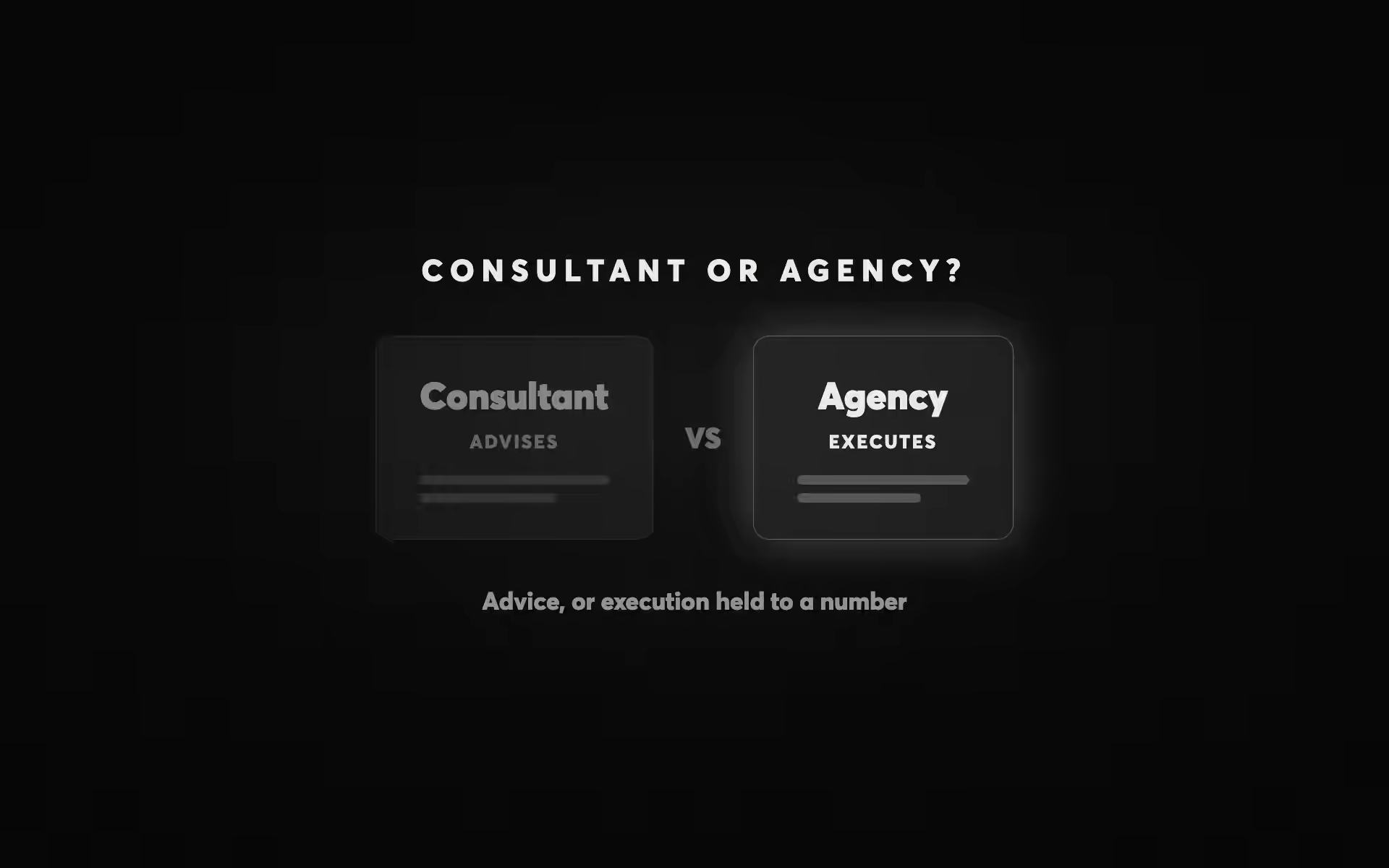
A consultant is paid for advice. An agency is paid for execution, and a good one is held to a number. Both can be called "business growth", which is why buyers often compare the wrong things.
What a business growth consultant does
A growth consultant looks at the whole business: who buys, why they buy, what each customer is worth, where deals stall, and whether the team and systems can handle more volume. The output is usually a diagnosis and a plan.
- Typical scope: market and customer research, pricing and offer review, sales process review, a prioritised growth plan.
- Who carries it out: your team, or suppliers you hire separately.
- How it is usually charged: a fixed project fee, a day rate, or a monthly advisory retainer.
- Where it works best: when the constraint is the business itself: an unclear offer, the wrong price, a sales team that cannot convert what marketing already sends.
What a growth marketing agency does
A growth marketing agency starts with the same questions, then builds and runs the system that answers them: the campaigns, the landing pages, the tracking that ties a lead back to its source, and the reporting that shows what each channel returns.
- Typical scope: strategy, paid search and social, SEO, websites and landing pages, analytics, CRM connections.
- Who carries it out: the agency, working with your sales team.
- How it is usually charged: a monthly management fee, with media spend paid separately. Some agencies tie part of the fee to performance.
- Where it works best: when you know who you sell to and the constraint is demand: not enough of the right enquiries.
Side by side
| Growth consultant | Growth marketing agency | |
|---|---|---|
| Main output | A diagnosis and plan | Leads, sales and the system that produces them |
| Who executes | Your team | The agency |
| Measured on | The quality of the advice | An agreed commercial number |
| Common fee model | Project fee or day rate | Monthly fee plus media spend |
| Risk if it goes wrong | A good plan nobody has time to run | Activity without a clear business case |
Questions that separate the good from the generic
Whichever you hire, these questions show quickly whether you will get growth or a deck.
- What number will we judge this on? Enquiries at or above a minimum deal size, signed customers, or revenue. Not impressions or clicks.
- Who owns the accounts and data? Your ad accounts, analytics and CRM should stay in your name.
- What happens in the first 90 days? A good answer names the baseline, the first changes and when you will see a result.
- Who does the work? Ask to meet the people, not just the person selling.
- Can you show results credited to the campaign that produced them? A multi-channel result should not be presented as a win for one channel.
What measured growth looks like over years
For a general insurance broker network, the brief was to increase "Find a Broker" enquiries against what the previous agency had delivered, on an equivalent media budget. The programme ran across search, social, audio and display, with budget moved toward the channels that performed. Broker leads reached 5× the prior agency's within three months, 6× by the end of year one and 9.7× by year five. That result belongs to the whole programme, and it was only possible because the enquiry that mattered was counted from day one.
Growth can also start with the foundations. BCS Broking had a website that had not produced a decent lead in eleven years. After a rebuild around the structure of their market, ten enquiries arrived in the first month, and the next job became qualifying them.
Which one you need
- Hire a consultant if you are unsure who your best customers are, your pricing is in question, or your team has capacity to execute a plan.
- Hire an agency if your offer is proven, you need more of the right enquiries, and you want one team accountable for the result.
- Hire one that does both if you want the diagnosis and the execution joined up, with the same people responsible for each.
How we combine strategy, media, websites and measurement: business growth at Involve Digital. If enquiries are the immediate gap, see lead generation.
Questions