InsightsGoogle Ads
Google Ads for Home Services: The 2026 Playbook
Emergency vs planned campaigns, radius economics, southern-hemisphere seasonality and call-first measurement — Google Ads built the way trades businesses actually win work.
22 July 2026Updated 28 September 20267 min readEdited by Michael Wilkins
Direct answer
Google Ads works for home services when the account mirrors how the work actually arrives: emergency and planned jobs run as separate campaigns, targeting is presence-based and tiered around the real service radius, ad schedules match the hours the phone is answered, and success is measured in booked jobs — not clicks or raw form fills. The most common failure is structural: one generic campaign averaging across a burst-pipe searcher and a renovation planner, landing on a website too thin to convert either. Fix the structure and the destination, then scale by season. Local Services Ads aren't available in Australia or New Zealand, so build on standard Search campaigns.
Home services is one of the best categories on Google Ads and one of the easiest to get wrong. A plumber, electrician, lawn-care operator or cleaner who captures high-intent local searches can build a genuinely predictable pipeline of booked jobs. The same business with a loosely targeted account burns budget on clicks from three suburbs past the service boundary, on services they do not offer, at hours when nobody answers the phone. The difference is not spend. It is structure.
This playbook covers what actually determines results for trades and home services businesses in Australia and New Zealand: how to split emergency and planned intent, how to make radius economics work for you, how to run a seasonal calendar that matches the southern hemisphere, and how to measure booked jobs instead of clicks.
Why home services is a different Google Ads game
Three structural facts separate home services from almost every other category.
First, the job is physical, so the click is only worth something inside your radius. A national retailer wastes nothing when someone two cities away clicks. You waste the entire click. Geographic discipline is not an optimisation in this category — it is the campaign.
Second, intent splits into two different buying modes. The person searching for a burst pipe at 10pm and the person planning a bathroom renovation are not in the same funnel, and treating them the same wastes money on both.
Third, conversion happens on the phone. For most trades, the enquiry that becomes a job is a call, not a form. If your account is optimising toward form fills while your best jobs arrive by phone, Google is learning from the wrong signal.
Emergency vs planned: run them as separate campaigns
The single highest-leverage structural decision in a home services account is splitting emergency intent from planned intent.
Emergency campaigns — burst pipe, blocked drain, no hot water, power out, tree down — should bid aggressively during the hours you genuinely answer, lead with call assets, and say the two things an emergency searcher cares about: you are available now, and you serve their suburb. Ad schedules matter enormously here, and call assets can be scheduled to show only while someone is answering. If you answer after hours, bid up after hours: that is when being available is the whole pitch. If you do not answer after hours, stop paying for those clicks entirely — an unanswered emergency click is a donation to your category.
Planned campaigns — renovation, landscaping, new heat-pump install, house wash, regular mowing — behave more like considered purchases. Quote forms work alongside calls, comparison behaviour is normal, and the job values are usually higher. These campaigns tolerate lower urgency but reward proof: photos of real work, response-time honesty and a clear quoting process.
Separating the two lets you bid, schedule and write ads for each mode instead of averaging across both.
The surface mix: Search first, everything else on merit
Standard Search campaigns on exact and phrase match remain the workhorse for trades — high-intent queries, controllable targeting, measurable calls. Build there first.
Google's other surfaces earn their place only after Search is solid. Local Services Ads, Google's pay-per-lead format, don't run in Australia or New Zealand: Google lists them only for the United States, Canada, the United Kingdom and several European countries (checked September 2026), so advice built around them doesn't apply here. Performance Max can add volume for planned-work categories, but treat it with care in lead generation: without tight lead-quality feedback it will happily optimise toward cheap, low-quality enquiries and spam form fills. Feed it real outcomes or keep it on a short leash.
Radius economics: structure the account around your map
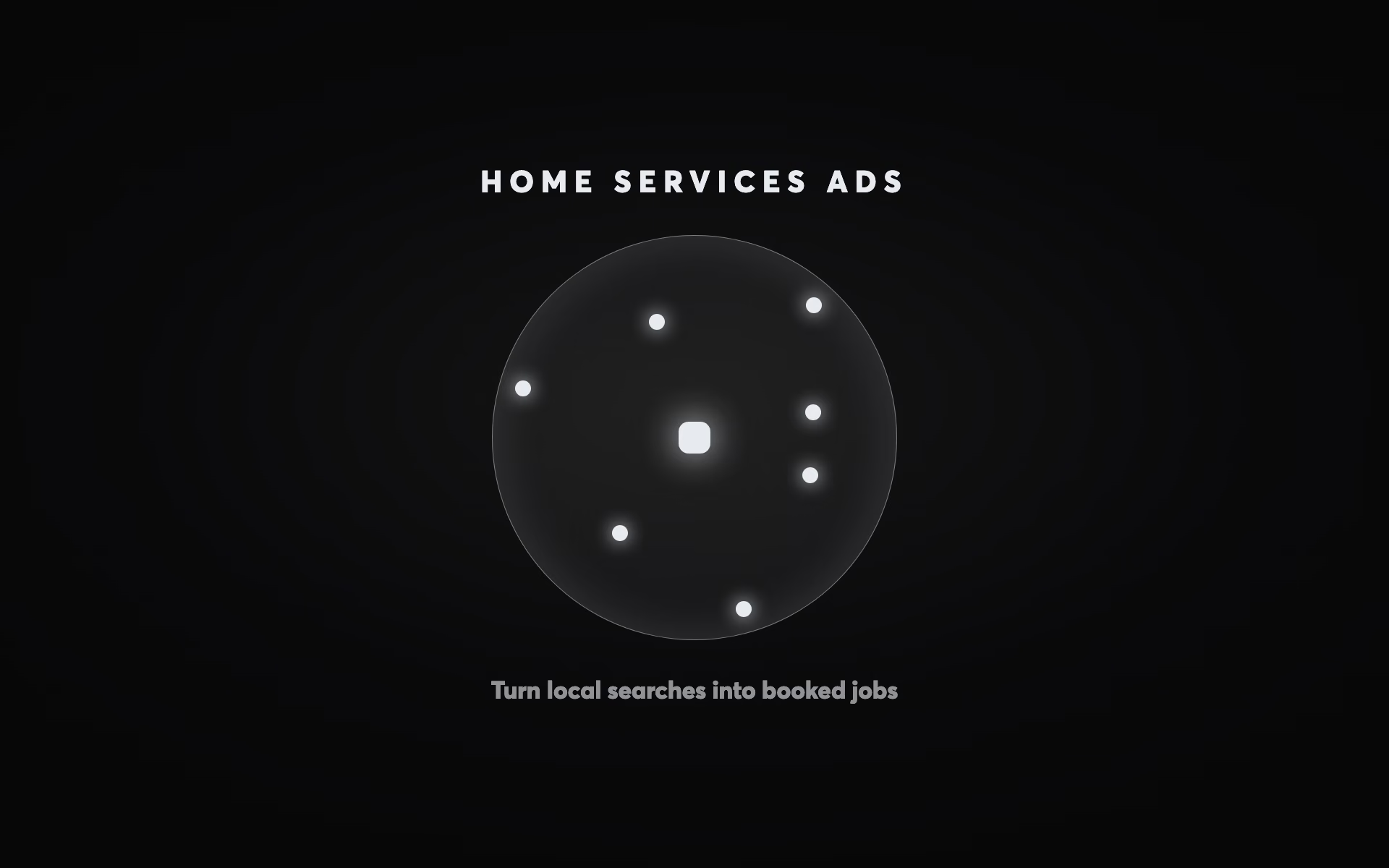
Every home services business has a map with three zones: the core suburbs where you win most work and travel costs least, a second band you serve but less profitably, and everywhere else. Your account should mirror that map.
Set location targeting to Presence (people in, or regularly in, your area), not the default, which also reaches people who have only shown interest in it. Tier your bids by zone — strongest in the core, moderate in the band, excluded beyond. Location bid adjustments do this under manual bidding, but Smart Bidding strategies don't apply them, so if you bid with Maximise conversions or a target CPA, split the zones into separate campaigns instead. Name real suburbs in ad copy, because "Emergency plumber in Riccarton" speaks to the person standing in Riccarton with water coming through the ceiling in a way "Plumber Christchurch" doesn't. And keep service-area honesty: advertising into suburbs you quietly do not service produces reviews you do not want.
A seasonal calendar that matches the southern hemisphere
Most Google Ads seasonality advice is written for the northern hemisphere. In Australia and New Zealand the calendar inverts, and Google's own search data shows it. In Keyword Planner's monthly figures for September 2023 to August 2026, searches for "lawn mowing" climbed from September and peaked between October and January in both countries. Heating searches jumped in late autumn — "gas heater service" in Australia from April, "heat pump service" in New Zealand from May — and stayed high into July. Air-conditioning installation searches peaked between November and January. Gutter and roof work splits by country: in New Zealand, "gutter cleaning" and "roof repairs" peaked in April, while in Australia gutter-cleaning searches were fairly even through the year, a little higher in spring. Check the pattern for your own trade and region, and plan budgets around your real season, not a generic one.
Two practical rules. Move budget ahead of the season, not with it — have campaigns, ads and budget ready before the first warm weekend of spring brings the mowing searches, not after. Do not switch campaigns fully off in the off-season. Even in June and July, "lawn mowing" searches ran at about two-thirds of their yearly average in both countries. Keep a floor on brand terms and genuine year-round intent, and scale the seasonal terms up and down instead — you stay visible for the work that still exists, and you avoid rebuilding from a standing start every spring.
Track booked jobs, not clicks
The account can only get as smart as the outcome you feed it. For home services that means calls first: call tracking with a sensible minimum duration so a wrong number does not count as a lead, call assets on emergency campaigns, and phone numbers that are actually answered. Forms matter for planned work, but score them — a quote request with a suburb and a job description is not the same as a one-line "how much".
Then push one level deeper: record which enquiries became quotes and which quotes became jobs, even if it is just a spreadsheet at first, and review keyword performance against that. When we built search campaigns for HIA's industry training courses — tradespeople, builders and contractors searching terms like "building certification course" and "construction safety training online" — the north-star metric was conversion rate at the keyword level, which showed which keywords were chewing up budget without delivering enrolments. The same discipline applies to a plumber's account word for word.
The weak-website trap
Google Ads amplifies whatever it lands on. If the destination is a three-page self-built site with no service pages, no areas, no proof and no clear way to enquire, the ads pay for traffic the site cannot convert.
Mr Mow Garden Services in Gore is the clean before-and-after. The original self-built site had three pages — home, contact, and a gallery that redirected to Facebook — and generated no new enquiries. Google Ads was planned only as a secondary channel; the priority was a site that could bring in work without ongoing ad spend. We replaced it in about two weeks, for NZ$1,000, with a fourteen-page site built for local search: a page per service, a page per area, and clear quote and call actions. It went live in late March 2026, and between April and August its monthly Google search impressions tripled. That structure is what paid clicks need to land on too. If your site is not there yet, fix that first or in parallel; our small business packages exist for precisely this.
Your first 90 days
Days 1–30: one emergency campaign and one planned campaign for your highest-value service, exact and phrase match only, presence-based targeting on your real service area, call tracking live, ad schedule matched to answering hours.
Days 31–60: add negative keywords weekly from the search-terms report (free, DIY, course, jobs, and every suburb you do not serve), split out a second service if the first is converting, and start recording enquiry-to-job outcomes.
Days 61–90: bid by zone, swap creative for the coming season, and judge every keyword on cost per booked job. Scale what books work. Cut what does not.
If you would rather have this built and run properly from day one, that is what we do. For the traffic that quietly eats trades budgets, see our article on wasted spend in trades Google Ads accounts; for how differently the same platform behaves by industry, see law firms and healthcare.
Questions