InsightsPaid Media
A Third of a Trades Ad Budget Reaches People Who Cannot Hire You
Job seekers, DIY searchers and price shoppers look identical to a customer on the enquiry line. An audited account, the third of spend that could never convert, and the careers page that turned waste into an asset.
19 September 20265 min readReviewed by Michael Wilkins
Direct answer
In trades and local services, broad match buys three kinds of traffic that cannot become customers: job seekers, DIY searchers and price shoppers. Because these convert on a contact form at a similar rate to real buyers, broad and exact match can produce the same number of enquiries while differing several times over in qualified work. An audit of one inherited traffic management account scored it 35 out of 100, with roughly a third of spend reaching traffic that could never convert — including a Performance Max campaign that turned 174,000 impressions into a single conversion, and budget spent on people searching for traffic controller courses and jobs. Involve Digital runs trades accounts on phrase and exact with a service page per service and an area page per area, and gives job-seeker intent a careers page rather than a negative keyword.
The enquiry line lies in this vertical
Here is the same budget spent two ways for a trade business. Look at the enquiries row, then look at the row underneath it.
| Broad match | Phrase + exact | |
|---|---|---|
| Clicks | 1,400 | 520 |
| CPC | A$4 | A$10 |
| Spend | A$5,600 | A$5,200 |
| Landing page conversion | 3% | 8% |
| Enquiries | 42 | 42 |
| Genuinely qualified | 10% | 45% |
| Real sales conversations | 4 | 19 |
| Cost per real conversation | A$1,400 | A$274 |
Illustrative model, not a benchmark — the shape of the arithmetic, not the figures. Run it on your own CPCs, landing page conversion rate and qualification rate.
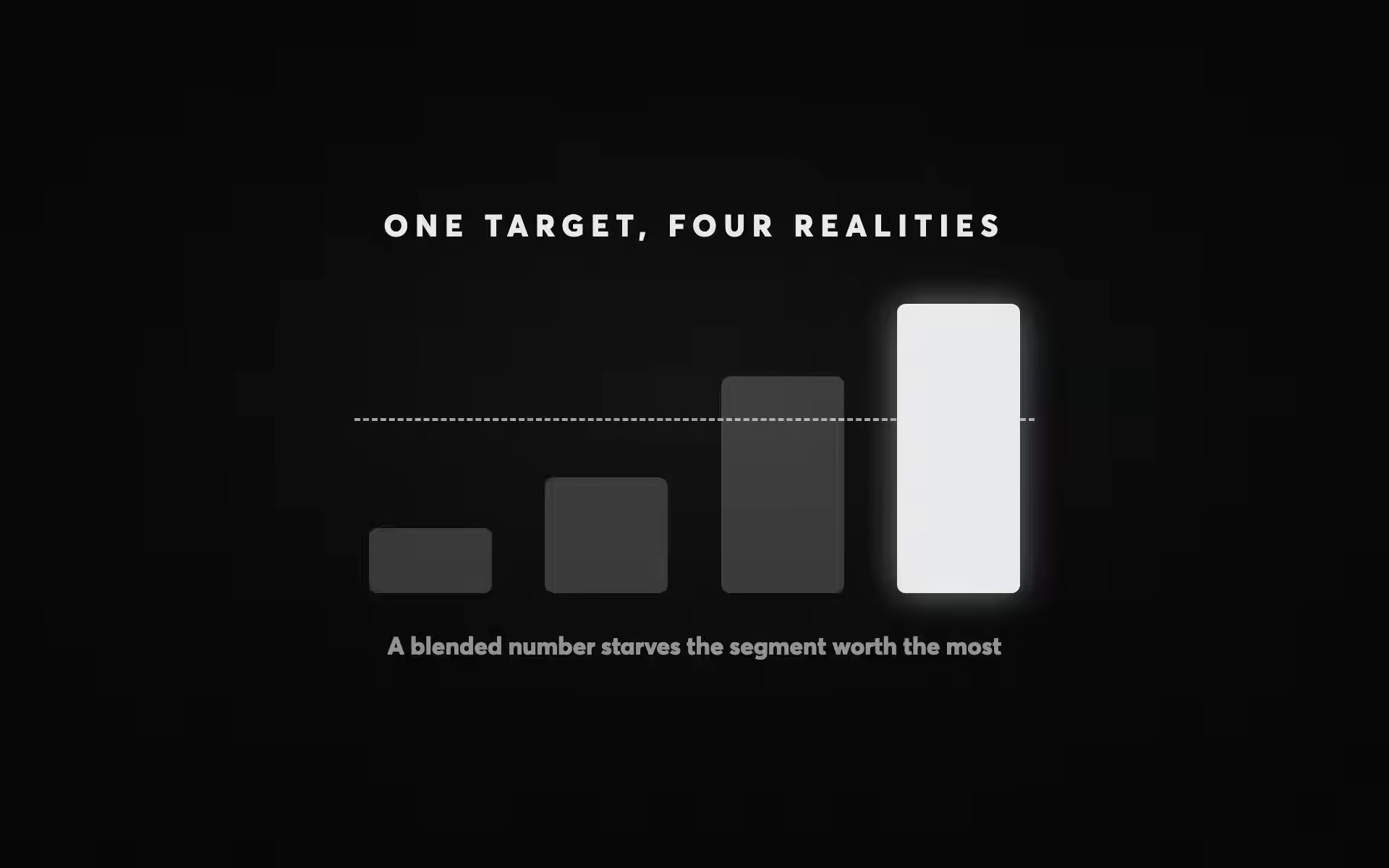
Both columns produce the same number of enquiries. That is the trap in trades and local services: broad match looks identical on the number most operators report, and falls apart on the number that pays wages.
What an inherited trades account actually contained
When we took over the Google Ads account for MLA Traffic — traffic management and traffic control across Melbourne and regional Victoria, working on civil projects, utility work, events and council contracts — our audit scored the inherited account 35 out of 100, with roughly a third of spend going to traffic that could never convert.
The specifics are worth listing, because they recur:
- A Performance Max campaign that turned 174,000 impressions into a single conversion. Broad automated inventory with no conversion signal worth learning from is a budget shredder in a low-volume, high-value category.
- Competitor brand keywords carrying quality scores of 1 and 2 — the lowest Google issues — producing nothing.
- A meaningful slice of budget on job-seeker intent: traffic controller courses, traffic control jobs.
- Every ad pointing at the homepage, because there were no service pages to point them at.
The last two are the same problem seen from both ends. Match type and landing page are one decision: a tightly matched query deserves a page that answers it, and a broadly matched query has no page that could.
The three audiences that cannot hire you
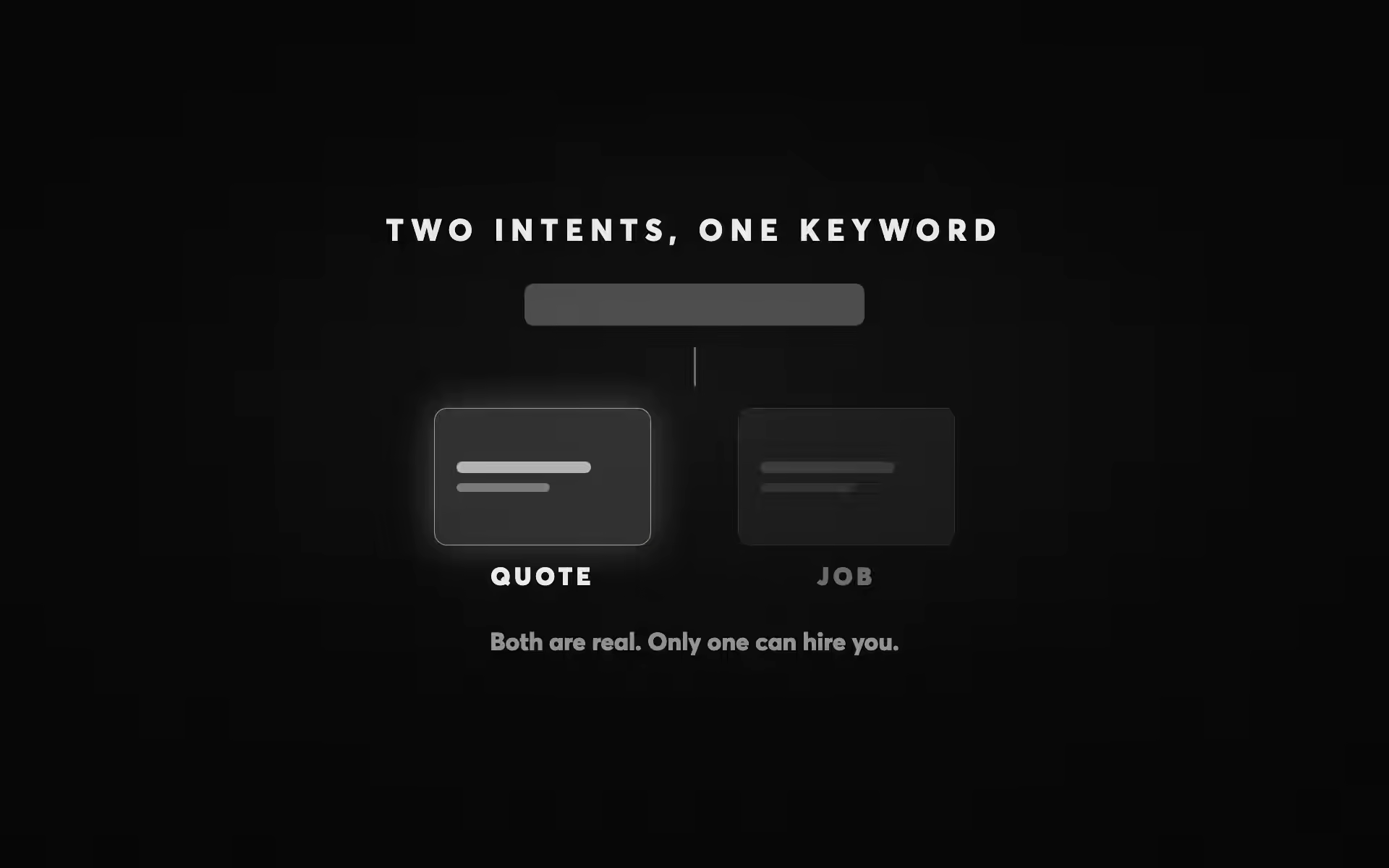
- Job seekers. In any licensed trade the same words describe the service and the career. “Traffic control”, “electrician”, “plumbing” are all typed by people looking for work.
- DIY searchers. Looking for how to do it themselves, what it should cost, or which part to buy. Enormous volume, cheapest clicks in the account.
- Price shoppers with no job. Researching a hypothetical, comparing a quote they already have, or checking a number for an insurance claim.
All three convert on a contact form at rates that look perfectly healthy. None of them can give you work.
The job seekers are an asset, once they have somewhere to go
This is the part most trades accounts get backwards.
The old MLA account was quietly paying for people searching “traffic controller course” and “traffic control job” — correctly treated as wasted spend, because an ad for commercial traffic management cannot convert a job seeker. But in the six weeks after the rebuild, the site produced 19 commercial leads and 18 job applications.
For a traffic management company that second number is not a side effect. It is the constraint. Winning work you cannot crew is worse than not winning it, and in a credentialed trade the limit on growth is accredited people rather than demand. Give that intent a careers page of its own and it stops being waste and starts being the thing that lets you say yes to the next contract.
So the rule is not “negative out the job seekers”. It is “stop paying to send them to a page about commercial services, and build the page they were looking for”.
Lead with the thing that makes you eligible
MLA hold VicRoads pre-qualification for Traffic Management Design and Implementation, Categories 1 and 2. A principal contractor cannot legally engage a company that does not. The rebuilt homepage leads with exactly that — the pre-qualifications, AS 1742.3 and Austroads AGTTM, 24/7 operation with under two-hour metro mobilisation — because councils, civil contractors and utilities are not buying traffic cones. They are buying confidence that the paperwork survives an audit.
Substitute your own trade's version: the licence number, the tier, the insurance limit, the accreditation. It belongs above the fold, and it belongs in the ad.
In local services, organic does more of the work than anywhere else
Trades is the vertical where earning beats buying most decisively, because local intent is specific and the competition for it is thin.
Mr Mow Garden Services mow lawns out of Gore, in Southland. Their site was three self-built pages with a gallery that redirected to Facebook, and it had never produced a single new enquiry. Rebuilt as fourteen pages in about two weeks for A$1,000 NZD all in — a page per service, a page per area, and a homepage that opens with the town — it ranked first for every core service term in the region within days of launch and appeared in AI search results, on no ongoing ad spend at all.
In a regional market you do not need thousands of visitors. You need the twenty people searching this week for what you sell, where you sell it, to find you first. That is an architecture problem before it is a budget problem.
The negative list to start from
- Careers: job, jobs, hiring, vacancy, salary, apprenticeship, course, certificate, training, licence, ticket.
- DIY: how to, DIY, yourself, tutorial, guide, hire, rent, buy, kit, parts, supplies.
- Price shopping: free, cheap, cheapest, price list, calculator, estimate.
- Adjacent trades you do not actually do — the fastest-growing section of the list once broad match is off.
Build the rest from your own search terms report, monthly. This is where the wasted third lives, and it grows back if nobody prunes it.
Do this on your account
- Count quoted jobs, not enquiries. If you cannot separate the two, that is the finding.
- Check whether every service and every area has its own page. If the ads all point at the homepage, fix the pages before the bids.
- Look at what your Performance Max campaign has actually produced. Impressions in the hundreds of thousands against single-digit conversions is a shredder, not a campaign.
- Give job-seeker intent a careers page, then negative it out of the commercial campaigns.
The arithmetic behind all of this is in broad match is the most expensive cheap traffic you can buy.
Questions