InsightsSEO
How to Choose an SEO Agency in Australia and New Zealand: Seven Questions and the Red Flags
Seven questions to ask an SEO agency in Australia or New Zealand, what good answers sound like, the red flags Google warns about, and what to expect in the first months.
19 November 20265 min readEdited by Michael Wilkins
Direct answer
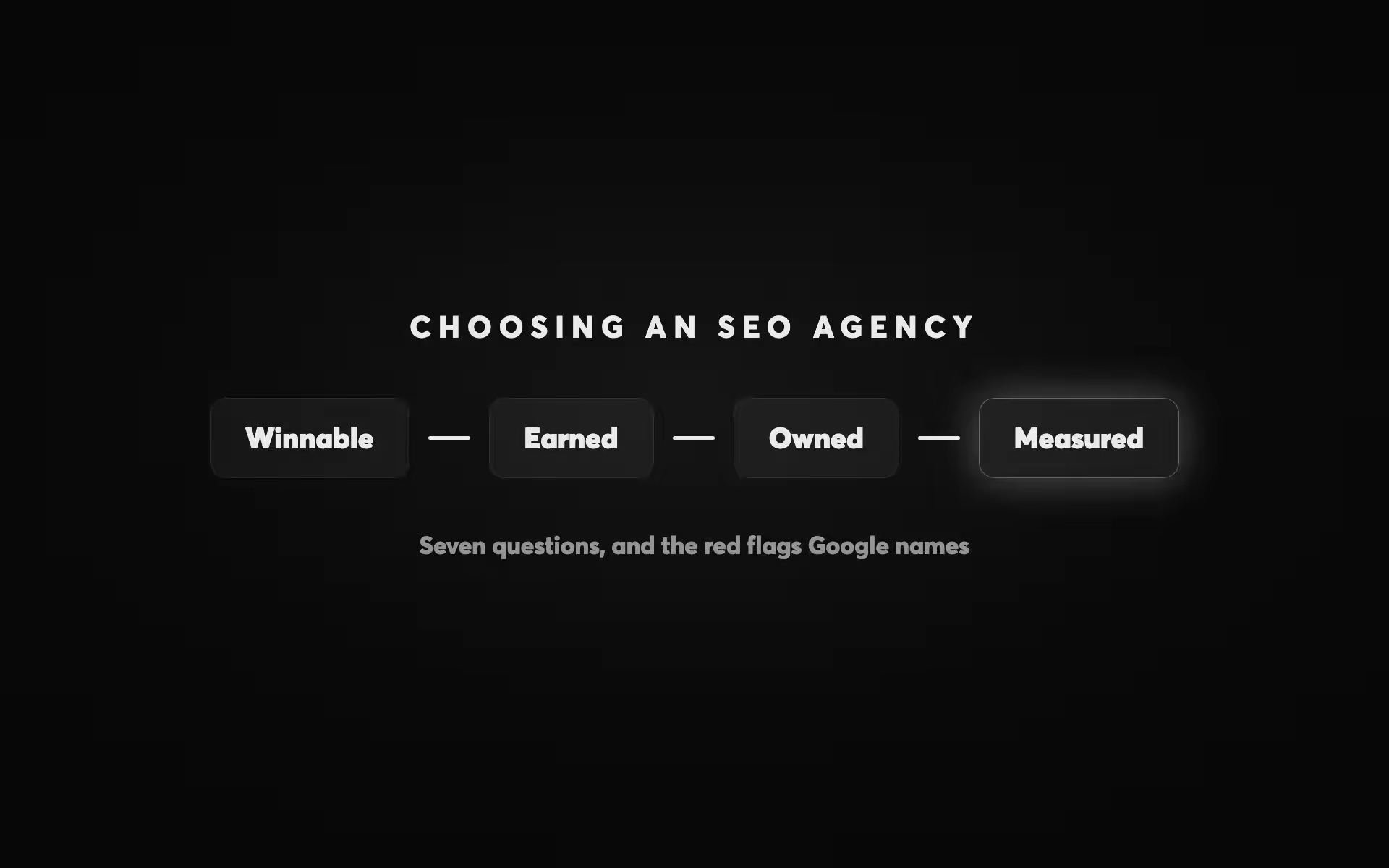
Choose an SEO agency by the searches it will target and how it will prove the work is paying, not by promised rankings. Ask which searches it will aim at and whether they are winnable, how it will report enquiries from people who did not already know your name, how it earns links, how it handles location pages, what it will change on your site and who owns it, how it treats Australia and New Zealand if you sell in both, and how it covers AI answers. Walk away from guaranteed rankings, bought links and a page for every suburb with the same copy: Google's own guidance warns against all three.
Start with Google's own advice
Google publishes a page on how to hire an SEO. It suggests asking for examples of past work, whether the agency follows Google Search Essentials, what results to expect and when, and whether it will share every change it makes to your site. It is also blunt about the biggest warning sign: "No one can guarantee a #1 ranking on Google."
The questions below build on that list for businesses selling in Australia and New Zealand. If you are still deciding whether you need an SEO specialist or a broader growth agency, start with how to choose a growth marketing agency.
Seven questions to ask an SEO agency
1. Which searches will you target, and which are winnable?
Listen for: a written list of the specific searches your customers type, such as a service and a place or a problem in your industry, with an honest view of which ones the agency thinks it can win and which it can't. Warning sign: a promise to rank you for one broad word, or no list at all.
Specific searches are usually where the money is. For BCS Broking, a specialist insurance broker, we rebuilt the site with a page for each insurance vertical and each surety bond type, titled in the words a finance director uses. Checked three months after the relaunch, BCS held the first organic result for "surety bonds broker australia construction mining" and sat fourth for "mining and resources insurance broker australia".
2. How will you show the work is paying?
Listen for: enquiries and sales from organic search, recorded in your CRM, plus traffic from people who searched for what you do rather than for your name. Search Console now has a branded queries filter that splits the two, so non-brand growth is easy to check. Warning sign: a monthly screenshot of rankings, or total traffic that is mostly people already looking for you.
Search Console is also where honest early progress shows. For Mr Mow Garden Services, a lawn mowing business in Gore, Southland, we replaced a three-page self-built site with a 14-page site with its own service and area pages. Search Console recorded 655 search impressions and 23 clicks in April 2026, its first full month live, and 2,054 impressions and 43 clicks in August, with no ongoing ad spend. From late June to late September 2026 it averaged position 4.9 for "chimney sweep gore", one of its services.
3. How do you earn links?
Listen for: pages and research worth citing, and relationships with publications in your field. Warning sign: link packages, guest posts for sale or a network of sites. Google's spam policies name buying or selling links for ranking as link spam, and say sites that break the policies can rank lower or drop out of results entirely.
4. How do you handle location pages?
Listen for: a page only for places you genuinely serve, each saying something specific about the work there. Warning sign: a page for every suburb or city with the same copy and the place name swapped. Google treats pages made mainly to rank as scaled content abuse. We explain the difference in our SEO strategy guide.
Done properly, structure pays. MLA Traffic, a traffic management company in Victoria, had a template site with no service or location pages. We rebuilt it with a page for every service and every area it covers, and since launch in June 2026 the site has brought in 72 enquiries and 58 job applications.
5. What will you change on my site, and who owns it?
Listen for: a log of every change, shared with you, and your website, Search Console, analytics and content kept in your name. Warning sign: changes made without telling you, or a site you can't take with you if you leave.
6. We sell in Australia and New Zealand. How will you handle both?
Listen for: a plan for which pages serve which country. Google's guidance on multi-regional sites covers country domains such as .com.au and .co.nz, country folders on one domain, and hreflang tags that tell Google which version suits which country. It also warns against automatically redirecting visitors based on where you think they are. Warning sign: one site with prices, phone numbers or regulations from one country shown to both, or two copies of the same pages with nothing telling Google which is which.
7. How do you cover AI answers?
Listen for: the same work done well. Clear, specific pages that answer real questions are what AI answers draw on. Three months after its relaunch, Google's AI Overview named BCS Broking among the brokers it cited for both of its main searches, and cited two of BCS's own insights articles as sources. Warning sign: a separate "AI package" sold with no change to the pages themselves. See generative engine optimisation for how we approach it.
Red flags at a glance
| What you hear | Why it matters |
|---|---|
| "We guarantee page one." | Nobody controls Google's results. Google says so on its own hiring page. |
| "We'll build you 50 links a month." | Bought links break Google's spam policies and can cost you rankings. |
| "A page for every suburb." | Copy that only swaps the place name fits Google's description of scaled content abuse. |
| "Our tools are proprietary, so we can't show you the changes." | You should see every change made to your own site. |
| "Traffic is up 200%." | Ask how much is from people who already knew your name, and how many became enquiries. |
| "It's a 12-month minimum." | A long lock-in signed before anyone has measured a baseline protects the agency, not you. |
What to expect, and when
Google's hiring page tells you to ask an agency about timeframes rather than giving one, and an honest agency won't promise a date for a specific position. In our experience, early signs such as pages being indexed, more impressions and first rankings for specific searches usually show inside two or three months. Enquiries follow as pages climb, which is why SEO is judged over quarters, not weeks.
Our small business packages put this in writing. We agree a list of target searches with you at the start, tell you honestly which we think are winnable, and do not guarantee a position, a number of enquiries or an amount of income. There is no minimum term, and you can cancel with 30 days' notice.
How we run SEO: SEO in Australia and New Zealand at Involve Digital. For the technical foundations an agency should check first, see technical SEO in 2026.
Questions