InsightsPaid Media
Performance-Based Marketing Agencies: How Pay for Performance Really Works, and Where It Breaks
How performance-based marketing agencies get paid, where pay per lead, pay per sale, bonuses and guarantees each break, and what fair shared risk looks like.
17 November 20263 min readEdited by Michael Wilkins
Direct answer
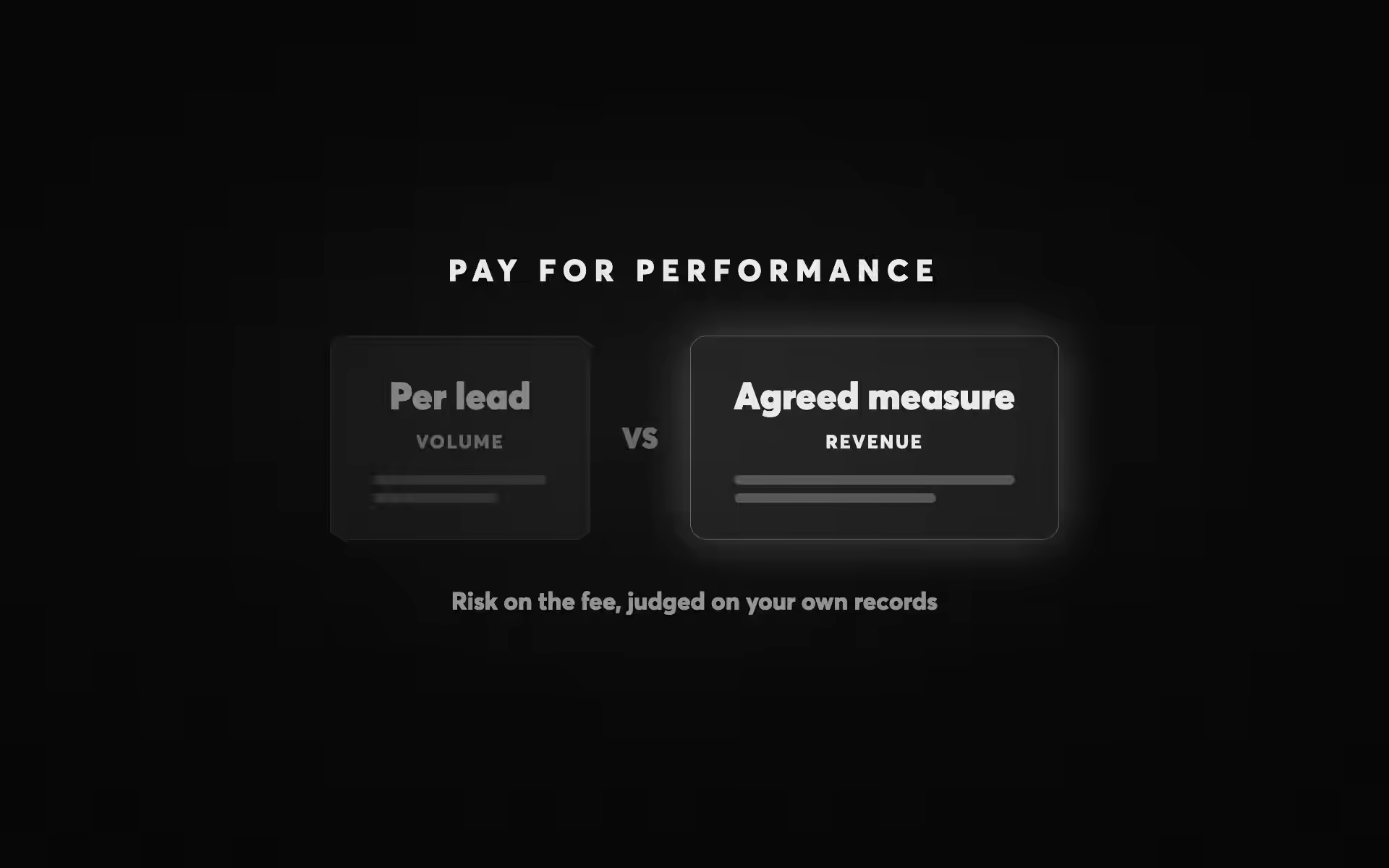
A performance-based marketing agency ties some or all of its pay to results instead of hours. The common models are pay per lead, pay per sale or revenue share, a retainer with a performance bonus, and a guarantee that refunds the fee if an agreed measure does not improve. Each can work, but each breaks in a predictable place: pay per lead rewards cheap leads, pay per sale invites disputes over attribution and ignores lifetime value, and any model judged on platform-reported results invites the agency to bid on your own brand, where conversions are cheap. Fair shared risk ties pay to one agreed commercial measure from your own records, measured against a signed baseline, while the agency is paid for the work.
What "performance-based" means
Most agencies call themselves performance agencies. Fewer put their own fees at risk. A truly performance-based arrangement links what the agency earns to a result you can check in your own records, not to activity or to what the ad platforms report.
The five models, and where each breaks
| Model | How it works | Where it breaks |
|---|---|---|
| Pay per lead | A fixed price for each form or call. | Pays for volume, so it delivers the cheapest leads, not customers. |
| Pay per sale or revenue share | A commission on each sale or a share of revenue. | Disputes over which sales the marketing caused, and no reward for customers who stay for years. |
| Retainer plus bonus | A base fee with a bonus for hitting a target. | Targets set before anyone has measured a baseline. |
| Fee-back guarantee | A normal fee, refunded if an agreed measure does not improve. | Fails if the measure is loose or read from the ad platforms alone. |
| Fee for the work | A fee for the work, judged on results you agree. | Breaks when nobody agrees what success looks like. |
Three ways performance deals go wrong
1. The agency is paid for the cheapest result
Pay an agency per lead and it will find the cheapest leads available. We explain the maths in why pay-per-lead marketing delivers leads that don't close.
2. The agency bids on your own name
Searches for your own brand are cheap and convert well, because those people were already looking for you. An agency judged on platform-reported conversions can make its numbers look good by spending more there. In one Australian B2B software account we audited, 62% of keyword spend went on product names bid on without the company name. We set out how to check your own account in should you bid on your own brand keywords.
3. The deal ignores how long customers stay
A commission on first-month sales undervalues a customer who stays for years. For an Australian trade credit insurance brokerage, Google Search returned A$5.34 for every dollar invested in the first year, and 2,037% over the seven-year average client lifetime. A deal judged on month one would have priced that work as a fraction of what it was worth.
What an agency cannot control
Your price, your sales team, how fast you answer the phone and how good your offer is all decide whether a lead becomes a sale. A fair performance deal measures what the agency's work can change, and records the things outside it, such as ad spend, offer and phone number, in a baseline you both sign.
What fair shared risk looks like
- One agreed measure, from your own records where possible: revenue from ads divided by spend, cost per job won, or cost per qualified enquiry.
- A signed baseline from the period before the agency starts.
- A fixed test period, long enough for the measure to move.
- Pay for the work, with the risk carried by the fee, not by a price per lead.
Our small business packages work this way for Google Ads. Before we start, we audit the last 90 days and agree one measure in writing, such as return on ad spend or cost per job. If it has not improved after our first 90 days, we refund our management fee for that period. If the baseline shows an account we don't believe we can improve, we say so and don't take it on.
Results worth judging an agency by
Look for results measured on money, not volume. For Teachers Mutual Bank, bid-strategy, CPA and quality-score optimisation cut Google Ads costs by 91%. For Rakuten Securities, a programme rebuilt around funded accounts rather than sign-ups delivered five times the funded accounts forecast.
How we run paid search: Google Ads at Involve Digital. For the wider engagement, see business growth.
Questions