InsightsLead Generation
Why Pay-Per-Lead Marketing Delivers Leads That Don't Close, and What to Pay For Instead
Pay-per-lead pricing pays for volume, so leads get cheaper and customers get dearer. An illustrative model, four examples of quality-led lead generation from our case studies, and what to pay for instead.
12 November 20263 min readEdited by Michael Wilkins
Direct answer
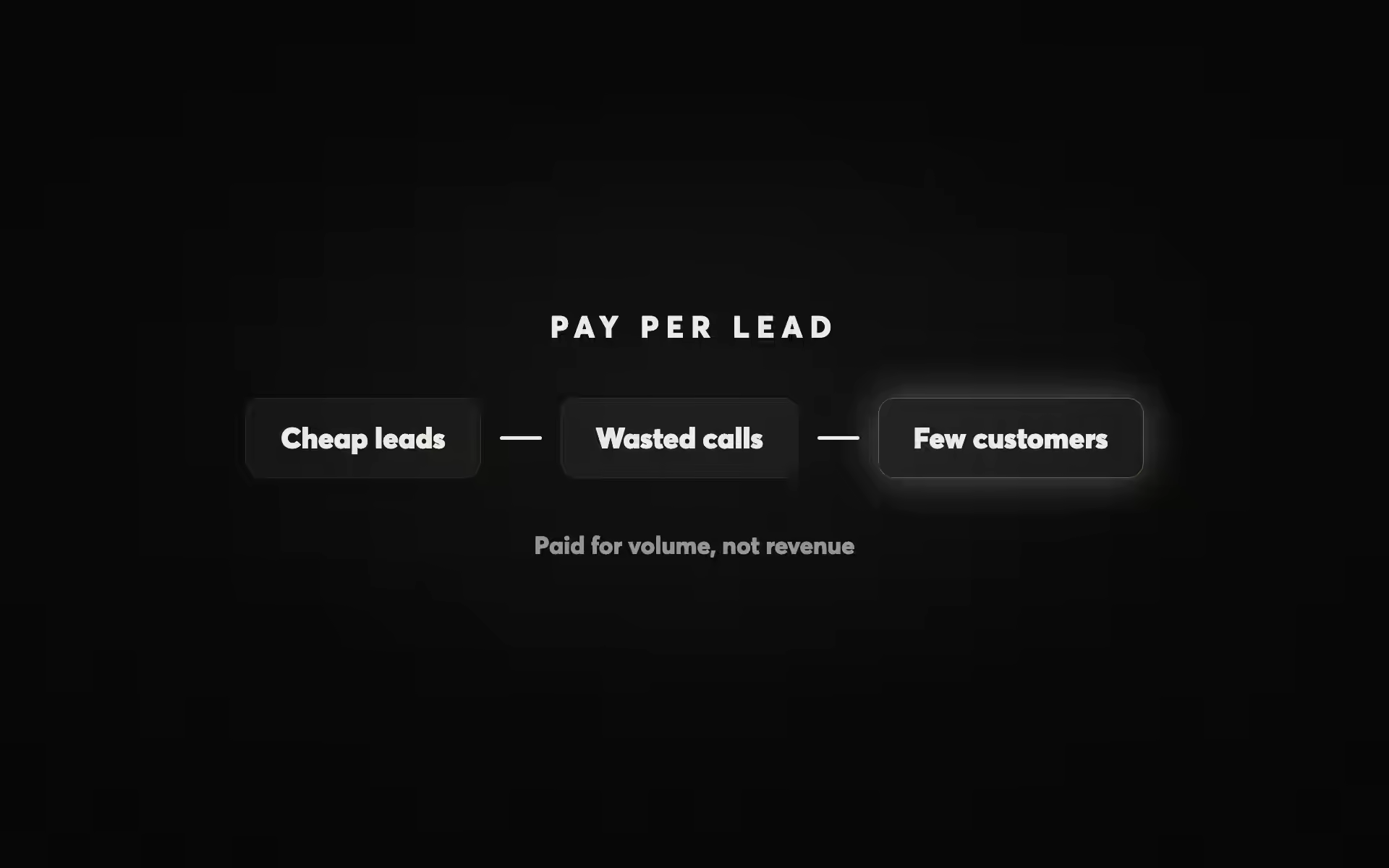
Pay-per-lead marketing charges a fixed price for each lead, usually a form fill or a call. It sounds like the agency shares your risk, but it pays the agency for volume, so the agency is rewarded for the cheapest leads it can produce: broad targeting, short forms, giveaways, and leads that may be shared with other businesses. The cost per lead looks good while the cost per customer climbs, and your sales team spends its time on people who will never buy. Pay instead for the work, agree in writing what a qualified lead is, and judge the result on qualified leads, customers and revenue. If you want shared risk, tie it to an agreed commercial measure, not a lead count.
How pay-per-lead works
A lead seller or agency runs the campaigns and charges you a set fee for every lead it delivers. The definition of a lead is usually loose: a completed form or a phone call of a minimum length. You pay the same for a buyer ready to sign as for a student, a competitor or someone who wanted the free download.
Why lead quality falls
An agency paid per lead makes the most money from the cheapest leads. Every lever that raises volume also lowers quality:
- Broad targeting. Wider audiences and looser keywords fill the form with people who could never buy.
- Short forms. Fewer fields mean more submissions and less information to qualify them.
- Incentives. Giveaways and quizzes produce form fills from people who wanted the prize.
- Shared leads. Some lead sellers can sell the same enquiry to several businesses. Ask whether yours are exclusive.
None of this shows in a cost-per-lead report. It shows in your sales team's calendar.
What it does to the numbers
| Paid per lead | Judged on quality | |
|---|---|---|
| Budget | A$5,000 | A$5,000 |
| Cost per lead | A$50 | A$125 |
| Leads | 100 | 40 |
| Qualified | 10% | 50% |
| Qualified leads | 10 | 20 |
| Customers (20% of qualified) | 2 | 4 |
| Cost per customer | A$2,500 | A$1,250 |
| Leads your sales team must work | 100 | 40 |
Illustrative model, not a benchmark. Run it on your own lead costs, qualification rate and close rate.
The cheaper lead costs twice as much per customer in this model, and takes two and a half times the sales effort to work through.
What quality-led lead generation looks like
Quality is engineered, campaign by campaign. Four examples from our case studies:
- Filtering at the keyword. For a specialist strata insurer, match types were kept to phrase and exact to keep out renters and unrelated searches, and a landing page test cut the cost per quote from more than A$980 to under A$80. Paid search alone produced 213 quotes, 68 bound policies and a 1.59× return in year one.
- Calibrating the form. For Clinic to Cloud, the Facebook lead form's field count was tuned to balance volume against lead quality, rather than cut to the minimum.
- Pricing segments separately. For Nuance, cost per lead ranged from A$14.66 for legal professionals to A$82.14 for finance professionals. A single price per lead would push spend towards the cheapest segment, whatever its customers were worth.
- Matching volume to capacity. For JB Markets, cost per lead fell to A$20, 60% below target, and the campaign then paused because the sales team could not handle the volume. More leads are only worth having if someone can work them.
What to pay for instead
- Pay for the work, with media spend shown separately.
- Agree what a qualified lead is in writing, with your sales team, before launch.
- Judge the result on qualified leads, customers and revenue recorded in your CRM.
- Share risk on a commercial measure, not a lead count. Our small business packages include a Google Ads performance guarantee: we agree one measure before we start, such as return on ad spend or cost per job, and if it has not improved after 90 days, we refund our management fee for that period.
If you are offered pay-per-lead anyway
- Are the leads exclusive to my business?
- What exactly counts as a lead, and can I reject the ones that don't qualify?
- Can I see the source, campaign and keyword behind every lead?
- Who owns the data and the ad accounts?
How we run lead generation: lead generation at Involve Digital. For how agencies charge and what a good engagement includes, see B2B lead generation agencies in Australia and New Zealand.
Questions