InsightsAI Search
AEO and GEO Services: What an AI Search Agency Actually Does, and How to Judge One
What AEO and GEO services involve, what Google says not to bother with, how to measure AI search visibility, the red flags when hiring an agency, and what a result looks like.
7 November 20263 min readEdited by Michael Wilkins
Direct answer
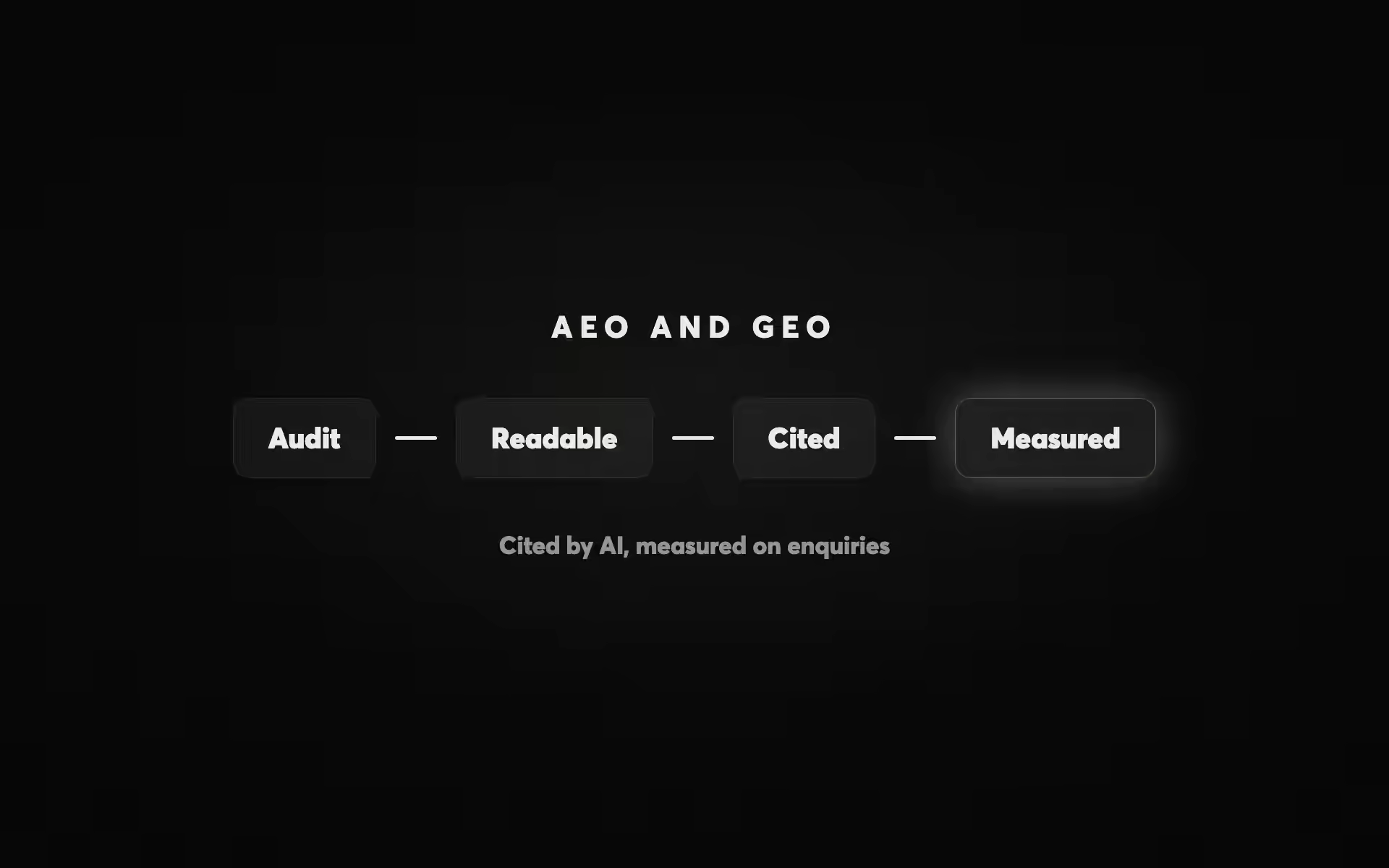
Answer engine optimisation (AEO) is the work of getting AI assistants such as ChatGPT, Claude, Perplexity and Gemini to cite your business in their answers. Generative engine optimisation (GEO) does the same for AI-generated search results such as Google's AI Overviews and AI Mode and Microsoft's Copilot. The two overlap, and both rest on ordinary SEO. A good AI search agency audits how the assistants answer your buyers' questions today, makes sure AI crawlers can read your pages, rewrites key pages so a clear, sourced answer comes first, builds your presence on other trusted sites, and measures citations alongside enquiries. Be wary of anyone who guarantees mentions in ChatGPT or sells llms.txt as the fix.
Why AI answers matter to buyers
When the Pew Research Center analysed the March 2025 Google searches of 900 US adults, people clicked a traditional result on 8% of visits to a results page with an AI summary, against 15% without one, and clicked a link inside the summary on 1%. A buyer who reads an answer that names your business has been influenced, whether or not they click.
AEO and GEO: the difference
- AEO targets the assistants people ask directly: ChatGPT, Claude, Perplexity and Gemini.
- GEO targets AI-generated answers inside search: Google's AI Overviews and AI Mode, and Microsoft's Copilot.
Most of the work serves both. Treat them as one programme built on your SEO, not as two separate products.
What the work involves
1. An audit of today's answers
Write down the 20 to 30 questions your buyers ask before they hire someone like you. Ask them in each assistant, record who gets named and which pages get cited, and repeat monthly with the same questions.
2. Pages AI crawlers can read
Google renders JavaScript, but most AI crawlers do not. When Vercel and MERJ tested in December 2024, the crawlers from OpenAI, Anthropic, Meta, ByteDance and Perplexity did not render JavaScript. If your main content only appears after scripts run, those assistants cannot see it. Decide on purpose which AI crawlers your robots.txt allows.
3. Content written to be cited
Put a clear answer first, then specific, dated, sourced detail. Researchers behind the GEO study (Aggarwal and colleagues, published at KDD 2024) found that changing how content is written could lift visibility in generative engine answers by up to 40%, and that what worked varied by subject.
4. Presence beyond your own site
Assistants draw on what other sites say about you. Consistent business details, accurate directory listings, reviews, and coverage on trusted industry sites all help an answer name you with confidence.
5. Measurement
Search Console's Generative AI report shows how often your pages appear in AI Overviews and AI Mode. It launched in June 2026, has been available to all sites since 31 August 2026, and shows impressions only. Bing Webmaster Tools reports on Copilot. For ChatGPT, Perplexity and Claude, use the monthly question audit. Then connect it to enquiries and sales in your CRM. Our guide to measuring GEO success sets it out step by step.
What Google says not to bother with
Google's guide to optimising for generative AI features says ordinary SEO best practice still applies, that structured data is not required to appear in AI features, and that Google Search ignores llms.txt files. Structured data is still useful for other reasons, but it is not a key to AI answers.
Red flags when you hire
- Guaranteed mentions in ChatGPT or any other assistant. Nobody controls those answers.
- llms.txt or "AI schema" sold as the fix.
- No audit and no measurement plan before the work starts.
- AI visibility reported on its own, with no link to enquiries or sales.
- AI search sold separately from SEO, as if the foundations did not matter.
What it looks like when it works
BCS Broking, a specialist broker for construction and mining, relaunched its website on 29 April 2026. Checked on 27 July, for the search "surety bonds broker australia construction mining", BCS held the first organic result, and Google's AI Overview named BCS Broking first among the brokers it cited, with two of BCS's own insights articles among its sources. For "mining and resources insurance broker australia", the AI Overview named them among "prominent firms including Aon, Coverforce, and BCS Broking".
Questions