InsightsGoogle Ads
Google Ads for B2B SaaS: The Complete Strategy Guide for 2026
How to run profitable Google Ads for B2B SaaS in 2026 — campaign structure, offline conversion tracking, value-based bidding, and real benchmarks.
4 September 202521 min readReviewed by Michael Wilkins
Direct answer
Google Ads for B2B SaaS requires a fundamentally different approach to ecommerce or local services. Non-branded B2B SaaS CPCs average $5.34 and have risen 29% year-over-year, while first-touch ROAS sits at just 78% — below breakeven. The gap between profitable and unprofitable SaaS Google Ads accounts comes down to one thing: whether the account optimises for form fills or for revenue. Companies importing offline conversions from their CRM and using value-based bidding generate 3× more pipeline at 31% lower cost per lead.
Google Ads for B2B SaaS: The Complete Strategy Guide for 2026
Google Ads for B2B SaaS is one of the most effective paid acquisition channels available — and one of the most frequently mismanaged. Non-branded SaaS CPCs have risen 29% year-over-year to an average of $5.34, CTRs are falling, and most accounts optimise toward the wrong conversions entirely.
This guide is part of our complete Google Ads for business growth series. It covers what's working right now for B2B SaaS: how to structure campaigns around your sales cycle, which bidding strategies connect ad spend to actual pipeline, how to set up offline conversion tracking so Google's algorithms learn what a good lead looks like, and the benchmarks you should be measuring against. We've included the frameworks and fixes we apply most often when auditing SaaS accounts.
What Has Changed for SaaS Advertisers in 2025–2026
The Google Ads platform shifted more in 2025 than in any prior year, and the changes hit B2B SaaS advertisers particularly hard. Three developments matter most.
AI Max for Search launched in May 2025. This is not a new campaign type — it's an upgrade suite for existing Search campaigns that uses AI to match ads to queries based on intent rather than just keywords. Google reports 14% more conversions at similar CPA on average, rising to 27% for campaigns still predominantly using exact and phrase match. Most critically for SaaS, Google states that AI Max is one of the primary ways ads will appear inside AI Overviews and AI Mode.
Performance Max got transparency. Campaign-level negative keywords (up to 10,000), full search term reports, and channel-level reporting all launched in 2025. For SaaS advertisers who avoided PMax because of its black-box nature, these controls change the equation — though PMax still requires offline conversion data to work properly for lead generation. The campaign structure principles differ significantly from ecommerce PMax setups where transactional data flows naturally.
AI Overviews compressed paid CTRs. Research across 3,119 queries and 1.1 million paid impressions found that paid CTR dropped 68% on queries where AI Overviews appear. However, brands cited within an AI Overview received 91% more paid clicks. For SaaS companies, this means content authority and GEO optimisation now directly impact paid search performance.
Why Google Ads Is Different for B2B SaaS
B2B SaaS breaks Google Ads conventions designed for consumer businesses. Understanding why is the first step to running profitable campaigns.
Sales cycles average 84 days. Enterprise deals take 6–12 months. Google's default 30-day conversion window misses the majority of your revenue. A click today might not become a closed deal for three to six months, and unless your account is configured to track that full journey, Google's algorithms never learn which clicks actually generate revenue.
Buying committees involve 6–10 decision-makers. Each gathers information independently, creating fragmented attribution. The person who clicks your ad is rarely the person who signs the contract.
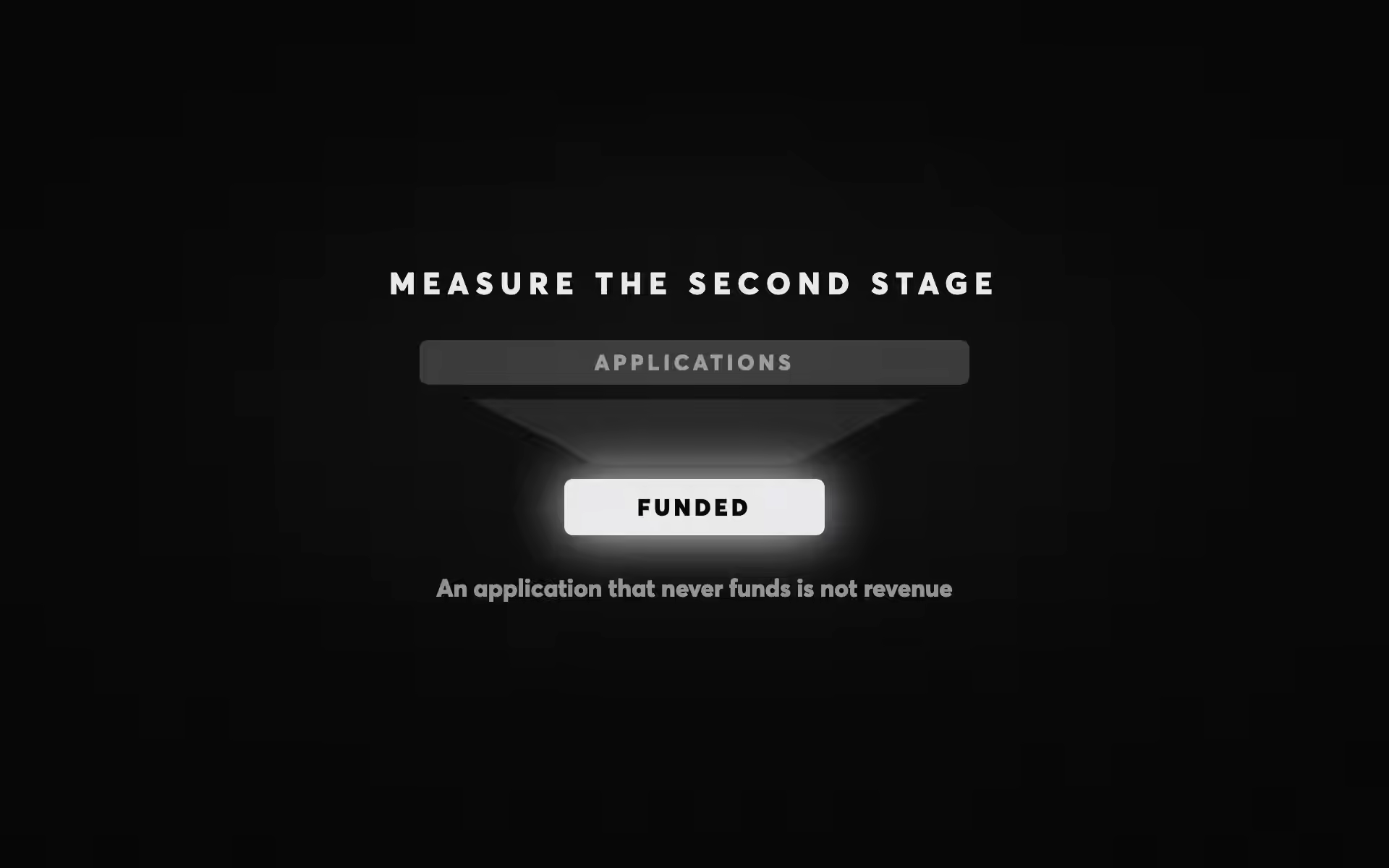
The initial "conversion" is far from revenue. A demo request, free trial signup, or content download is not a sale. When Google optimises toward form fills, it finds the cheapest ones — which are almost never the ones that convert to paying customers. This is the fundamental problem with B2B SaaS Google Ads and the reason most accounts underperform.
CAC payback periods average 23 months for private SaaS companies. Short-window ROAS calculations are misleading. A campaign showing negative ROAS at 30 days might be your most profitable channel when measured across the full customer lifetime.
These challenges are similar to those faced by professional services firms and financial services companies, but SaaS adds the complexity of free trial and freemium conversion models on top.
B2B SaaS Google Ads Benchmarks for 2026
These benchmarks are drawn from Dreamdata (B2B attribution platform), Firebrand (B2B tech agency data), WordStream, Lever Digital, and HockeyStack. Use them to evaluate your account — not as targets in isolation. For benchmarks across all industries, see our Google Ads for business growth pillar guide.
| Metric | B2B SaaS Benchmark | Context |
|---|
Understanding SaaS ROAS
First-touch ROAS for non-branded SaaS Google Ads is approximately 78% — technically below breakeven. This alarms SaaS founders who compare against ecommerce benchmarks of 4–5×. But the comparison is misleading.
SaaS revenue is recurring. A $50 CPL that generates a customer paying $500/month for 36 months has an LTV of $18,000. The initial ROAS looks negative; the LTV:CAC ratio is exceptional. This is why SaaS companies must measure Google Ads performance through LTV:CAC ratios and CAC payback periods, not first-touch ROAS.
The industry-standard minimum LTV:CAC ratio is 3:1. Top-quartile SaaS companies achieve 5:1 or better. Below 2:1 indicates sustainability problems. Above 8:1 may signal under-investment in growth.
CAC Benchmarks by Segment
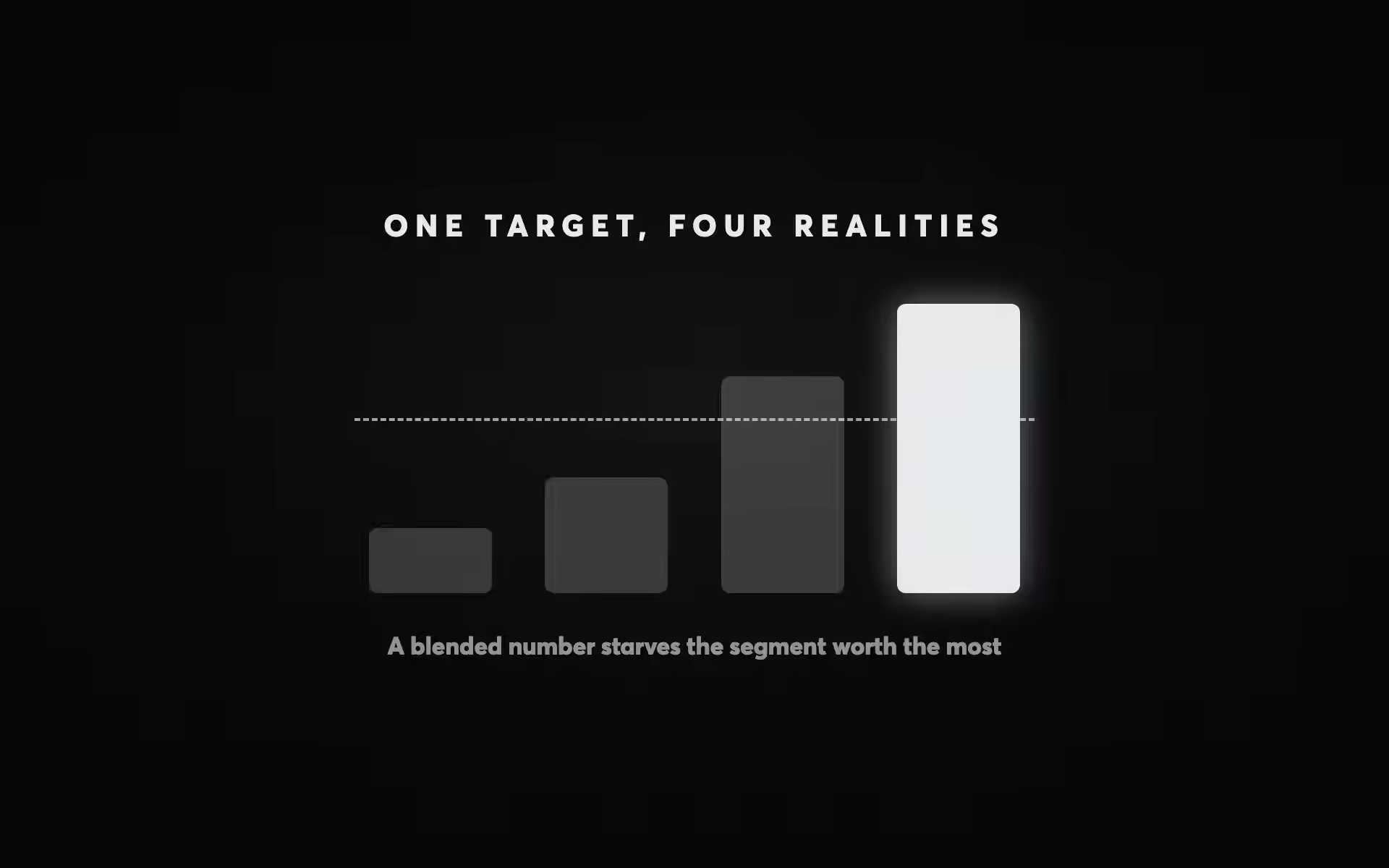
Customer acquisition costs vary dramatically by target market. SMB-focused SaaS averages $200–$900 CAC. Mid-market runs $1,500–$4,500. Enterprise ranges from $5,000–$15,000+. The median across 936 SaaS companies is $2.00 in sales and marketing spend per $1 of new ARR — and that ratio has increased 14% in the past year.
How to Structure Google Ads Campaigns for B2B SaaS
Campaign structure for SaaS follows a five-pillar model. Each pillar serves a distinct purpose in the buyer journey.
Pillar 1: Brand campaigns protect your branded search terms and capture high-intent prospects who already know you. These typically achieve 1,200%+ ROAS using only 5–7% of total budget. Always run brand campaigns separately — mixing them with non-brand inflates your reported performance and hides underperformance elsewhere.
Pillar 2: High-intent product campaigns target buyers actively searching for solutions. Keywords like "[category] software," "[use case] tool," and "[function] platform" capture prospects in evaluation mode. These are your highest-converting non-brand campaigns.
Pillar 3: Competitor campaigns capture prospects evaluating alternatives. Target "[Competitor] pricing," "[Competitor] alternative," and "[Competitor] vs" queries — not top-level brand names where most searchers are existing customers trying to log in. Competitor campaigns require dedicated comparison landing pages and separate budget allocation with adjusted CPA targets.
Pillar 4: Problem-aware campaigns capture broader searches from prospects who know they have a problem but haven't yet identified the solution category. Keywords like "how to reduce [pain point]," "why is [process] so slow," and "[problem] for [industry]" are lower intent but reach buyers earlier in their journey.
Pillar 5: Remarketing campaigns cover the long B2B sales cycle. Sequence content over 90 days: educational content (Days 1–7), case studies and ROI calculators (Days 7–30), demo CTAs and migration guides (Days 30–90). This sequenced approach improves trial-to-paid rates by 15–30%.
The recommended budget split: 70% Search campaigns, 30% Performance Max once you have sufficient offline conversion data flowing. Scale from high-intent keywords ($0–10K/month) to adding competitor and remarketing campaigns ($10–25K/month) to expanding into adjacent verticals ($25K–50K+/month).
Keyword Strategy for B2B SaaS
Keyword strategy must align with your SaaS business model. Enterprise SaaS should lean toward problem-aware and solution-aware keywords. Self-serve PLG products should focus on high-intent, ready-to-buy keywords.
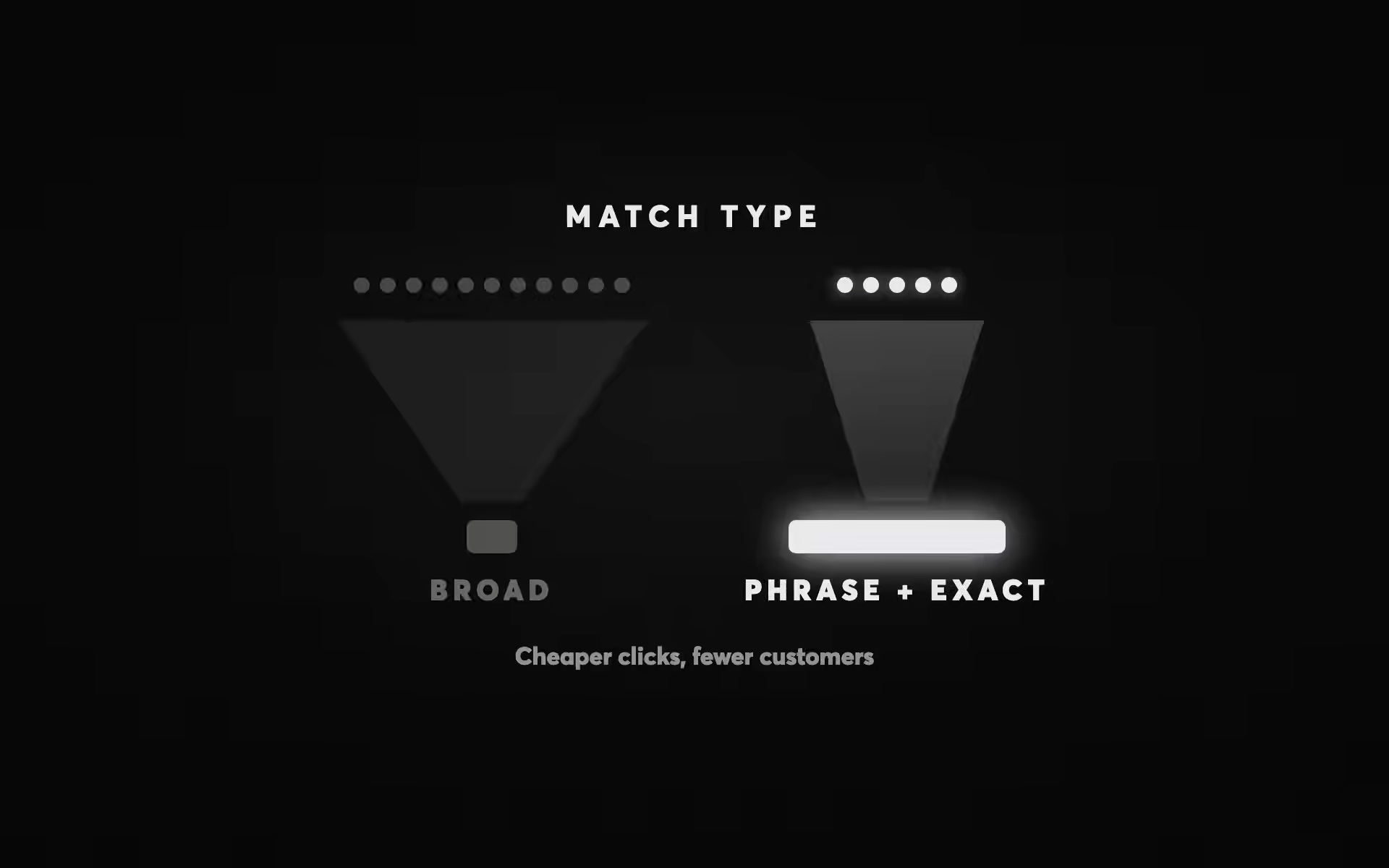
Start with exact and phrase match. Build comprehensive negative keyword lists before enabling broad match. An analysis of 150+ B2B SaaS accounts found that 57% of every dollar spent goes to search terms that never convert. Every 10% increase in wasted spend raises CPA by 38–65%.
Broad match requires guardrails. Only use broad match with Enhanced Conversions for Leads AND value-based bidding running simultaneously. Without both, broad match in B2B SaaS bleeds budget to irrelevant queries — students researching for coursework, job seekers, and existing customers looking for support.
Negative keywords are non-negotiable. Exclude "free," "open source," "jobs," "careers," "salary," "tutorial," "course," "login," "support," and competitor employee-related terms. Audit search term reports weekly for the first three months, then biweekly once patterns stabilise.
The SaaS Funnel: From Click to Closed-Won
The B2B SaaS funnel has more stages and more leakage points than any other Google Ads vertical. Understanding benchmark conversion rates at each stage tells you where your real problems are.
A typical SaaS funnel moves through five stages: ad click to landing page conversion (3–5%), lead to MQL (40–60% depending on lead scoring), MQL to SQL (13–22%), SQL to opportunity (50–60%), and opportunity to closed-won (16–30%). The overall click-to-customer rate is approximately 0.5–1.5%.
This means for every 1,000 clicks at $5.34 CPC ($5,340 spend), you might generate 40 leads, 20 MQLs, 4 SQLs, 2 opportunities, and 0.5 customers. If your ACV is $20,000, that single customer generates $20,000 in first-year revenue against $5,340 in ad spend — a 3.7× first-year ROAS before accounting for LTV.
The funnel math explains why SaaS Google Ads looks unprofitable on surface metrics but can be highly profitable when measured correctly. It also explains why optimising for form fills instead of downstream revenue is catastrophic — Google finds the cheapest leads, not the ones that convert through five more stages to become customers.
Offline Conversion Tracking: The Single Most Impactful Change
Offline conversion tracking is the single most impactful change a B2B SaaS advertiser can make. Without it, Google optimises toward form fills. With it, Google learns which clicks generate actual pipeline and revenue.
How It Works
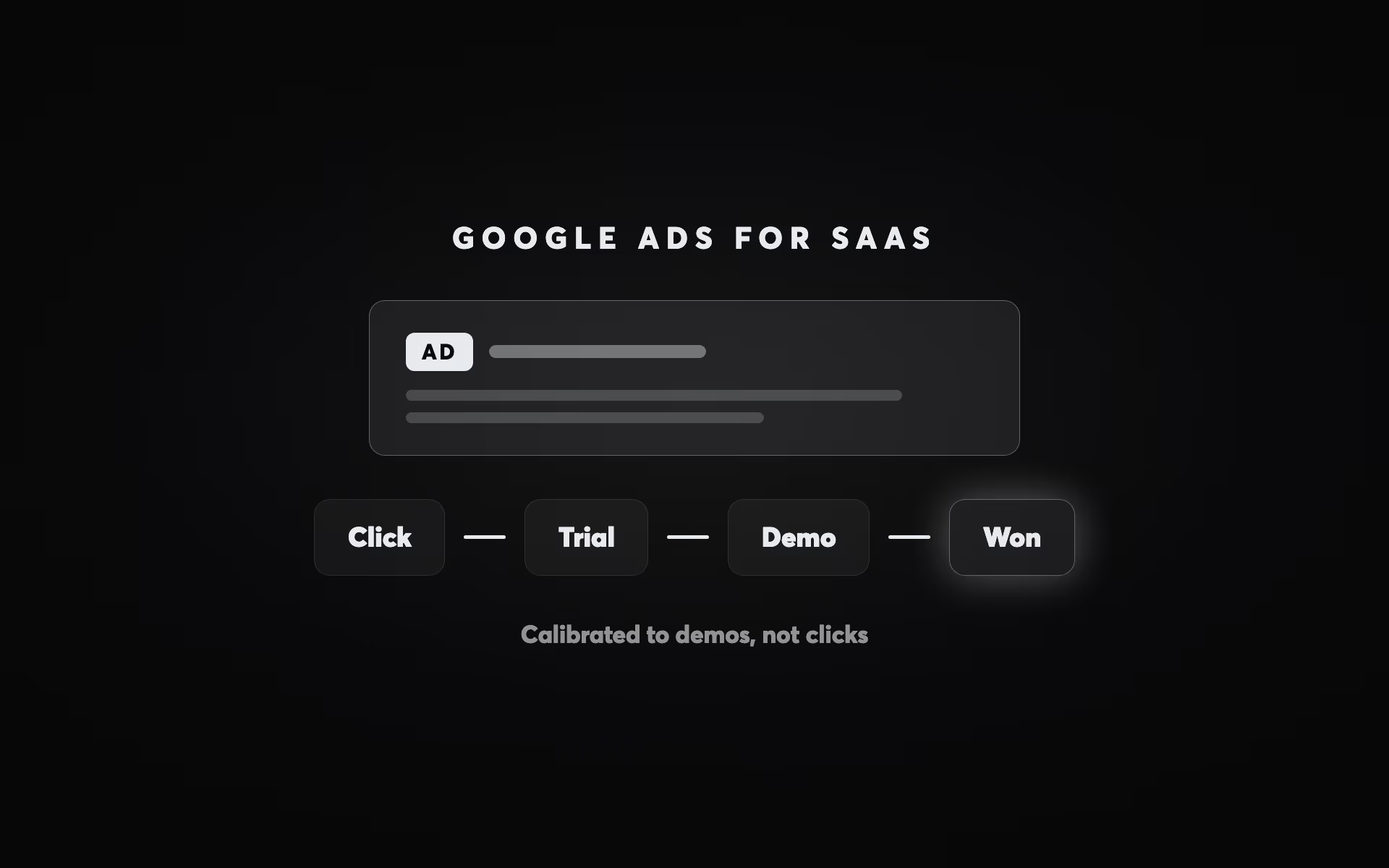
When someone clicks your ad, Google records a click ID (GCLID). Your CRM captures this ID alongside the lead. As the lead progresses through your pipeline — MQL, SQL, Opportunity, Closed-Won — you send those stage changes back to Google Ads with assigned values. Google's algorithms then learn which audience segments, keywords, and placements produce leads that actually close.
CRM Integration Methods
HubSpot: Use the native "Ads Optimization Events" tool to sync lifecycle stage changes to Google Ads automatically. Assign tiered values: MQL ($10–50), SQL ($100–500), Opportunity (higher), Closed-Won (actual deal value).
Salesforce: Native integration through Google Ads Data Manager syncs opportunity stages and revenue data. Configure enhanced conversions to pass hashed email at form submission for cross-device matching.
Pipedrive and other CRMs: Use Zapier workflows that trigger on pipeline stage changes and upload conversions via the Google Ads API. Works reliably but requires monitoring for sync failures.
Critical configuration details: Upload conversions daily, not weekly. Set your attribution window to 60–90 days — not Google's 30-day default, which misses most B2B conversions. Note that GCLIDs expire after 90 days, which is problematic for enterprise sales cycles exceeding three months.
Accounts that implement offline conversion tracking and value-based bidding generate 3× more pipeline at 31% lower cost per lead. This is not a marginal improvement — it is the difference between a profitable SaaS Google Ads programme and one that burns budget.
Value-Based Bidding for SaaS
Value-based bidding shifts Google's optimisation from conversion volume to conversion quality. Instead of telling Google "get me more leads," you tell it "get me leads that are worth more."
The formula: Proxy Value = Close Rate × ACV × Margin × Stage Probability. For example: MQL = $100, SQL = $900, Opportunity = $3,000, Closed-Won = actual deal value. This tells Google that one opportunity is worth 30 MQLs.
Target ROAS generally outperforms Target CPA for B2B SaaS. Google's data shows moving from tCPA to tROAS yields a median 14% increase in conversion value. The migration path: start with Maximize Conversions to build data, ensure 30+ conversions per month per campaign, move to Maximize Conversion Value, then gradually introduce a Target ROAS constraint.
Value-based bidding requires sufficient conversion volume and consistent CRM data flowing back. If your account generates fewer than 30 conversions per month per campaign, it may not have enough signal for value-based strategies to work. In that case, consolidate campaigns to concentrate conversion volume.
Performance Max and Demand Gen for B2B SaaS
Performance Max can work for B2B SaaS but demands proper setup. Without CRM data flowing back, PMax creates what practitioners call a "feedback loop of doom" — optimising for the cheapest form fills, which are almost never qualified leads. The prerequisites: 100+ Customer Match records, sufficient conversion volume for lower-funnel actions, automated offline conversion import, weekly negative keyword updates, and biweekly placement exclusions. PMax should supplement Search, not replace it.
Demand Gen campaigns are increasingly effective for SaaS pipeline building. The reduced audience minimum of just 100 users (January 2026) is significant for B2B niche targeting where audience lists are typically small. Demand Gen delivers 58% lower CPMs versus LinkedIn for equivalent audience targeting and 2.8× higher CTR than standard display for retargeting. Use it for YouTube case study distribution, customer testimonial video, and product demo clips targeting warm audiences.
Both campaign types follow the same principles as their ecommerce counterparts, but the conversion actions, audience signals, and measurement frameworks are entirely different for lead generation.
Competitor Conquesting for SaaS
Competitor campaigns work when executed with precision and fail when they're lazy. The most common mistake is bidding on top-level competitor brand names — "HubSpot," "Salesforce," "Monday.com" — where most searchers are existing customers trying to log in.
Target intent-driven variations instead. "[Competitor] pricing," "[Competitor] alternative," "[Competitor] problems," "[Competitor] vs [Your Product]," and "[Competitor] reviews" capture high-intent evaluators at 40% lower CPL than generic search.
Legal considerations: Bidding on competitor keywords is legal. Using trademarked names in ad copy is restricted. Never use Dynamic Keyword Insertion on competitor campaigns — it can auto-insert competitor names into headlines, appearing as impersonation.
Landing pages matter most. Build dedicated comparison pages with transparent feature tables, switching case studies, and migration guides. Generic landing pages on competitor traffic convert poorly because the visitor's context is entirely about evaluation, not discovery.
Set realistic expectations. Competitor campaigns produce higher CPCs, lower Quality Scores, and lower conversion rates than non-competitor campaigns. Budget and CPA targets must be set separately. The value comes from capturing high-intent prospects at the evaluation stage — not from volume.
The Seven Mistakes Burning SaaS Google Ads Budgets
These are the errors we find in nearly every B2B SaaS Google Ads audit:
- Optimising for MQLs instead of revenue — When you mark a whitepaper download as a primary conversion alongside demo requests, Google treats them as equally valuable. You end up drowning in email addresses from people who will never buy your software.
- Ignoring offline conversion imports — Without CRM data flowing back, Google can never learn what a "good" lead looks like. Implementing offline conversion tracking alone can cut CAC by 22%.
- Not separating brand from non-brand — Brand campaigns achieve ~1,200% ROAS using only ~7% of budget. Mixing them with non-brand hides underperformance and gives a false sense of profitability.
- Using broad match without guardrails — The median waste in unoptimised B2B SaaS accounts is 73%. Start with exact and phrase match. Add broad only after Enhanced Conversions for Leads and value-based bidding are running as guardrails.
- Sending traffic to the homepage — Every campaign needs a dedicated landing page matching ad intent. Message match lifts conversions 15–25%. Generic homepages with multiple CTAs and navigation options leak prospects.
- Tracking only form fills — Without MQL → SQL → Opportunity → Closed-Won visibility, you cannot evaluate which campaigns actually generate revenue. You're optimising blind.
- Setting and forgetting campaigns — SaaS Google Ads requires weekly search term audits, monthly creative refreshes, quarterly strategy reviews, and continuous CRM data validation. Neglect compounds into thousands of wasted dollars over time.
Is your SaaS Google Ads account optimising for form fills instead of revenue? We audit B2B SaaS accounts and show you exactly where the waste is, which campaigns actually drive pipeline, and what to fix first. Book a free Google Ads audit with Involve Digital.
Book Your Free Google Ads Audit Using The Form Below
For a broader view of how Google Ads drives growth across every industry — including benchmarks, campaign types, and platform-level strategy — read our complete Google Ads for business growth guide.
Questions