InsightsSEO and GEO strategy
SEO & GEO Strategy for 2026 and Beyond
The Integrated SEO and GEO Strategy Framework for 2026
4 August 202514 min read
Direct answer
Effective SEO and GEO strategy in 2026 treats both disciplines as layers of one system. SEO provides the infrastructure — crawlability, structure, and indexation — that enables AI systems to discover and evaluate content. GEO engineers the trust, entity clarity, and explanatory quality that makes AI confident enough to recommend. Neither works alone. Businesses that integrate both into a unified commercial framework build compounding authority competitors cannot replicate.
SEO & GEO Strategy for 2026 and Beyond
The businesses that will dominate their categories in 2026 are not the ones doing the most SEO or the most GEO. They are the ones that have understood these are not separate disciplines at all — they are layers of one system, and the system only works when both layers are engineered together.
SEO provides the infrastructure AI needs to discover and process your content. Generative Engine Optimisation engineers the trust, clarity, and authority that makes AI confident enough to recommend you. Treating them as separate workstreams — or worse, as competing priorities — is the most expensive strategic mistake a business can make in 2026. This article provides the integrated framework for building both into a single commercial growth system.
Why SEO and GEO Are Not Competing Strategies
The misconception that SEO and GEO are separate began when AI-driven search emerged as a new category. Teams assumed they needed a GEO strategy on top of their SEO strategy — two workstreams, two budgets, two sets of metrics.
This framing is wrong, and it leads directly to the most common GEO failures we see in practice.
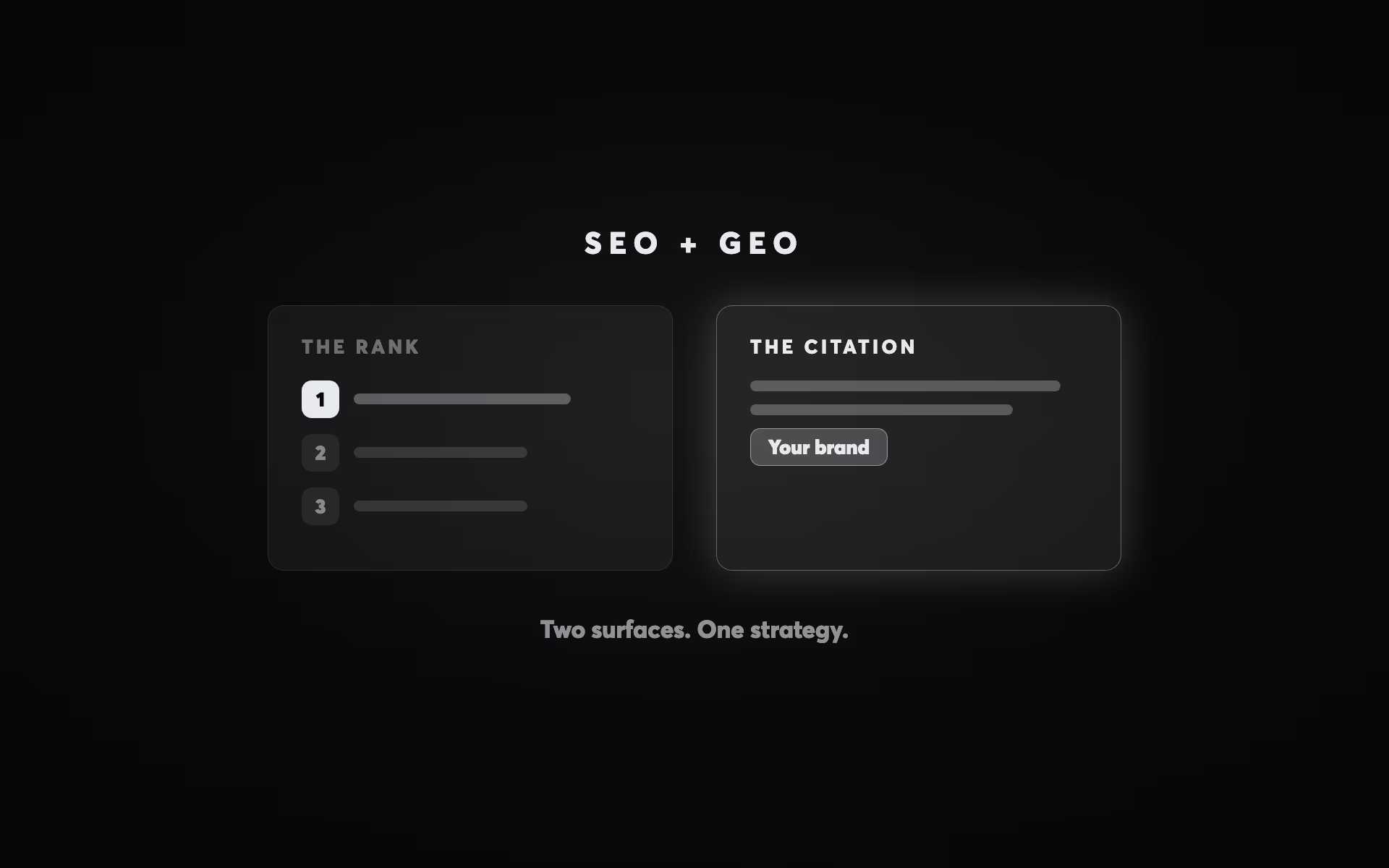
SEO and GEO are not parallel strategies. They are sequential layers. SEO creates the structural conditions for AI discovery — crawlability, site architecture, internal linking, and page-level organisation. GEO creates the content conditions for AI trust — entity clarity, explanatory quality, source reliability, and authority signals.
Without SEO, AI cannot find your content. Without GEO, AI can find your content but will not trust it enough to recommend. Both layers are required, and they must be designed as one system from the beginning.
The Strategic Framework: Infrastructure, Authority, Conversion
Integrated SEO and GEO strategy operates across three layers that build on each other. No layer works in isolation, and skipping any one of them collapses the entire system.
Layer 1: Infrastructure (SEO)
Infrastructure is the technical foundation that makes everything else possible. This layer includes site architecture that organises content into pillar-and-cluster structures AI can traverse, internal linking that creates the semantic relationships AI uses to infer topical authority, technical SEO that ensures crawlability, indexation, and page speed, and schema markup that provides structured data AI systems can parse directly.
This is the layer most teams already understand. The mistake is treating it as the complete strategy when it is only the foundation. Infrastructure without authority content is a warehouse with nothing on the shelves — structurally sound but commercially empty.
Layer 2: Authority (GEO)
Authority is where AI trust is built. This layer includes entity architecture that defines your business, services, and positioning with stable, precise terminology across every touchpoint, explanatory content that demonstrates genuine expertise through first-principles reasoning, cause-and-effect logic, and verifiable claims, proof architecture that includes case studies, outcome data, frameworks, and methodology documentation, and consistency enforcement that ensures every page, profile, and directory listing aligns with your entity definitions.
This is the layer most teams underinvest in. Authority is where AI decides whether to recommend you — and it is the layer that compounds most powerfully over time.
Layer 3: Conversion (Commercial)
Conversion translates AI visibility into revenue. This layer includes conversion infrastructure that captures and qualifies AI-referred traffic, sales alignment that ensures teams understand the quality difference between AI-referred and traditional leads, measurement frameworks that track the metrics that actually prove GEO value rather than traffic vanity metrics, and attribution systems that credit AI influence across the buyer journey.
This is the layer most teams forget entirely. Authority without conversion infrastructure is wasted trust — AI recommends you, but the leads have nowhere to go.
How to Build the Infrastructure Layer
The infrastructure layer is foundational and must be built first. Every subsequent layer depends on it.
Site architecture should reflect how AI systems traverse and categorise content. Pillar pages define your core topics. Cluster articles expand on specific aspects of each pillar. Every cluster links up to its pillar, and the pillar links down to every cluster. Cross-links between clusters exist only where conceptually relevant — not for link volume, but for semantic relationship signalling.
Internal linking is the mechanism AI uses to infer topical ownership. We think of internal links as semantic instructions — they tell AI "this page is connected to this concept, and this page owns the broader topic." The SEO infrastructure principles that make this work have not changed in 2026 — they have simply become more important because AI depends on them more heavily than traditional search algorithms did.
Technical SEO ensures AI can access and process what you have built. Crawl errors, indexation issues, slow page speed, and broken schema all create friction that reduces AI confidence. Technical SEO does not win GEO on its own — but technical failures can lose it.
How to Build the Authority Layer
The authority layer is where competitive advantage is created. Infrastructure gets you discovered. Authority gets you recommended.
Entity architecture begins with precise definition. What does your business do? Who does it serve? What outcomes does it deliver? These questions must be answered with stable terminology that remains consistent across every page, profile, and directory listing. Ambiguity is the fastest way to destroy AI confidence — when definitions shift, AI infers risk and defaults to a clearer competitor.
Explanatory content demonstrates genuine expertise rather than claiming it. AI systems evaluate whether your content teaches — whether it provides first-principles reasoning, cause-and-effect logic, clear definitions, and verifiable claims. Content that explains rather than persuades is what AI considers recommendation-safe.
Proof architecture provides the evidence layer. Case studies with documented outcomes, frameworks with reproducible methodology, outcome data that supports your claims, and external validation from credible third-party sources. Proof architecture does not replace explanatory content — it reinforces it, creating redundant trust signals that compound AI confidence.
How to Build the Conversion Layer
The conversion layer is the most neglected component of SEO and GEO strategy. Businesses invest heavily in visibility and authority, then fail to capture the commercial value they have created.
Conversion infrastructure means building clear pathways from AI-referred landing pages to qualified enquiries. Service pages should define offerings precisely, pricing or scoping guidance should reduce friction, and contact mechanisms should be accessible without requiring the visitor to search for them.
Sales alignment means ensuring your team understands that AI-referred leads are fundamentally different from traditional organic traffic. These leads arrive with higher trust, clearer intent, and shorter decision timelines. Sales conversations should skip the justification phase and move directly to fit assessment. This is where the B2B advantage becomes most visible — AI-referred leads close faster and at higher rates because the credibility work has already been done.
Measurement means tracking what matters. AI citation frequency, assisted conversions, close rate by source, and sales velocity are the four metrics that prove GEO value. Sessions, bounce rate, and average ranking position are not. Building the right measurement framework before launching the strategy is essential — without it, teams optimise for the wrong outcomes and abandon GEO before it compounds.
The Integration Principle: Everything Connects
The most important principle of SEO and GEO strategy is integration. Every decision in one layer should reinforce the others.
Site architecture decisions should reflect authority content planning — pillar pages are defined by the entity categories you want AI to associate with your business. Authority content should be written with conversion pathways built in — not as afterthoughts, but as structural elements of the content strategy. Measurement should track the full journey from AI citation through to closed revenue — not just fragments of the process.
When these layers operate as an integrated system, the result is compounding authority. AI discovers your infrastructure, trusts your authority content, and recommends your business — which generates demand that your conversion layer captures and your sales team closes. Each recommendation reinforces AI confidence, which increases recommendation frequency, which drives more demand.
This compounding effect is why early investment matters so much. The businesses that build this system first become the hardest to displace. The gap compounds quarterly — not because they spend more, but because authority accrues to the businesses that earned it first.
The 90-Day Implementation Roadmap
Integrated SEO and GEO strategy does not require years of preparation. It requires deliberate sequencing across a 90-day implementation cycle.
Days 1–30: Infrastructure Sprint. Audit and fix technical SEO foundations. Define pillar-and-cluster architecture. Build the internal linking framework. Implement schema markup. Establish entity definitions and ensure consistency across all digital touchpoints.
Days 31–60: Authority Build. Create pillar content that defines your core topics comprehensively. Launch cluster articles that expand on specific aspects with explanatory depth. Build proof architecture through case studies, frameworks, and outcome documentation. Enforce entity consistency across all new content.
Days 61–90: Conversion Activation. Connect authority content to conversion pathways. Align sales processes with AI-referred lead characteristics. Implement the GEO measurement framework. Begin tracking AI citation frequency, assisted conversions, and close rate by source. Report commercial results to leadership.
This sequencing matters. Infrastructure first, because nothing else functions without it. Authority second, because AI needs content to evaluate before it can recommend. Conversion third, because capturing value requires the first two layers to be generating AI-referred demand.
What Happens After 90 Days
The 90-day implementation establishes the system. What happens after determines how fast it compounds.
From day 91 onward, the focus shifts to expansion and reinforcement. New cluster content deepens authority within existing pillar topics. Entity consistency is maintained as the business evolves. Proof architecture grows as new case studies and outcome data accumulate. Measurement matures from directional signals to precise commercial attribution.
The most important shift after the initial implementation is recognising that GEO is not a project with an end date. It is an operating model — a continuous system for building compounding authority that becomes your most defensible growth asset. The businesses that treat it this way are the ones AI will recommend in 2026, 2027, and beyond.
The Cost of Waiting
Every quarter you delay building this system, competitors who started earlier compound further ahead. AI authority is not a level playing field that resets each month — it is cumulative, and early movers earn structural advantages that become increasingly difficult to close.
The competitive moat effect is real. Once AI systems trust a provider's explanations and consistently cite their content, displacing them requires not just matching their quality — it requires surpassing it consistently over time. Starting now does not guarantee dominance, but waiting guarantees falling further behind.
What Should You Do Next?
If you are ready to build an integrated SEO and GEO strategy that compounds authority and drives commercial results, the first step is understanding where you stand today.
Book a GEO Readiness Audit with Involve Digital. We will assess your current infrastructure, identify authority gaps, map the conversion opportunities, and build a 90-day roadmap tailored to your business and category.
Questions