InsightsGoogle Ads
Google Ads for B2B SaaS: The Complete Strategy Guide
How to run Google Ads for B2B SaaS: structure the account around the sale, send CRM stages back to Google, bid on value, and read the benchmarks with their limits.
26 February 2026Updated 28 September 202624 min readEdited by Michael Wilkins
Direct answer
Google Ads works for B2B SaaS when the account learns from pipeline rather than form fills. Import CRM stages (qualified lead, opportunity, closed deal) back into Google Ads as conversions, preferably through enhanced conversions for leads, give each stage a value, and bid on value. Keep brand, high-intent category, competitor, problem-aware and remarketing campaigns separate; add Performance Max or AI Max only once CRM data is flowing; and judge the account on cost per qualified opportunity and payback, not cost per lead.
Google Ads puts a software company in front of buyers at the moment they search for a solution. That makes it valuable in B2B SaaS, and easy to get wrong: the conversion Google can see, a demo request or a trial, sits months and several people away from the revenue, and an account that optimises to the form fill finds more people who fill in forms.
This guide covers what changed on the platform in 2025 and 2026, how to structure a SaaS account, how to get CRM stages back into Google Ads, how to bid on value, and which published benchmarks are worth reading. It draws on two software programmes we have run.
What changed in 2025 and 2026
AI Max for Search. Google launched AI Max in beta in May 2025, a one-click suite for existing Search campaigns: search term matching that reaches beyond your keywords, text customisation and final URL expansion. At launch Google said advertisers typically saw 14% more conversions or conversion value at a similar cost per acquisition or return on ad spend, and 27% for campaigns still mostly on exact and phrase match (Google, May 2025). In April 2026 it took AI Max out of beta, citing an average of 7% more conversions or conversion value from the full suite compared with search term matching alone. Campaigns using automatically created assets or the campaign-level broad match setting upgrade to AI Max automatically from September 2026, and Dynamic Search Ads from February 2027 (Google, updated June 2026). In a SaaS account, where the search terms are the main defence against unqualified traffic, make that decision deliberately rather than letting the upgrade make it.
Performance Max became more controllable. Through 2025 Google added campaign-level negative keywords (applied to Search and Shopping inventory), negative keyword lists, a search terms report for every Performance Max campaign and a channel performance report (Google, September 2025). That answers the usual objection to Performance Max for lead generation, but not the bigger one: it still learns from whatever you count as a conversion.
AI Overviews and paid clicks. Seer Interactive's 2025 study of informational queries (3,119 search terms across 42 client organisations) found paid click-through rate on queries showing an AI Overview fell from 19.7% in June 2024 to 6.3% in September 2025 (Seer Interactive, November 2025). Its larger April 2026 update, covering 53 brands from January 2025 to February 2026, found paid click-through rate on AI Overview queries held in a 13–16% range through 2025 and into 2026, and called paid search the most predictable lever in search (Seer Interactive, April 2026). Being named inside the AI Overview is a separate job from the ad: that is generative engine optimisation (GEO).
Offline conversions moved to Data Manager. Google now describes offline conversion import as a legacy feature and recommends enhanced conversions for leads, imported through Google Ads Data Manager. Since 15 June 2026, offline conversion and enhanced-conversions-for-leads uploads made by API go through the Data Manager API rather than the Google Ads API (Google Ads Help). If your CRM integration was built on the old API, check it is still uploading.
Why Google Ads is different for B2B SaaS
The sale is long and involves several people. Enterprise deals can take months, and the person who clicks your ad is often not the person who signs. Unless the account tracks the journey past the form, Google never learns which clicks produced revenue.
The first conversion is far from revenue. A demo request, a trial or a download is not a sale. When Google optimises toward form fills it finds the cheapest ones, and those are rarely the ones that become customers. That problem, and what segmenting by vertical and persona does about it, is covered in detail in why SaaS accounts fill up with unqualified leads.
Payback runs over years, and it is getting longer. Benchmarkit's 2025 benchmarks of B2B SaaS companies put the median spend on sales and marketing at two dollars for every dollar of new-customer annual recurring revenue in 2024, up 14% on the year, and found CAC payback 12.5% longer at the median than in 2022 (Benchmarkit, 2025). A campaign that looks unprofitable at 30 days can still pay back over a customer's lifetime, so judge it on the lifetime numbers.
Professional services firms and financial services companies face versions of the same long, considered purchase (see our guides to winning clients in professional services and customer acquisition in financial services). SaaS adds free trials and freemium plans on top.
What the published benchmarks say
Dreamdata's B2B Google Ads benchmarks are the ones we could check at source. Its data comes from B2B companies that connect Google Ads to its attribution platform: it is not limited to SaaS and does not report Australia or New Zealand separately, so read it for direction, not as targets.
| Measure | Finding | Source |
|---|---|---|
| Non-branded search cost per click | Up about 29% between August 2024 and July 2025 | Dreamdata, 2025 |
| Non-branded search click-through rate | Down from 5.47% to 4.04% over the same period | Dreamdata, 2025 |
| Non-branded search share of B2B ad budgets | Down from 38.10% to 32.83% over the same period | Dreamdata, 2025 |
| Return on ad spend, non-branded against branded search | 78% on 39% of budget, against 1,299% on 7% of budget | Dreamdata 2024 benchmark, updated October 2025 |
Reading return on ad spend in SaaS. A 78% return for non-branded search looks like a loss, and on a single sale it would be; Dreamdata's page does not say which attribution model or revenue window sits behind it. SaaS revenue recurs. A customer paying A$500 a month for three years is worth A$18,000 in revenue before margin, so a channel can return less than it costs in the first period and still be profitable once retention is counted. The branded figure shows the opposite trap: branded search converts people who already know you, which is why it belongs in its own campaign, where it cannot flatter the numbers around it.
To work out what a customer is worth to you, and so what you can afford to pay for one, use the economics chapter of the B2B SaaS guide to lead generation, which sets the ceiling from contract value, margin and retention rather than from a market benchmark.
How to structure Google Ads campaigns for B2B SaaS
Structure a SaaS account around five kinds of intent, each in its own campaign, so each can have its own budget, bids and landing pages, and none flatters another in the reports.
1. Brand campaigns capture people who already know you and protect your name from competitors bidding on it. Keep them separate, with their own budget.
2. High-intent product campaigns target buyers searching for a solution: "[category] software", "[use case] tool", "[function] platform". These are usually your best-converting non-brand campaigns.
3. Competitor campaigns capture prospects evaluating alternatives. Target "[competitor] pricing", "[competitor] alternative" and "[competitor] vs" rather than the bare brand name, which many searchers type to find their own login. Send this traffic to comparison pages and give it its own budget and targets.
4. Problem-aware campaigns reach buyers who know the problem but not the category: "how to reduce [pain point]", "[problem] for [industry]". They sit earlier in the journey and are worth running once the first three are working.
5. Remarketing covers the long cycle. Sequence it: education first, then case studies and pricing, then the demo or trial. Use Customer Match to keep existing customers out of prospecting campaigns.
Clean separation is what keeps a long programme readable. For rhipe, Microsoft's specialist cloud-licensing distributor in Asia Pacific, we ran the programme recruiting IT services businesses, managed service providers and resellers as Microsoft Cloud Solution Provider partners across nine markets, Australia and New Zealand among them. The Google Ads programme ran across eight sub-accounts split by product, vendor activation and geography, with brand kept apart from product, search from display and remarketing from prospecting. Over four years it produced 181 click-attributed signed partners on A$231,263 of Google Ads media: A$1,278 per signed partner. Click-through and conversion rates read low, because the audience was small and the conversion counted was a signed partner rather than a form. The programme predates Performance Max, but the separation still applies.
Build in sequence rather than to a fixed split. Start with brand and high-intent search, with conversion tracking that reaches the CRM. Add competitor and remarketing campaigns once those are converting. Test Performance Max or AI Max only when qualified-lead or opportunity data is flowing back, because both learn from whatever you count as a conversion.
Keyword strategy for B2B SaaS
Enterprise SaaS leans toward problem-aware and solution-aware keywords; self-serve products toward high-intent, ready-to-buy terms.
Start with exact and phrase match, and build the negative list before you let broad match or AI Max's search term matching loose. In a software account, broad match buys students, job seekers, competitors and the free-tier crowd, and they convert on a form at prices that look attractive. Our article on unqualified SaaS leads sets out who broad match buys in software, and the arithmetic is in broad match is the most expensive cheap traffic you can buy.
Negative keywords are not optional. Start with "free", "open source", "jobs", "careers", "salary", "tutorial", "course", "login" and "support", then add from the search terms report every week for the first few months, and less often once the patterns settle.
The SaaS funnel: from click to closed-won
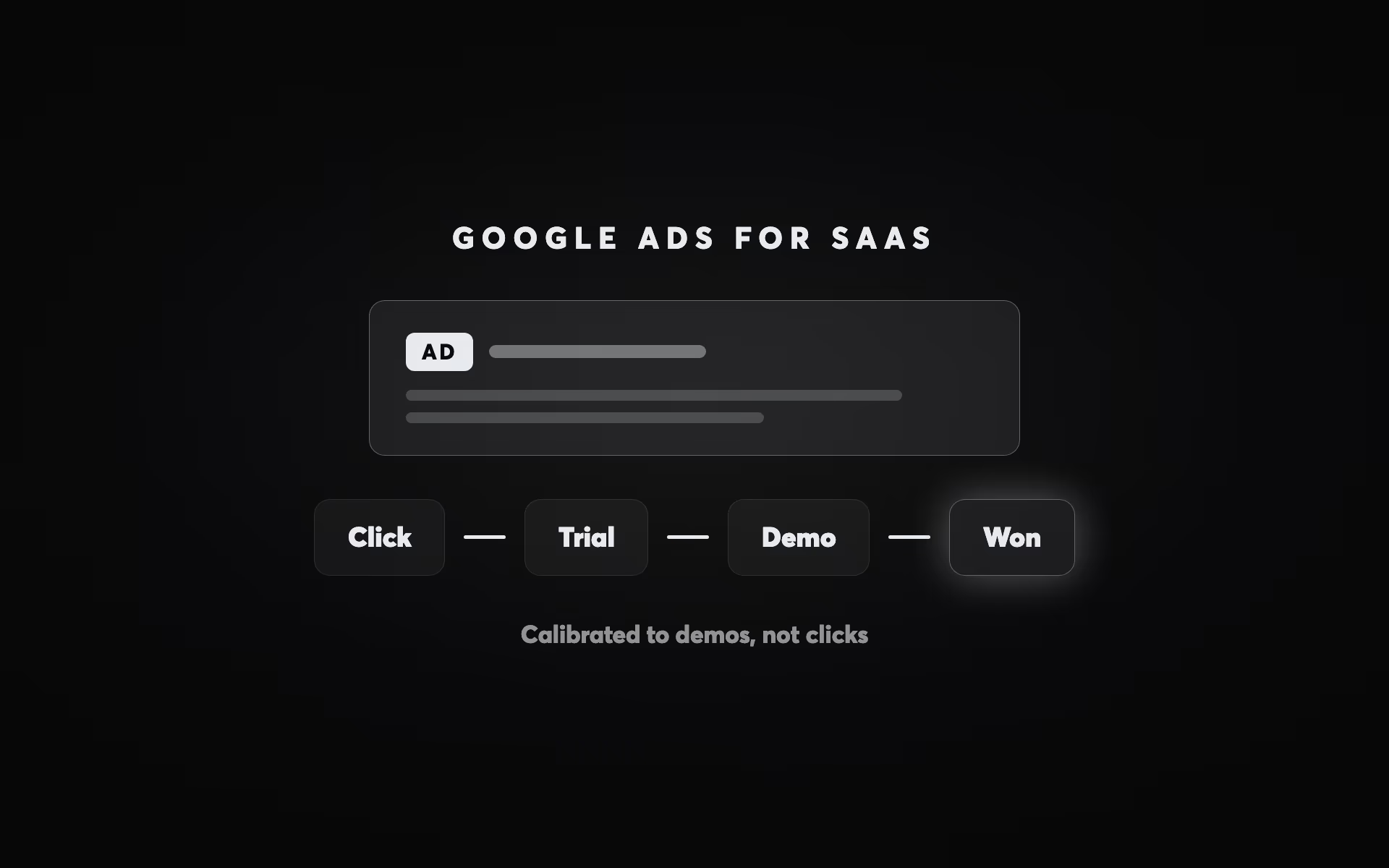
A SaaS funnel has more stages than most Google Ads verticals, and each one leaks. The rates below are placeholders to show the arithmetic, not benchmarks; replace them with your own from the CRM.
Take 1,000 clicks. At a 4% landing-page conversion rate that is 40 leads. If half become marketing-qualified, that is 20 MQLs; if one in five of those becomes sales-qualified, 4 SQLs; if half of those become opportunities, 2; and if one opportunity in four closes, half a customer. One customer for every 2,000 clicks.
So on these rates the media cost of a customer is 2,000 times your average cost per click. Compare that with the first year of the contract. If the annual contract value is higher, the channel pays back its media inside a year; if it is lower, you are relying on retention. Either way the answer lives in the stages after the form, which is why optimising to form fills is so costly: Google finds the cheapest leads, not the ones that survive four more stages.
Offline conversions: send the CRM back to Google Ads
If you change one thing in a SaaS account, change what Google optimises for. Without CRM data it optimises toward form fills. With it, Google learns which clicks become pipeline and revenue.
How it works
When someone clicks your ad, Google records a click ID, the GCLID. Your site passes it into the CRM with the lead. As the lead moves through the pipeline, you send each stage back to Google Ads as a conversion with a value. Enhanced conversions for leads adds hashed customer data, such as the email address from the form, so the stage can still be matched to the ad when the click ID is missing.
Connecting your CRM
HubSpot: create ad conversion events in HubSpot's ads tool. They sync lifecycle stage changes and form submissions to Google Ads through enhanced conversions for leads, for contacts with a Google click ID or with contact data shared with Google. Only stage changes after you create the event count, and the number of events depends on your Marketing Hub edition: up to 5 on Starter, 50 on Professional and 100 on Enterprise (HubSpot).
Salesforce: connect it through Google Ads Data Manager, which lists Salesforce among its data sources alongside HubSpot and Zoho CRM (Google).
Pipedrive and other CRMs: Data Manager does not connect to Pipedrive directly. Google points to Zapier for CRMs it does not support, or you can upload through one of Data Manager's file sources such as Google Sheets. Whichever route you take, monitor it: a sync that fails quietly starves the bidding of the conversions it learns from.
The settings that matter
- Upload at least daily. Google recommends daily uploads so Smart Bidding can respond to imported conversions (Google Ads Help).
- Lengthen the conversion window. The default click-through window is 30 days; depending on the conversion source you can set it as long as 90 (Google Ads Help).
- Mind the import limits. Google keeps the click ID for 90 days, and enhanced conversions for leads must be uploaded within 63 days of the click. When a deal closes later than that, Google's advice is to send an earlier stage that happens inside the window, such as the qualified lead or the opportunity.
Value-based bidding for SaaS
Value-based bidding tells Google that some conversions are worth more than others. The instruction changes from "get me more leads" to "get me leads that are worth more".
Give each stage a value. A stage is worth roughly the share of deals at that stage that go on to close, times the average first-year contract value (times gross margin, if you would rather bid on profit). On the illustrative funnel above, with annual contracts of A$24,000: one opportunity in four closes, so an opportunity is worth about A$6,000; half of sales-qualified leads become opportunities, so an SQL is worth about A$3,000; one MQL in five becomes sales-qualified, so an MQL is worth about A$600. An opportunity is then worth ten MQLs to the bidding.
Target ROAS is usually the better fit for SaaS than Target CPA, because it bids on value rather than volume. Google's own data found that advertisers who moved from Target CPA to Target ROAS saw a median 14% increase in conversion value at a similar return on ad spend (Google, global data from March 2021). Build up to it: Maximise conversions while the data accumulates, then Maximise conversion value, then a Target ROAS once you meet Google's minimum of 15 conversions in the past 30 days for Search (Google Ads Help). Value-based bidding also needs at least two different conversion values to work with (Google Ads Help).
If the qualified stage happens too rarely for that, bid on an earlier stage that happens more often, and keep campaigns few so each learns from as many conversions as possible.
Performance Max and Demand Gen for B2B SaaS
Performance Max can work for SaaS lead generation, but only on CRM data. Without qualified-lead or opportunity conversions flowing back, it optimises toward the cheapest form fills. Before you launch it, import CRM stages, set brand exclusions and campaign-level negatives, restrict final URL expansion to the pages you want traffic on, review the search terms and channel reports weekly, and run it alongside Search rather than instead of it.
Customer Match has an eligibility threshold. Any policy-compliant advertiser can use a customer list for observation and exclusions, but using it for targeting needs 90 days of Google Ads history and more than US$50,000 of lifetime spend (Customer Match policy). Files need at least 100 records, and Google recommends lists of at least 100 users so the ads serve (Google Ads Help). For most small SaaS accounts the first use is excluding existing customers.
Demand Gen earns its place in SaaS distributing case-study videos, customer stories and product demos to people who already know you, rather than as a cold lead source. Its value-based bidding needs more data than Search: Target ROAS requires at least 50 conversions in the past 35 days in the campaign, with 10 in the past seven days, or 100 across all your Demand Gen campaigns (Google Ads Help).
Give each channel one job
In a SaaS programme Google Ads is rarely the only channel, and it works best with a defined job. Clinic to Cloud sells cloud practice-management software to Australian specialists and GPs, a consultative sale with a high qualification bar. Working as its paid-media partner alongside the agency of record, we built the programme across Google Ads and Facebook from a standing start. Google Ads carried high-intent capture: branded and specialist-product search, layered with in-market audiences, plus Customer Match remarketing seeded from existing prospect data. Facebook Lead Gen carried prospecting at scale, with the form's field count tuned to balance volume against lead quality, and the Google Display Network carried nurture to an uploaded lead-nurture list.
Across the programme, blended cost per lead fell 57.7% in the first four months, from A$227.27 to A$96.15 on a 17% budget increase, while monthly lead volume rose 2.76 times. Over 11 tracked months it delivered 1,067 leads at a blended A$146.29, and the retainer renewed every month for 18 consecutive months. Those are Google Ads and Facebook results combined. What they show about Google Ads is the job it was given: converting active demand and re-engaging warmed contacts, while Facebook prospected at scale.
Competitor conquesting for SaaS
Competitor campaigns work when they are precise. The common mistake is bidding on a competitor's bare brand name, where many searchers are existing customers looking for their login.
Target intent-driven variations instead: "[competitor] pricing", "[competitor] alternative", "[competitor] vs [your product]" and "[competitor] reviews".
Know the trademark rules. Google's trademark policy does not restrict using another company's trademark as a keyword. If the owner complains, Google reviews the complaint and may restrict a direct competitor from using the trademark in ad text (Google Ads trademark policy). Keep competitor names out of your ads, and don't use keyword insertion in these ad groups, which can put them there for you.
Landing pages matter most. Build comparison pages with honest feature tables, switching stories and migration guides. A visitor from a competitor search is evaluating, and a generic page gives them nothing to evaluate.
Set targets separately. Competitor terms usually cost more and convert less than your own category terms, so give them their own budget and cost targets, and judge them on the evaluators they bring in rather than on volume.
Customer data and privacy in Australia and New Zealand
Enhanced conversions, Customer Match and CRM imports all send customer data to Google, hashed with SHA-256. Hashing hides the data, but in Australia the regulator's view is that it does not stop it being personal information.
- Australia. The Privacy Act 1988 covers businesses with annual turnover above A$3 million and some smaller ones (OAIC). The OAIC's guidance on tracking pixels makes the point directly: a hashed email address can make someone reasonably identifiable once a platform can match it. Treat uploaded lists the same way. Say in your privacy policy and collection notices that you share customer data with advertising platforms (APPs 1 and 5), use it only for purposes people would expect or have agreed to (APP 6), give people a simple way to opt out of direct marketing (APP 7), and take reasonable steps when the data goes overseas (APP 8) (OAIC, 2024).
- New Zealand. The Privacy Act 2020 applies to small businesses and sole traders as well as large organisations (Privacy Commissioner). The Commissioner's guidance on third-party providers turns on whether the provider uses the information for its own purposes as well as yours: if it does, sharing it can be a disclosure that must be allowed under IPP 11, and IPP 12 may apply when the provider is based overseas (Privacy Commissioner).
- Google's own policy requires your privacy policy to disclose that you share customer data with third parties to perform services on your behalf, consent where the law requires it, and only data you collected first-hand (Customer Match policy).
If you are unsure whether the Act covers your business or how your notices should read, get privacy advice before you upload.
Seven faults we look for first in a SaaS account
- Optimising to MQLs instead of revenue. When a whitepaper download and a demo request are both primary conversions, Google treats them as equal and fills the pipeline with downloads.
- No CRM data coming back. Without imported stages, Google cannot learn what a good lead looks like.
- Brand mixed with non-brand. Branded search converts people who already know you and flatters every number it is blended with.
- Broad match without guardrails. Add broad match or AI Max's search term matching only after exact and phrase are working, the negatives are in place and bidding learns from qualified conversions.
- Traffic sent to the homepage. Each campaign needs a landing page that answers the search that triggered it.
- Tracking only form fills. Without MQL, SQL, opportunity and closed-won visibility, you cannot tell which campaigns produce revenue.
- Set and forget. A SaaS account needs weekly search-term reviews, regular creative refreshes and a check that the CRM sync is still running.
If you would like a second opinion on a SaaS account, talk to us, or see how we run paid search.
Questions