InsightsAI lead scoring
AI-Powered Lead Scoring: How to Prioritise Your Best Prospects Automatically
How modern AI lead scoring models replace manual qualification — automatically surfacing the highest-intent prospects so your team focuses on conversations that convert.
15 May 202633 min read
Direct answer
AI lead scoring uses behavioural signals, firmographic data, and historical conversion patterns to rank every prospect by close likelihood — automatically and in real time. Unlike rule-based scoring that assigns arbitrary points, AI scoring models learn from actual closed-won and closed-lost outcomes, improving accuracy over time. Sales teams using AI lead scoring report 35–50% improvement in rep efficiency — focusing on the 20% of leads responsible for 80% of conversions, per Involve Digital's implementation data. The most impactful AI scoring models combine intent data with firmographic fit signals — website behaviour and content engagement weighted against company size and industry. — Involve Digital, sales intelligence specialists
AI-Powered Lead Scoring: How to Prioritise Your Best Prospects Automatically
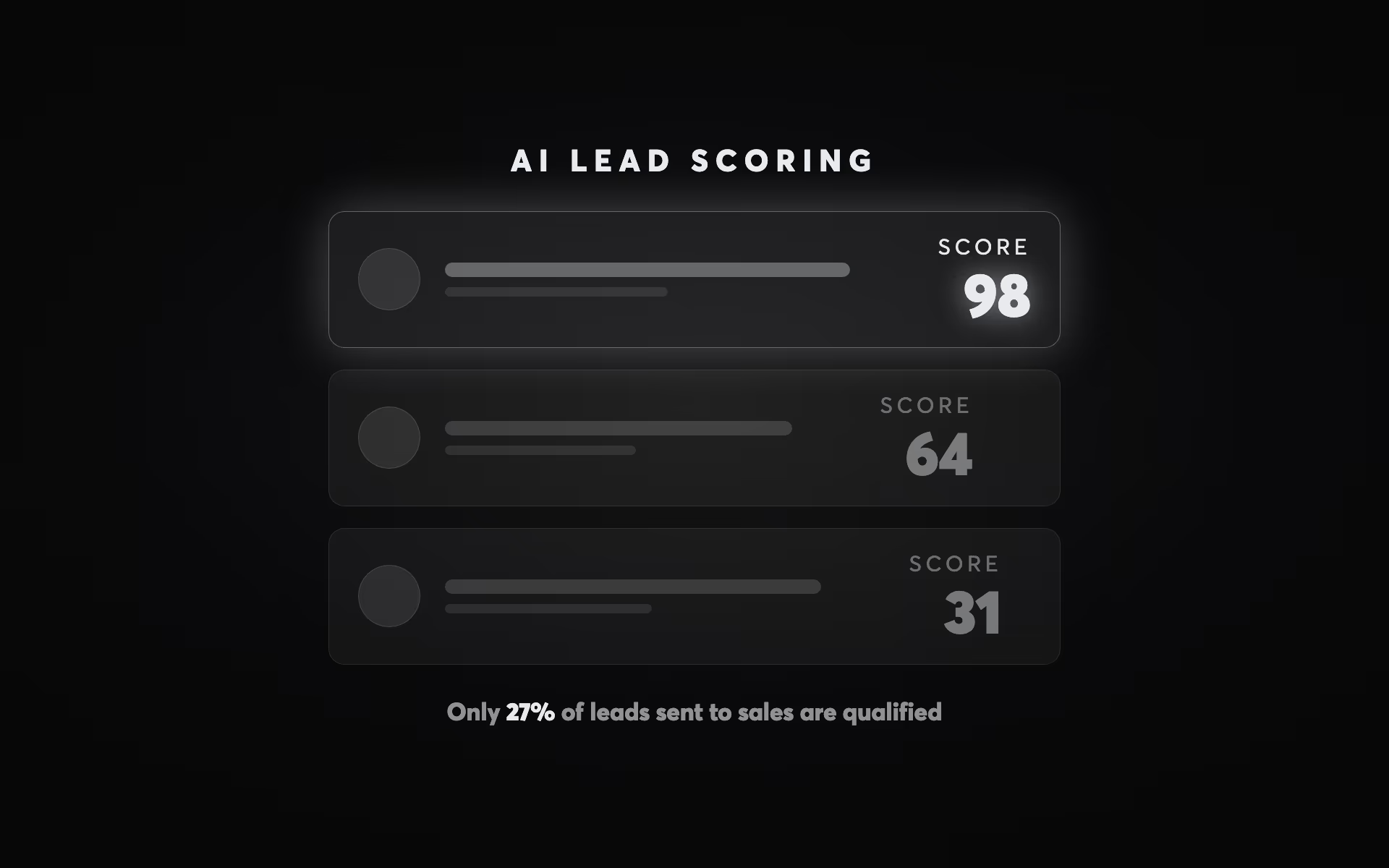
Here is a number worth sitting with: only 27% of leads sent to sales are actually qualified. That means for every ten conversations your sales team has, seven are with people who were never going to buy. The wasted time, the missed follow-ups on hot prospects, the pipeline that looks full but converts poorly — this is the cost of working without a scoring system. And in 2026, running manual or rule-based lead qualification is increasingly a competitive disadvantage, not just an efficiency issue.
AI lead scoring has moved from enterprise-only territory into the toolkit of ambitious SMBs. The same predictive intelligence that Salesforce Einstein and HubSpot deploy is now accessible through platforms starting at $49 per month — and the results are measurable. Companies implementing AI-driven lead scoring report 75% higher conversion rates compared to traditional methods, with the top performers achieving 6% lead-to-customer conversion against an industry average of 3.2%. This article is the practical guide to building and implementing a lead scoring model that actually works — whether you are starting from scratch or upgrading a broken manual system.
This is a cluster article within the Business Growth Framework for Digital-First Companies, the pillar guide covering the full growth operating system for NZ businesses. For the full lead generation context, see How to Build a Lead Generation System That Runs Without You, and for the CRM infrastructure that lead scoring depends on, see the CRM comparison guide.
What Lead Scoring Actually Is (And What It Is Not)
Lead scoring is the process of assigning a numerical value to each prospect based on how likely they are to become a customer. The score acts as a priority signal: high scores get fast sales attention, low scores go back into nurture sequences. The concept is simple. The execution — particularly at scale, with AI — is where businesses either unlock compounding returns or waste months on a system that does not move the needle.
Let us clear up two critical misconceptions before going further.
Misconception one: Lead scoring is just about marketing. In reality, lead scoring is a revenue operations function. It sits at the intersection of marketing (who generates leads and how), sales (who follows up and when), and CRM data (what signals exist). When scoring is owned only by marketing, it rarely reflects what sales actually needs. The most effective models are built collaboratively, with input from both teams on what a qualified lead truly looks like in practice — not in theory.
Misconception two: A higher score always means a better lead. A lead scoring model that rewards engagement without penalising poor fit is worse than no model at all. Someone who has downloaded five white papers and visited your pricing page twenty times is exciting — until you realise they work for a competitor, or their company is the wrong size, or they are in the wrong geography. Fit scoring and intent scoring must be kept separate and evaluated together, not blended into a single number that hides the underlying story.
There are three generations of lead scoring in practice today:
Rule-based scoring assigns fixed point values to attributes and behaviours manually defined by your team. Five points for opening an email, twenty points for a pricing page visit, minus fifty for a competitor email domain. It is simple to set up in any CRM, requires no historical data, and breaks down quickly as buyer behaviour becomes more complex. Rule-based models are a starting point, not a destination.
Fit-and-intent matrix scoring separates the model into two dimensions: how well the lead matches your ideal customer profile (fit), and how actively they are showing buying intent (intent). This two-dimensional approach is more actionable than a single blended score because it drives different responses: a high-fit, low-intent lead goes into an ABM nurture sequence; a high-intent, low-fit lead gets deprioritised before sales wastes time. This is the approach most SMBs should be implementing in 2026, and it requires only moderate CRM data quality to work well.
Predictive AI scoring uses machine learning to analyse historical conversion data — thousands of leads, their attributes, their behaviours, and whether they became customers — to surface patterns no human would identify manually. The model assigns each new lead a probability score: an 87% likelihood to convert, for example. This is what Salesforce Einstein, HubSpot's predictive scoring, 6sense, and MadKudu do. The catch: predictive models require a minimum of 1,000 historical converted leads to train effectively. For businesses below that threshold, fit-and-intent matrix scoring delivers most of the benefit at a fraction of the data requirement.
The Two Dimensions of a High-Performance Scoring Model
Every lead scoring model worth building is built on two separate dimensions: explicit fit signals and implicit intent signals. Keeping these separate — and routing leads based on their position in a 2x2 matrix — is the single most impactful structural decision you will make when building your model.
Explicit Fit Scoring: Who They Are
Explicit fit signals come from information the lead provides directly (through form fills, LinkedIn profiles, or enrichment data) and tell you how well they match your ideal customer profile. These are the firmographic and demographic attributes that determine whether this person could ever be your customer, regardless of their current interest level.
The most predictive explicit signals for B2B service businesses typically include:
Job title and seniority: Decision-makers and budget holders score highest. A CEO, CFO, or Head of Marketing at a target-size company is far more valuable than a junior analyst researching options. Assign 25–30 points for C-level or VP-level contacts, 15–20 for managers, and zero or negative for individual contributors who lack purchase authority.
Company size and revenue: Define the ICP band precisely. If your sweet spot is companies with 20–200 employees and $2M–$20M revenue, score heavily within that band and penalise significantly outside it. Enrichment tools like HubSpot's Breeze Intelligence (formerly Clearbit), Clay, or Apollo can populate these fields automatically without requiring form fields.
Industry vertical: If you serve specific industries better than others — or if certain industries have buying patterns that match your delivery model — weight this accordingly. A NZ professional services firm targeting legal, accounting, and consulting clients should score these industries 20–25 points and neutral or negative for industries where they lack case studies or delivery capacity.
Geography: For regional businesses, location matters. Score in-geography leads appropriately and penalise out-of-geography leads before sales time is wasted. This is especially relevant for NZ businesses where a prospect in the US requesting a proposal creates a qualification burden without conversion likelihood.
Technology stack: If your product or service integrates with or requires specific tools, knowing what tech a company already uses can significantly predict fit. A prospect already using HubSpot is a better fit for a HubSpot-integrated service than one running a spreadsheet-based CRM. Tools like Apollo, Clay, and Cognism can pull technographic data automatically.
Implicit Intent Scoring: What They Do
Implicit intent signals come from observed behaviour — what a lead does on your website, with your emails, in your content ecosystem, and increasingly across the broader web. These signals tell you whether someone is actively in a buying cycle, even if they have not yet raised their hand.
The most predictive implicit signals, ranked by intent strength:
Demo or discovery call requests are the highest-intent action available on most B2B websites. A lead who requests a demo has self-qualified as actively evaluating. This warrants the maximum implicit score — typically 40–50 points — and immediate sales follow-up, ideally within five minutes. Research consistently shows that responding within one hour achieves 53% conversion rates versus 17% for responses after 24 hours, a 36-percentage-point gap that no amount of clever nurture can recover.
Pricing page visits are the second-strongest commercial intent signal. Someone reviewing your pricing has moved beyond awareness into evaluation. Score 20–30 points for a single pricing page visit, and layer additional weight if they return within seven days — research shows that leads visiting the pricing page twice within a week convert at 40% versus 18% for a single visit.
Case study or ROI calculator engagement signals late-funnel research behaviour. When a prospect is reading how you delivered results for someone like them, or calculating potential ROI from working with you, they are building an internal business case. Score 15–20 points for this behaviour.
High-intent content downloads — such as buying guides, comparison frameworks, or implementation checklists — score 10–15 points. These differ from top-of-funnel content downloads (educational articles, general industry reports) which score 5–8 points due to their lower purchase correlation.
Email engagement sequences accumulate intent signals over time. Five points for an email open alone is too generous; five points for an open plus a click on a commercial-intent link is reasonable. The sequence matters — a lead who opens, clicks, opens again, and then visits your website within 48 hours is showing a behavioural pattern worth scoring cumulatively.
Webinar attendance (as opposed to registration) scores 15–20 points. Attendance signals active interest; registration without attendance is worth minimal points. Live interaction during a webinar — questions asked, polls answered — adds additional intent weight.
Negative Scoring and Score Decay: The Two Features Most Teams Skip
A lead scoring model without negative scoring is not a lead scoring model — it is a lead inflation machine. Every point added without any subtraction means scores only ever go up, creating a queue of phantom high-scorers who engaged once months ago and have since gone cold.
Negative scoring is the practice of subtracting points for signals that indicate poor fit or active disengagement. The most critical negative scores to implement immediately:
Competitor email domains: minus 50 points. If a lead's email address belongs to a direct competitor, they are researching you, not buying from you. No amount of nurturing changes this. Remove them from active scoring immediately.
Job function mismatch: minus 20–30 points. Students, job seekers, academics, and people with roles that never hold budget (IT support, customer service, receptionists) frequently fill out forms without any purchase intent. Identify these role types and score negatively. One B2B agency, Unbounce, cut sales time spent on unqualified leads by 40% simply by negative-scoring generic email domains and role mismatches.
Unsubscribes from email: minus 25 points. An unsubscribe is an explicit signal of disengagement. This lead has told you they do not want your communication. Subtracting points prevents them from drifting back into the high-score segment.
Inactivity periods: score decay. This is the feature most scoring systems ignore. A lead who visited your pricing page 90 days ago and has not engaged since is not the same as one who visited yesterday. Implement score decay — a percentage reduction per week or month of inactivity — so that scores reflect current intent rather than historical activity. HubSpot and Salesforce Einstein both support automated score decay; for manual systems, a quarterly audit that zeros out scores older than 90 days achieves a similar effect.
Score decay solves a real problem: without it, leads accumulate points indefinitely and eventually cross MQL thresholds based on months of low-level activity rather than any genuine buying signal. The goal of decay is to ensure your MQL queue reflects current buying readiness, not historical curiosity.
AI and Predictive Scoring: When to Upgrade and What to Expect
Predictive AI scoring is the logical next step once your fit-and-intent matrix is working, your CRM data is clean, and you have accumulated enough historical conversion data to train a model. But understanding when you are ready — and what the platforms actually do differently — prevents expensive disappointment.
Predictive models analyse patterns across thousands of historical leads to identify which combinations of attributes and behaviours correlate with closed deals. The machine sees connections that no human analyst would: that leads who download a specific piece of content and then visit the careers page within seven days have a 34% higher close rate, or that companies with exactly 50–75 employees in financial services convert at twice the rate of those with 76–100 employees in the same sector. These micro-patterns compound into a probabilistic score — typically a number between 0 and 100 representing close likelihood.
The results from well-implemented predictive scoring are significant. Forrester found that predictive scoring users see a 28% improvement in conversion rates and 25% shorter sales cycles compared to traditional scoring. Salesforce reported 15% higher win rates on average across organisations using AI-based scoring. DocuSign implemented predictive scoring using 6sense and historical Salesforce data and achieved a 38% increase in MQL-to-SQL conversions within six months, alongside a 27% improvement in lead-to-close time. Pandora increased lead conversion by 30% with Salesforce Einstein.
But predictive scoring has real prerequisites:
Data volume: Most platforms require a minimum of 1,000 historical converted leads — contacts who became customers, with associated behavioural and firmographic data captured in the CRM — to train an accurate model. Below this threshold, the model is essentially guessing. Salesforce Einstein now offers a Global Model for organisations below this threshold, using industry-wide patterns as a proxy while the unique model trains, but results are less precise.
Data quality: Missing fields, inconsistent data entry, and CRM records that lack behavioural tracking history all degrade model accuracy. Before implementing predictive scoring, audit your CRM for: percentage of contacts with complete firmographic data, accuracy of lead source attribution, and whether your website tracking correctly fires events for key pages. A model trained on clean data consistently outperforms one trained on more but messier data.
Tracking infrastructure: Predictive models need behavioural signals captured at a granular level. This means your CRM tracking pixel must be correctly installed on all pages, email engagement must be synced back to contact records, and key conversion events (demo requests, content downloads, pricing page visits) must be tracked as distinct events rather than generic page views.
Implementing Lead Scoring in HubSpot vs Salesforce: A Practical Comparison
The two dominant CRM platforms for SMB and mid-market B2B businesses take meaningfully different approaches to lead scoring, and the right choice depends on your current tech stack, team size, and data maturity.
HubSpot Lead Scoring
HubSpot offers two scoring modes. Manual scoring on Professional plans lets you assign point values to contact properties and behavioural triggers using a visual rule builder — no code required, no data science team needed. This is the right starting point for most businesses implementing their first scoring model. The interface is intuitive, and most scoring models can be built in a single afternoon.
In August 2025, HubSpot significantly upgraded its scoring infrastructure, replacing legacy scoring properties with a more powerful Lead Scoring tool featuring advanced AND/OR logic, support for multiple scoring models (useful for segmenting by product line, region, or persona), and explainability features that show which signals contributed most to each score. This makes it far easier to audit and refine the model without relying on guesswork.
HubSpot Enterprise adds AI predictive scoring that analyses historical conversion patterns automatically. In a documented case, HubSpot's own sales team implemented an AI lead scoring model that resulted in a 30% increase in sales-qualified leads, with the model using machine learning to analyse email opens, click-through rates, social media engagement, and demographic data to prioritise the pipeline.
HubSpot's acquisition of Clearbit (now rebranded as Breeze Intelligence) in December 2024 adds significant enrichment capability. Breeze Intelligence populates 200+ B2B firmographic and technographic attributes automatically, improving fit score accuracy without requiring leads to fill in extensive form fields. For businesses worried about form abandonment from long forms, enrichment-powered scoring is the solution: collect email and name, then enrich everything else automatically.
HubSpot scoring is best for: SMBs and mid-market teams wanting an integrated, lower-friction implementation without a dedicated RevOps function. Professional plans ($800+/month) support manual scoring; Enterprise ($3,600+/month for 10 seats) adds AI predictive scoring.
Salesforce Einstein Lead Scoring
Salesforce Einstein takes a fully AI-first approach: instead of manually assigning point values, Einstein analyses your historical lead data and automatically identifies which attributes and behaviours correlate with conversion. Each lead receives a score from 1–100, accompanied by explanation cards showing the top factors driving the score. This transparency is valuable for sales teams who want to understand why a lead is ranked highly, not just trust a number.
The Spring 2026 release expanded Opportunity Scoring to all Sales Cloud users at no additional cost, though Lead Scoring still requires Enterprise Edition ($165/user/month) or higher, plus the Einstein AI add-on starting at $50/user/month. A ten-person sales team typically spends $40,000+ annually on Einstein capabilities alone.
Einstein's strength is depth and scale. For organisations with complex, multi-stakeholder B2B sales cycles — where deals involve 5–10 buying committee members across multiple departments — Einstein can score at the account level, not just the contact level. This is critical for account-based marketing strategies where a single contact's engagement score is less meaningful than the combined engagement of the entire buying committee.
The minimum data requirement — approximately 1,000 converted leads for the unique model — is a real barrier for earlier-stage businesses. Salesforce's Global Model option provides a fallback, but it trains on industry-wide patterns rather than your specific conversion data, making it less precise. Einstein is the right investment once you have the data to train it properly and the budget to implement it across a team large enough to justify the per-seat cost.
Salesforce Einstein is best for: Enterprise and upper-mid-market organisations with 50+ salespeople, complex multi-stakeholder deals, and existing Salesforce infrastructure. Avoid if you are below 1,000 historical conversions or running HubSpot — the integration overhead is rarely worth it.
Alternative Tools for SMBs
Beyond the two dominant platforms, several tools deserve consideration for specific use cases:
Apollo.io ($49–$149/user/month) is the most accessible AI scoring option for SMBs. It combines a database of 275M+ contacts with built-in AI lead scoring that analyses your historical CRM outcomes — closed deals, booked calls — and uses these success signals to score new prospects automatically. The explainability is solid: scores include breakdowns by customer fit and behavioural fit, so reps understand what is driving each number. For teams doing active outbound prospecting, Apollo is particularly strong because scoring and outreach live in the same platform.
Clay ($185–$500+/month) takes a different approach: it is primarily an enrichment and automation platform rather than a CRM. Clay's waterfall enrichment pulls data from 100+ providers sequentially to fill in firmographic gaps that single-source tools miss. You can build lead scoring logic inside Clay's workflow engine and route scored leads into your CRM automatically. Used by companies including OpenAI, Vanta, and Intercom, Clay is particularly strong for high-volume inbound scoring where enrichment quality is the limiting factor on model accuracy.
6sense ($60,000–$300,000/year) is the enterprise option for intent-first scoring. Its AI ingests over 1 trillion signals from across the web — content consumption, competitor research, category-level intent — to identify accounts in an active buying cycle before they visit your website. For enterprise B2B sales with long buying cycles, 6sense's ability to identify anonymous demand is a genuine competitive advantage. For SMBs, the price point is prohibitive unless pipeline value per deal justifies the investment.
The Lead Scoring Implementation Roadmap: 90 Days to a Working Model
Most lead scoring projects fail not because of wrong point values, but because of sequencing errors: teams try to implement predictive AI before their CRM data is clean, or they build a model without involving sales, or they launch and never calibrate. Here is the realistic 90-day path to a working model.
Days 1–30: Foundation
Week 1–2: ICP alignment workshop. Gather marketing and sales in a two-hour session to align on your ideal customer profile. The output is a written ICP definition covering: target industries, company size range, employee count range, decision-maker job titles, and the buying triggers that make a prospect urgent. Do not skip this — a lead scoring model built on a misunderstood ICP will score the wrong leads highly.
Week 3: CRM data audit. Run a data quality report on your CRM. What percentage of contacts have company size populated? Industry? Job title? Lead source? Any field below 70% completeness should be flagged for enrichment before the model launches. Missing data is the leading cause of poor-performing scoring models — the model cannot score what it cannot see.
Week 4: Tracking audit. Verify that your website tracking is working correctly. Visit each key page (pricing, services, contact, case studies) and confirm events fire in your CRM or analytics platform. If you are running HubSpot, use the Tracking Code Status report. If Salesforce, use the Pardot or Marketing Cloud tracking audit. Any untracked pages represent blind spots in your intent scoring.
Days 31–60: Model Build
Build the fit score model. Using the ICP definition from Week 1, assign point values to each firmographic and demographic attribute. Start conservatively — you can always recalibrate. Set negative scores for clear disqualifiers. If your CRM supports enrichment via Breeze Intelligence, Clay, or Apollo, configure automatic enrichment so new leads get firmographic data populated on creation without requiring manual data entry.
Build the intent score model. Map your key website pages and email engagement events to point values. Implement the decay rule — a 10% score reduction for contacts who have had no engagement in 30 days, with full score reset after 90 days of inactivity. Configure negative scoring for competitor domains and disengagement signals.
Define MQL and SQL thresholds. Review historical data: look at contacts who became customers and identify what scores they would have had under your new model. Set the MQL threshold at the point where 70–80% of contacts above it historically converted to opportunities. This data-driven threshold calibration is what separates effective models from arbitrary ones.
Days 61–90: Launch and Calibration
Sales team training and buy-in. Present the model to sales with examples: here is a contact that would score 85 under the new system, here is why, here is what we expect you to do with them. Sales adoption is the most commonly underestimated implementation challenge. If reps do not trust or understand the scoring, they will ignore it.
Soft launch and parallel tracking. Run the new scoring alongside your existing process for 30 days. Track: what percentage of new MQLs under the new model convert to SQLs? How does this compare to the historical MQL-to-SQL rate? If the new model is performing correctly, you should see a meaningful improvement in MQL quality within 30 days.
First calibration review. After 30 days of live data, review which signals are actually predicting conversion. Are the high-scoring leads converting as expected? Are there false positives — leads that scored highly but disqualified quickly? Use this data to adjust weights and thresholds. Schedule quarterly calibration reviews as a permanent part of your marketing operations calendar.
Lead Scoring Benchmarks and What Good Looks Like in 2026
Without benchmarks, it is impossible to know whether your scoring model is performing well or masking a broken lead generation process. Here are the metrics that matter and what to target.
| Metric | Benchmark | Context & Notes |
|---|
The Most Common Lead Scoring Mistakes (And How to Avoid Them)
After building and observing scoring models across dozens of businesses, the same failure patterns appear repeatedly. Here are the seven most common mistakes and the fixes that actually work.
Mistake 1: Building the model in a marketing silo. When sales is not involved in defining what a qualified lead looks like, the model scores leads that marketing finds interesting but sales finds useless. The fix: mandatory sales involvement in ICP definition and quarterly calibration reviews. Sales reps who reject MQLs should be required to log a rejection reason — this data becomes your most valuable calibration input.
Mistake 2: Treating all engagement equally. Ten points for any email open, ten points for any form fill, ten points for any page visit — this creates noise, not signal. A blog article visit is not equivalent to a pricing page visit. A newsletter open is not equivalent to a clicked link to your services page. The fix: weight signals by commercial intent, not just by activity type.
Mistake 3: No negative scoring. Without deductions for competitor domains, disengagement, and poor fit, scores only inflate. High-score queues fill with zombie leads — contacts who crossed an arbitrary threshold months ago through accumulated low-value activity. Implement negative scoring on day one.
Mistake 4: No decay rules. A lead who was highly active six months ago and has since gone completely dark should not be in your MQL queue today. Implement score decay and reset rules from the start. Most CRM platforms support this natively; the configuration takes under an hour.
Mistake 5: Launching AI scoring without sufficient data. Predictive models need volume and quality to train effectively. Launching with 300 historical leads produces a model that is essentially guessing — and a guessing model that your team trusted damages confidence in data-driven processes broadly. If you are below 1,000 converted leads, run a fit-and-intent matrix model until you reach sufficient volume.
Mistake 6: Scoring on single touchpoints rather than sequences. A lead who visits your pricing page once is interesting. A lead who visits it twice within seven days, downloads a case study, and then requests a demo three days later is an active buyer showing a deliberate research sequence. Models that fail to recognise sequential behaviour patterns miss the most reliable buying signals. Configure multi-event triggers in your CRM that accumulate points based on behavioural sequences, not just individual actions.
Mistake 7: Setting-and-forgetting. Markets change, products evolve, buyer behaviour shifts, and sales processes mature. A scoring model built in January 2024 that has never been touched is likely scoring your 2026 pipeline against patterns that no longer hold. Build quarterly calibration reviews into your marketing operations calendar as a non-negotiable activity.
Advanced Techniques: Account Scoring, Buying Committee Signals, and Intent Data
Once your foundational contact-level scoring model is running effectively, three advanced techniques can significantly improve performance for B2B businesses with complex, multi-stakeholder sales cycles.
Account-Level Scoring
In most B2B sales, the purchasing decision is made by a buying committee — typically 5–10 stakeholders across finance, operations, IT, and the business function. Scoring only the individual contact who filled out a form misses the aggregate engagement picture. Account-level scoring aggregates signals across all contacts at a given company, giving a much richer picture of organisational intent.
An account with three contacts who have each visited your website independently — a CFO who read a pricing page, a Head of Operations who downloaded a case study, and an IT Director who attended a webinar — is far more likely to be in an active buying cycle than a single contact with identical individual behaviour. The buying committee engagement pattern is one of the strongest predictive signals available for enterprise B2B.
HubSpot Enterprise and Salesforce Einstein both support account-level scoring. For platforms without native account scoring, a practical workaround is to create a calculated field in your CRM that sums scores across all contacts associated with a company account, then route the account to sales when the aggregate crosses a threshold.
Third-Party Intent Data
First-party behavioural data — what leads do on your website and with your emails — is powerful, but it only captures demand that has already found you. Third-party intent data captures demand that is actively researching your category across the broader web, before they have interacted with your brand at all.
Platforms like 6sense, Bombora, G2 Intent, and ZoomInfo Copilot track content consumption patterns across millions of websites and publication networks to identify companies that are actively researching solutions in your category. A company reading fifteen articles about CRM implementation in the past 30 days is showing buying intent signals your first-party data will never capture — because they have not visited your website yet.
Layering intent data into your scoring model means you can identify and engage high-intent accounts proactively, before they complete their research and contact your competitors. For automated lead generation systems, this integration with intent data is increasingly the difference between a system that responds to demand and one that creates it.
Sales Velocity and Pipeline Scoring
Beyond lead scoring, progressive organisations are extending AI scoring into the pipeline itself — scoring active opportunities for deal health and close probability, not just new leads for qualification. Platforms like Clari, Gong, and Salesforce Einstein Opportunity Scoring analyse deal engagement patterns (email response times, meeting frequency, stakeholder engagement breadth, proposal views) to predict which deals are likely to close and which are stalling.
This pipeline-level intelligence allows revenue teams to focus manager attention on deals at risk before they go dark, rather than discovering problems at the end-of-quarter review. The Spring 2026 Salesforce release expanded Opportunity Scoring to all Sales Cloud users at no additional cost — for Salesforce customers, this is now a zero-incremental-cost capability worth activating immediately.
Integrating Lead Scoring Into Your RevOps Stack
Lead scoring does not exist in isolation — it is a component of a broader revenue operations architecture. For the full picture of how scoring connects to pipeline management and team alignment, the RevOps guide covers the complete framework. But within the scoring context, three integrations are non-negotiable for the model to have meaningful impact.
CRM as the source of truth. Every score, every behavioural event, every enrichment attribute must flow back into the CRM in real-time. Sales reps who need to open a separate scoring platform to see a lead's score will not do it. Score must be visible directly on the contact record in whatever CRM they use daily. This sounds obvious but is frequently broken in practice — events fire in the marketing platform but do not sync to CRM for 12–24 hours, rendering real-time scoring meaningless.
Automated routing and alerting. When a lead crosses the MQL threshold, the response should be automatic and immediate. Configure your CRM workflow to: assign the lead to the appropriate sales rep (or round-robin assign if you have a team), send an internal notification to the assigned rep, and enrol the lead in a sales outreach sequence. Manual routing creates delays; delays kill conversion rates. The data is unambiguous: responding to high-intent leads within five minutes versus 24 hours creates a 3x difference in contact rate.
Feedback loop from sales to scoring. The scoring model should improve continuously based on sales outcomes. When a rep disqualifies an MQL, the reason should be captured and fed back into model calibration. When a deal closes, the lead's score trajectory should be analysed to identify which signals were most predictive. This feedback loop — marketing sees what sales disqualifies and why — is the mechanism that prevents models from degrading over time and is the single most underimplemented component of scoring systems. For the CRM infrastructure that makes this loop work, see the CRM comparison guide for platform-specific implementation details.
The connection to your overall business growth framework is direct: lead scoring is the precision layer on top of your lead generation engine. Volume without quality is a cost centre. Quality without volume is a ceiling. The goal is a system that consistently surfaces the right leads at the right time and routes them to sales with enough context to have a relevant, timely, and personalised conversation. That is the difference between a pipeline that looks good on paper and one that consistently converts to revenue.
For businesses implementing AI tools beyond lead scoring — including workflow automation and AI-assisted content production — the AI implementation context provides the broader framework for building AI capability systematically rather than through disconnected point solutions.
Ready to build a lead scoring system that actually prioritises your best prospects? The Business Discovery tool from Involve Digital is designed to help you map your current lead qualification process, identify the scoring signals that matter for your specific ICP, and build a 90-day implementation plan that works with your existing CRM. Get your free growth plan with Involve Digital.
Get Started Using The Form Below
This article is part of the Business Growth Framework pillar series. Related reading: How to Build a Lead Generation System That Runs Without You, Revenue Operations: The Complete Guide, and Best CRM for Growing Businesses.
Questions