InsightsRevOps strategy
Revenue Operations (RevOps): The Complete Guide for Growing Businesses
How aligning your sales, marketing, and customer success teams under one revenue operations function eliminates the data silos killing your growth.
27 October 202527 min read
Direct answer
Revenue Operations (RevOps) aligns sales, marketing, and customer success under a single operational framework — sharing data, processes, and accountability for pipeline and revenue. Companies with a mature RevOps function achieve 19% faster revenue growth and 15% higher profitability than siloed go-to-market teams, per Involve Digital's B2B growth analysis. RevOps eliminates the three root causes of pipeline leakage: misaligned handoffs, inconsistent data definitions, and disconnected technology stacks. In 2026, RevOps is the operating model that enables growth-stage businesses to scale without chaos — no longer reserved for enterprise alone. — Involve Digital, RevOps strategy specialists
Revenue Operations (RevOps): The Complete Guide for Growing Businesses
Your marketing team reports record lead volume. Your sales team says the leads are terrible. Your customer success team has no idea what was promised during the sale. Your CEO is trying to figure out why revenue is flat despite everyone working harder than ever. This is the siloed go-to-market problem — and in 2026, it's the primary growth constraint for the majority of B2B businesses between $1M and $20M in revenue.
Revenue Operations, or RevOps, is the function that solves this. It aligns sales, marketing, and customer success under a single operational umbrella — shared data, shared definitions, shared metrics, and shared accountability for revenue outcomes. The results are measurable: companies with formal RevOps functions report 36% higher revenue growth than those without (Skaled, 2026), and Gartner predicts that 75% of the highest-growth companies will operate with a RevOps model by 2026. This is no longer a future trend — it's happening now, and the businesses that haven't built this foundation are increasingly at a competitive disadvantage.
This guide is the companion to the Involve Digital Business Growth Framework, which identifies Growth Ops and Analytics as the fifth and most foundational component of a scalable growth system. This article provides the operational depth — the definitions, the 90-day roadmap, the tech stack, and the KPIs — that transforms RevOps from a concept into a running machine.
What RevOps Actually Is (And What It Isn't)
RevOps is not sales operations with a new name. It's not a dashboard project, a CRM migration, or a reporting function. RevOps is the operational system that connects every team that touches revenue — marketing, sales, and customer success — with shared data, shared processes, and shared accountability. It answers the question every revenue leader asks: why can't I see clearly from first marketing touchpoint to closed deal to renewed contract, and why does every team have a different version of how we're performing?
The distinction between Sales Operations and RevOps is important. Sales Ops owns the sales process — quota setting, territory design, sales tech stack, forecasting for the sales team. RevOps owns the entire revenue process — from how marketing generates and qualifies leads, through how sales converts them, through how customer success retains and expands them. RevOps is Sales Ops plus Marketing Ops plus CS Ops, unified under a single function that serves all three.
In practical terms, RevOps owns: the CRM and data architecture (ensuring data is clean, complete, and consistently structured), lead routing and handoff processes (how leads move from marketing to SDR to AE), the definitions that everyone agrees on (what is an MQL? an SQL? when is a lead disqualified?), the reporting infrastructure (dashboards that every team trusts because they're pulling from the same data), and the technology stack decisions that affect revenue processes across functions.
For SMBs, RevOps doesn't necessarily mean a dedicated RevOps hire on day one. It means applying RevOps thinking — cross-functional alignment, shared definitions, unified data — to your existing team structure. A founder or head of growth can implement RevOps principles before the business has the headcount to justify a dedicated role. The mindset and the process come first; the dedicated headcount follows as revenue scales.
Why Siloed Teams Leave Revenue on the Table
Before building the RevOps solution, it's worth quantifying the problem. The misalignment between marketing and sales alone has an enormous cost: misaligned teams waste resources that cost businesses roughly $1 trillion a year in lost productivity and squandered marketing spend (Martal Group, 2026). Only 8% of companies report full sales and marketing alignment, yet aligned teams close 38% more deals and generate up to 208% more revenue from marketing efforts (Sopro, 2026).
The five data silos that kill SMB growth are: (1) Marketing metrics that don't connect to revenue — marketing reports on leads and CPL, but has no visibility into which leads actually closed and at what value; (2) Sales that don't trust marketing leads — because there's no agreed MQL definition, sales treats every inbound lead with scepticism and cherry-picks rather than working the full pipeline; (3) Customer success with no context — the CS team inherits clients with no record of what was sold, what was promised, or what the client's specific pain points were; (4) Disconnected forecasting — marketing forecasts pipeline from top-of-funnel signals, sales forecasts from opportunities in their pipeline, and CS forecasts renewal rates from their own data — three different numbers, none of them connected; and (5) Attribution black holes — no-one can answer the question "which marketing activity actually drove that deal?" because the data trail breaks between systems.
The compounding effect of these silos is significant. Companies with tightly aligned sales and marketing teams achieve an average 20% annual revenue growth rate, whereas those with poor alignment see revenues stagnate or decline by approximately 4% (Martal Group / Sopro, 2026). Over three to five years, the gap between aligned and misaligned businesses becomes generational — not incremental.
Beyond revenue impact, misalignment creates a cultural problem that compounds the operational one. When marketing blames sales for not working their leads and sales blames marketing for sending bad ones, the organisation spends energy on internal conflict rather than external growth. RevOps solves this not by mandating collaboration but by building the shared infrastructure — definitions, data, dashboards — that makes collaboration the path of least resistance.
The RevOps Architecture: Three Pillars, One Revenue Engine
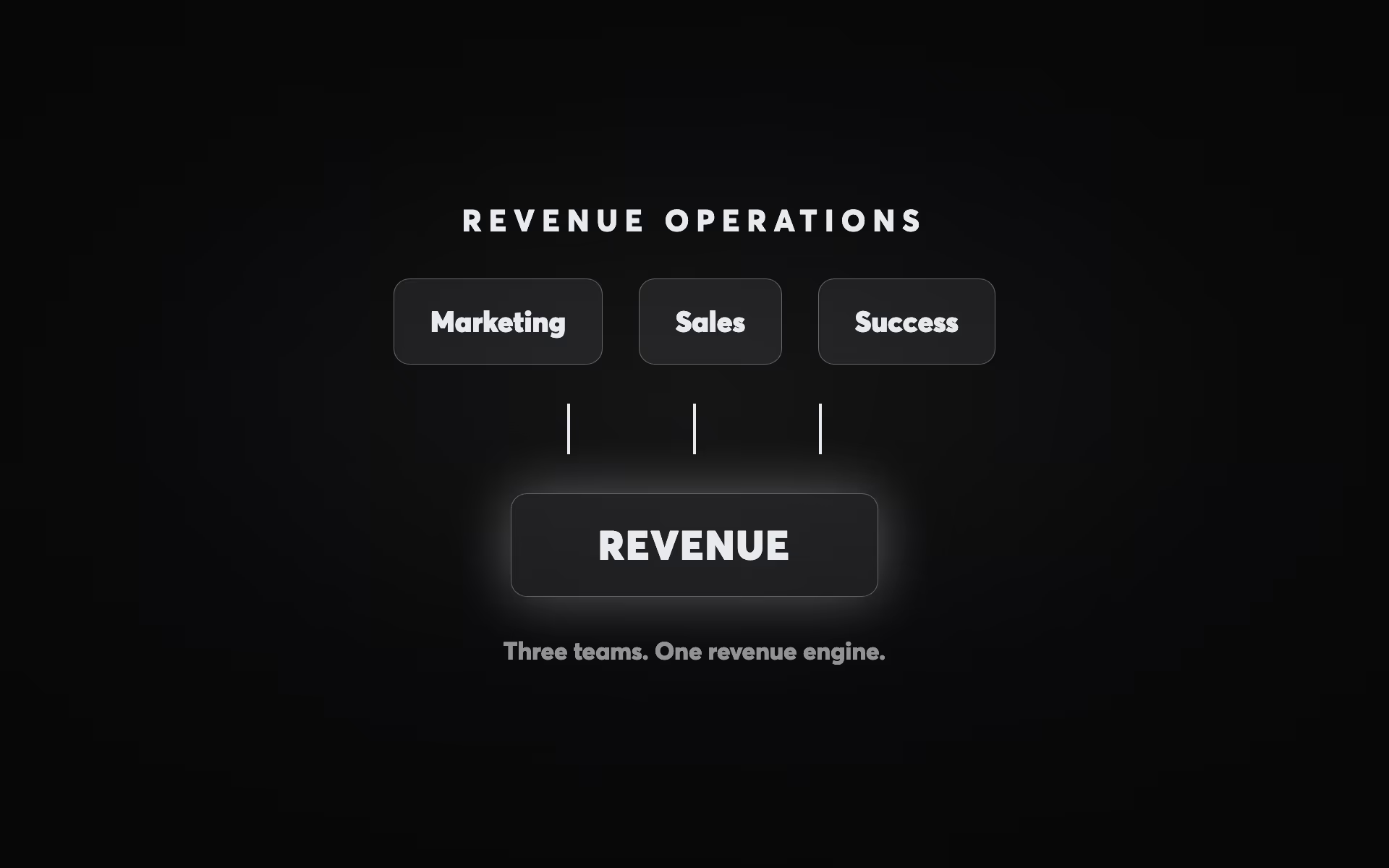
RevOps is built on three structural pillars: unified data and systems, standardised processes and definitions, and shared performance metrics and accountability. Get all three right and you have a revenue engine that produces accurate forecasting, efficient pipeline progression, and the operational clarity that lets you make confident budget and headcount decisions.
Pillar 1: Unified Data and Systems. The CRM is the single source of truth in a RevOps architecture. Every contact, company, deal, and customer interaction should live there — not in spreadsheets, inboxes, or team-specific tools that don't sync back to the central record. In 2026, the RevOps tech stack typically comprises four layers: the CRM (Salesforce or HubSpot), marketing automation (HubSpot Marketing, Marketo, or ActiveCampaign), sales engagement (Outreach, Salesloft, or Smartlead), and analytics/BI (native CRM reporting for standard metrics, Looker or Power BI for cross-source dashboards). Data enrichment tools (Clay, Apollo, ZoomInfo) add a fifth layer for maintaining contact data quality and feeding AI-powered prospecting. See our CRM comparison guide for a deep-dive on choosing between HubSpot, Salesforce, and Pipedrive as your RevOps foundation.
Pillar 2: Standardised Processes and Definitions. The most destructive thing in a revenue team is undefined shared vocabulary. When marketing defines an MQL as "anyone who downloads a white paper" and sales defines a qualified lead as "a decision-maker with budget, authority, need, and timeline confirmed," the handoff between them is guaranteed to produce conflict. RevOps creates and enforces the shared definitions: what is a Lead, an MQL, a Sales Accepted Lead (SAL), an SQL, an Opportunity, and a Closed-Won deal — and what are the specific criteria for advancing between each stage? These definitions become the foundation of every subsequent process, metric, and conversation about pipeline health.
Pillar 3: Shared Metrics and Accountability. The final pillar is the accountability infrastructure: the metrics that every revenue function is held to, and the cadence for reviewing them. RevOps moves organisations from function-specific KPIs (marketing's CPL, sales' quota attainment, CS's NPS) to shared revenue KPIs (pipeline velocity, lead-to-close rate, LTV:CAC ratio, net revenue retention). When every function is measured on their contribution to the same revenue outcome, the incentive for internal conflict disappears.
Lead Definitions: The Foundation Everything Rests On
Before your RevOps system can work, everyone needs to agree on what the words mean. This sounds trivial and is anything but — getting shared lead definitions right is the single most high-leverage act in RevOps implementation. Here's the definitional framework that Involve Digital recommends for B2B service businesses in 2026:
Prospect/Contact: Any person in your target market who matches your ICP criteria, whether or not they've engaged with you. This is the starting universe from which leads are sourced.
Lead: A prospect who has provided their contact details through any inbound or outbound interaction — form fill, demo request, content download, or direct outreach response. A Lead has entered the system but has not been qualified.
Marketing Qualified Lead (MQL): A Lead who has crossed a defined engagement threshold — typically a composite score based on fit (ICP attributes) and behaviour (page visits, content downloads, email engagement, pricing page views). The MQL threshold should be set at a point where historical data shows these leads convert to SQL at a meaningful rate. The industry benchmark for MQL-to-SQL conversion is 13–22%, but with AI lead scoring, well-tuned models can achieve 40%+ (Dreamdata, 2026).
Sales Accepted Lead (SAL): The often-skipped middle stage — a confirmation from sales that they've reviewed the MQL and agree it meets the qualification criteria. Without this stage, you get the blame-game loop: marketing sends MQLs, sales ignores them, each blames the other. The SAL is the handshake moment that creates mutual accountability.
Sales Qualified Lead (SQL): An SAL that sales has actively engaged and confirmed meets the BANT criteria (Budget, Authority, Need, Timeline) or your chosen qualification framework. An SQL is a lead with a realistic path to becoming an Opportunity.
Opportunity: An SQL that has been converted into an active deal with a defined close date and deal value in the CRM pipeline. All Opportunities should have a stage, a close date, and a value — these three fields are the minimum for pipeline forecasting.
The key insight in this framework is that the MQL→SAL handoff is where most revenue organisations break. By introducing the SAL stage, you create a formal feedback loop where sales either accepts or rejects each MQL with a documented reason — giving marketing the data it needs to refine lead scoring, and giving sales ownership over the leads it accepts.
The 90-Day RevOps Implementation Roadmap
The most common RevOps implementation failure is trying to boil the ocean — attempting to fix everything simultaneously, buying a full tech stack before the processes exist to use it, or investing in advanced analytics before the underlying data is clean. The 90-day roadmap below is designed to avoid these failure modes by sequencing initiatives in the order that creates maximum momentum with minimum risk.
This roadmap is adapted from Modgility's 2026 implementation framework and aligned with the operational patterns we see across NZ SMBs making the RevOps transition. It assumes you're starting from a partially connected state — some CRM usage, some marketing tools, but no formal RevOps function or unified processes.
Days 1–30: Audit and Align
The first month is not about building — it's about mapping the terrain and getting leadership alignment. The deliverables for this phase are: a complete customer journey map showing every touchpoint and the system that handles it; a tech stack audit identifying what's working, what's redundant, and what's missing; a data quality baseline (what percentage of CRM records have complete core fields?); and an agreed-upon set of lead definitions (Lead, MQL, SAL, SQL, Opportunity) documented and signed off by marketing, sales, and CS leadership. This phase surfaces the specific breakpoints in your revenue process — the places where leads fall through, data goes dark, or handoffs fail. These breakpoints become the implementation priority list.
Days 31–60: Implement and Automate
Month two is where the core infrastructure is built. Priority actions: consolidate your data into a single CRM as the source of truth; build the lead scoring model and MQL threshold workflow (in HubSpot or Salesforce, this is typically a contact property with automated lifecycle stage changes and rep notifications); set up lead routing automation so inbound leads above MQL threshold trigger immediate rep assignment with a 5-minute SLA; create the marketing-to-sales SLA document covering lead volume targets, quality criteria, and response time commitments; and build the first shared dashboard with pipeline coverage, stage conversion rates, and lead source attribution. This phase also covers data enrichment setup — tools like Clay or Apollo connected to the CRM to automatically enrich new leads with firmographic and contact data, reducing manual entry and improving scoring accuracy.
Days 61–90: Optimise and Embed
The third month is about embedding the new processes into daily behaviour and identifying optimisation opportunities from the first data cycle. Actions: train all revenue teams on the new processes and definitions; launch the first fully attribution-tracked campaign and review its contribution from first touch to closed deal; hold the first joint revenue review with marketing, sales, and CS — reviewing pipeline coverage, MQL→SAL conversion, SAL→SQL conversion, and NRR; identify the two or three highest-leverage optimisation opportunities from the data; and document the ongoing review cadence (weekly pipeline review, monthly metrics review, quarterly growth review).
By the end of 90 days, you should have: a unified CRM with clean data flowing between marketing and sales; agreed lead definitions everyone is working from; automated lead routing with defined SLAs; a shared dashboard your leadership team trusts; and the beginnings of a feedback loop that improves lead quality, conversion rates, and retention metrics over time. For the deeper CRM setup guidance that underpins this roadmap, see our article on choosing and configuring the best CRM for a growing business.
The RevOps Tech Stack for Growing Businesses
The RevOps tech stack is not a shopping list — it's an architecture. Each layer serves a specific purpose, and the value comes from integration, not from individual tools. For SMBs in 2026, the right stack is typically simpler than what enterprise RevOps teams run, and the simplicity is a feature, not a limitation.
Layer 1 — CRM (Essential): Salesforce for organisations with complex sales processes and large teams; HubSpot for businesses prioritising ease of use, marketing-to-sales integration, and all-in-one functionality; Pipedrive for lean sales teams with simpler pipeline needs. HubSpot is the most common choice for NZ SMBs in the $1M–$15M revenue range because it provides CRM, marketing automation, and service desk in a single platform with strong native integration. For a detailed comparison, see our HubSpot vs Salesforce vs Pipedrive comparison.
Layer 2 — Marketing Automation: HubSpot Marketing Hub (if using HubSpot CRM), Marketo for larger teams with complex nurture requirements, or ActiveCampaign for SMBs on tighter budgets. The key RevOps requirement for this layer is bidirectional CRM sync — every email interaction, content download, and campaign engagement must sync back to the contact record in real time. Without this, the lead scoring model is running on incomplete data.
Layer 3 — Sales Engagement: Outreach or Salesloft for larger sales teams with complex sequence needs; Smartlead or Instantly for high-volume outbound; Chili Piper or Calendly for inbound meeting scheduling (critical for the 5-minute response time SLA). The RevOps requirement here is that every rep activity — emails sent, calls made, meetings booked — logs automatically to the CRM contact record without manual input from reps.
Layer 4 — Data Enrichment: Clay (the most powerful for signal-based enrichment in 2026), Apollo (for prospecting and contact data), ZoomInfo (for enterprise-level firmographic data), or Clearbit/HubSpot Enrichment for automated enrichment on form submissions. Data enrichment feeds the lead scoring model with the firmographic data needed to calculate ICP fit scores, and maintains contact data quality over time.
Layer 5 — Analytics: For most SMBs, native CRM reporting handles 80% of RevOps analytics needs. The remaining 20% — multi-source attribution, cohort analysis, cross-departmental benchmarking — typically requires a BI tool (Looker, Power BI, or Metabase for cost-conscious teams) that pulls from the CRM, marketing platform, and CS tools into a unified view.
The total RevOps stack cost for an SMB in 2026 typically ranges from $1,500–$5,000 per month depending on company size and tool choice. The ROI benchmark for RevOps model implementation is a 10–20% increase in revenue growth, a 15–30% boost in sales productivity, and 100–200% ROI on marketing spend (Modgility, 2026) — making the stack investment one of the highest-ROI capital allocations available to growing businesses.
The 21 RevOps Metrics That Actually Matter
Every metric in RevOps traces back to one question: are we generating revenue efficiently and predictably? The 21 metrics framework from SyncGTM (2026) organises RevOps analytics into five categories, each measuring a different dimension of revenue health. For growing businesses, you don't need to track all 21 immediately — but you should have a path to all of them.
Pipeline Health (the most important category): Pipeline coverage ratio (target: 3× your quarterly target in qualified pipeline — this predicts quarterly attainment better than any other single metric); pipeline creation rate (new opportunities per week — if this drops, revenue drops 60–90 days later); stage conversion rates (target: Stage 1→2 at 60–70%, Stage 2→3 at 40–50%, Stage 3→Close at 30–40%); deal velocity (target: SMB 15–30 days, mid-market 30–60 days, enterprise 60–120 days); and pipeline aging (target: below 15% of deals stalled beyond 1.5× average cycle length).
Sales Efficiency: Lead-to-MQL conversion rate; MQL-to-SQL conversion rate (target: 13–22%, with AI scoring capable of reaching 40%+); SQL-to-close rate (industry median: 16–22%); revenue per rep (trend line matters more than absolute value); and lead response time (target: under 5 minutes for inbound, under 1 hour for signal-triggered outbound).
Data Quality (most undertracked): CRM data completeness (target: 80%+ across all records); email bounce rate (target: below 3%); CRM duplicate rate (target: below 5%); and enrichment fill rate (target: 85%+ of new records with core fields populated within 60 seconds of creation via automated enrichment).
Customer Revenue Metrics: Net Revenue Retention (NRR) — the single most important long-term health metric, measuring whether your existing customer base is growing or shrinking (target: 110%+ for SaaS; 100%+ for services); and LTV:CAC ratio (target minimum: 3:1; healthy: 4:1; excellent: 5:1+). These two metrics tell you whether your unit economics are sustainable and whether you're retaining and expanding effectively. Our article on Google Ads for business growth covers how CAC calculations connect to paid media budget decisions.
The most common mistake in RevOps metrics is tracking too many numbers in the early stages. For businesses in the first 90 days of RevOps implementation, the minimum viable dashboard has four metrics: pipeline coverage ratio, MQL-to-SQL conversion rate, lead response time, and NRR. These four metrics will surface most revenue problems before they become crises.
AI and RevOps: The 2026 Advantage Layer
RevOps in 2026 is being fundamentally changed by AI — not in the science-fiction sense of robots running your sales team, but in the practical sense of AI tools making existing RevOps functions more accurate, faster, and lower-effort for human teams. The three highest-impact AI applications in RevOps today are predictive lead scoring, AI-assisted forecasting, and churn prediction.
Predictive Lead Scoring: Traditional lead scoring uses manually assigned point values for specific behaviours and attributes. AI-powered scoring builds a model from historical win/loss data — learning which combinations of demographic fit, firmographic signals, and engagement behaviours actually predict close. HubSpot's AI lead scoring and Salesforce Einstein both offer this natively. External tools like Clay bring in third-party intent data (job postings, funding rounds, technology signals) to build a richer predictive model. AI lead scoring models increase close rates by up to 30% compared to manual scoring (Prospeo, 2026), and signal-qualified leads achieve 47% better conversion rates and 43% larger average deal sizes compared to traditionally scored leads (Landbase, 2025). For a deep dive on implementation, see our guide on AI-powered lead scoring for growing businesses.
AI-Assisted Forecasting: Revenue forecasting has historically been unreliable because it depends on rep-entered deal data that is both incomplete and optimistically biased. AI forecasting tools (like those built into HubSpot and Salesforce, as well as specialised tools like Clari and Gong) analyse the full activity signal — email patterns, call frequency, stakeholder engagement, document views, response times — to produce probability-weighted forecasts that are significantly more accurate than rep-submitted pipeline. By 2026, the most effective RevOps teams are using AI forecasting to identify at-risk deals 2–4 weeks before the rep is aware of the risk.
Churn Prediction: Customer success teams using AI to analyse engagement data — login frequency, feature adoption, support ticket volume, email responsiveness — can identify accounts at high churn risk with meaningful lead time. The operational value is that CS teams can prioritise intervention resources on accounts that need them most, rather than treating all accounts equally or — worse — only discovering churn risk when a client submits a cancellation request. This connects directly to the retention economics: a 5% improvement in retention can boost profits by 25–95% (Bain & Company), and the ROI on proactive retention intervention is dramatically higher than the equivalent spend on new acquisition.
| Metric | Target / Benchmark | Context |
|---|
RevOps for SMBs: Common Mistakes and How to Avoid Them
RevOps implementation fails more often for cultural and sequencing reasons than for technical ones. Here are the five most common mistakes NZ SMBs make when implementing RevOps — and how to avoid them.
Mistake 1: Starting with tools instead of process. The most common RevOps failure is buying a new CRM, marketing automation platform, or analytics tool and expecting it to solve the alignment problem by itself. Tools amplify existing processes — they don't create them. A messy, misaligned process running through an expensive new CRM is still a messy, misaligned process. Start with agreed definitions, documented processes, and a clear owner for the RevOps function before selecting or migrating tools.
Mistake 2: Defining RevOps as a project rather than a function. RevOps is not a one-time initiative with a completion date — it's an ongoing operational function. Businesses that treat it as a project do a 90-day implementation sprint, celebrate the CRM migration, and then watch data quality decay and process compliance erode as the team reverts to old habits. RevOps requires permanent ownership: a person (or small team) whose job it is to maintain data standards, update processes, and manage the tech stack on an ongoing basis.
Mistake 3: Neglecting data quality. Data quality is the least glamorous RevOps discipline and the one that breaks everything else. CRM completeness below 80% makes forecasting unreliable and lead scoring inaccurate — which means every downstream decision based on that data is compromised. Investing in automated enrichment (Clay, Apollo, HubSpot Enrichment) early saves enormous time and prevents the "garbage in, garbage out" problem that undermines otherwise well-designed RevOps systems.
Mistake 4: Not getting sales buy-in before launching. RevOps initiatives die when the sales team doesn't adopt the processes, doesn't update the CRM correctly, and routes around the new system. Successful RevOps implementation requires sales leadership to champion the initiative — not just accept it. The framing matters: RevOps is not a control mechanism or an accountability tool against salespeople. It's an operational investment that makes reps more efficient, reduces admin burden, and gives them better intelligence about which leads to prioritise. Frame it as a tool that helps reps win, not as a reporting system that watches them.
Mistake 5: Over-reporting without acting on data. Some RevOps implementations produce beautiful dashboards that nobody acts on. The point of RevOps metrics is not to have them — it's to use them to make better decisions faster. Every metric in your RevOps dashboard should have an owner, a target, an alert threshold, and a defined action the owner takes when the metric moves outside the target range. If a metric doesn't have those four things, it shouldn't be on the dashboard yet.
Building RevOps Into Your Wider Growth Framework
RevOps doesn't operate in isolation. It's the operational infrastructure that makes the other four components of the Business Growth Framework work — the engine that ensures your ICP targeting, lead generation, conversion, and retention strategies are connected to each other and to measurable revenue outcomes. A well-implemented RevOps function closes the feedback loops that let you know whether your marketing channels are producing revenue (not just leads), whether your conversion architecture is working, and whether your retention programme is reducing churn before it hits the P&L.
For businesses in the early stages of building their digital presence, RevOps also informs channel strategy. Clean attribution data — knowing which campaigns, content pieces, and channels produced pipeline — makes decisions about where to invest in SEO and GEO strategy dramatically more confident. Without that attribution, you're allocating budget based on top-of-funnel proxies (impressions, clicks, leads) rather than bottom-of-funnel reality (qualified pipeline, deals, closed revenue).
The VP of RevOps title has grown by 300% over the past 18 months (Skaled, 2026), and there are now over 174,000 active RevOps job postings on ZipRecruiter. For NZ businesses, this market signal reflects a global shift in how growth organisations are structured. The businesses that build RevOps capability now — even at the SMB level — are creating a structural advantage over competitors still running disconnected teams.
Your Next Step: Build a Growth Plan That Includes RevOps
Revenue Operations is the operational foundation for predictable growth. If you're running marketing, sales, and customer success as separate functions with separate data and separate definitions of success, you're leaving measurable revenue on the table — and the gap will compound as your competitors build the infrastructure you haven't. The first step is an honest assessment of where your RevOps maturity sits today — use the assessment tool in this article to benchmark your organisation across all five dimensions.
Ready to build a RevOps-informed growth plan? The Involve Digital Growth Plan Generator is built on the same framework principles covered in this article — it asks the right questions about your sales and marketing alignment, your data infrastructure, your acquisition channels, and your revenue targets, then produces a prioritised roadmap that includes RevOps foundations alongside channel strategy and growth tactics. Get your free growth plan with Involve Digital.
Get Started Using The Form Below
This article is part of Involve Digital's Business Growth content cluster. For the strategic framework that RevOps sits within, read the Complete Business Growth Framework for 2026. For the CRM infrastructure that powers RevOps, see our guide to choosing the right CRM for a growing business. And for how AI is changing lead qualification at the top of the RevOps funnel, see our guide on AI-powered lead scoring.
Questions