InsightsAI-referred lead conversion
Why AI-Referred Leads Convert Better
How AI Recommendations Drive Higher Lead Conversion and Revenue
27 June 202512 min read
Direct answer
AI-referred leads convert better because trust and intent are pre-qualified before the visit. When AI systems recommend a business, buyers arrive with reduced uncertainty, clearer needs, and higher decision confidence. The result is shorter sales cycles, higher close rates, and stronger ROI compared to traditional organic or paid traffic sources.
Why AI-Referred Leads Convert Better
AI-referred leads convert at significantly higher rates than traditional search traffic — and most businesses do not understand why. When platforms like Google's AI Overviews, ChatGPT, or Perplexity recommend a business, the buyer arrives in a fundamentally different state. Trust has already been established. Intent has been clarified. The comparison phase has been compressed or eliminated entirely.
This article explains the mechanics behind AI-referred lead quality, why these leads close faster with less friction, and what this means for how you measure marketing performance in 2026.
Why Conversion Quality Now Matters More Than Traffic Volume
Traffic used to be the growth metric. In 2026, decision influence is.
AI systems operated by Google and OpenAI increasingly sit between the buyer and the market. They filter options before a website is ever visited. That means fewer visits, higher intent, and better outcomes across the funnel.
This is not a traffic problem. It is a qualification upgrade. The businesses winning in 2026 are not the ones generating the most sessions — they are the ones generating the most trust before the first click. Understanding how AI recommends businesses is the first step to capitalising on this shift.
How AI Pre-Qualifies Trust Before the First Click
AI does what sales teams try to do — before the prospect ever reaches your site.
By the time an AI-referred lead lands on your website, three things have already happened. First, they trust the source that recommended you. AI platforms carry borrowed authority — when a buyer receives a recommendation from ChatGPT or Google's AI Overview, they treat it with the same weight as a referral from a trusted colleague. Second, they accept your category fit. The AI has already positioned your business as relevant to their specific need, eliminating the "are you the right type of provider?" question. Third, they believe you are credible. The AI's selection process has implicitly validated your expertise.
This removes the early-stage friction that kills most conversion funnels. Traditional search traffic arrives asking "Are you worth considering?" AI-referred traffic arrives asking "How do we proceed?"
That distinction is the single biggest driver of conversion performance in AI-driven search.
How AI Compresses the Buyer Journey
The traditional buying funnel assumes a linear, multi-stage process: awareness, research, comparison, decision, action. Each stage creates friction. Each transition loses prospects.
AI collapses this structure.
When a buyer asks an AI system for a recommendation, the engine compresses vendor research, feature comparison, and risk evaluation into a single response. The buyer moves from question to shortlist to action — often skipping entire stages that traditional marketing spends months trying to optimise.
This compression delivers measurable commercial benefits. Time to decision shrinks because the research phase is handled by the AI. Price sensitivity decreases because trust has been pre-established rather than earned through negotiation. Drop-off points are eliminated because there are fewer stages to fall out of.
The result is higher lead-to-sale velocity, improved sales efficiency, and greater revenue per visit — even when total traffic is lower.
Why AI-Referred Leads Close at Higher Rates
AI recommendations carry borrowed authority. This is the mechanism that makes the conversion difference real.
When a buyer receives a recommendation from an AI system, they make an implicit assumption: due diligence has already occurred. Unsafe choices have been filtered out. The recommendation is defensible. This is the same psychology that makes personal referrals so powerful — but operating at scale through machine systems.
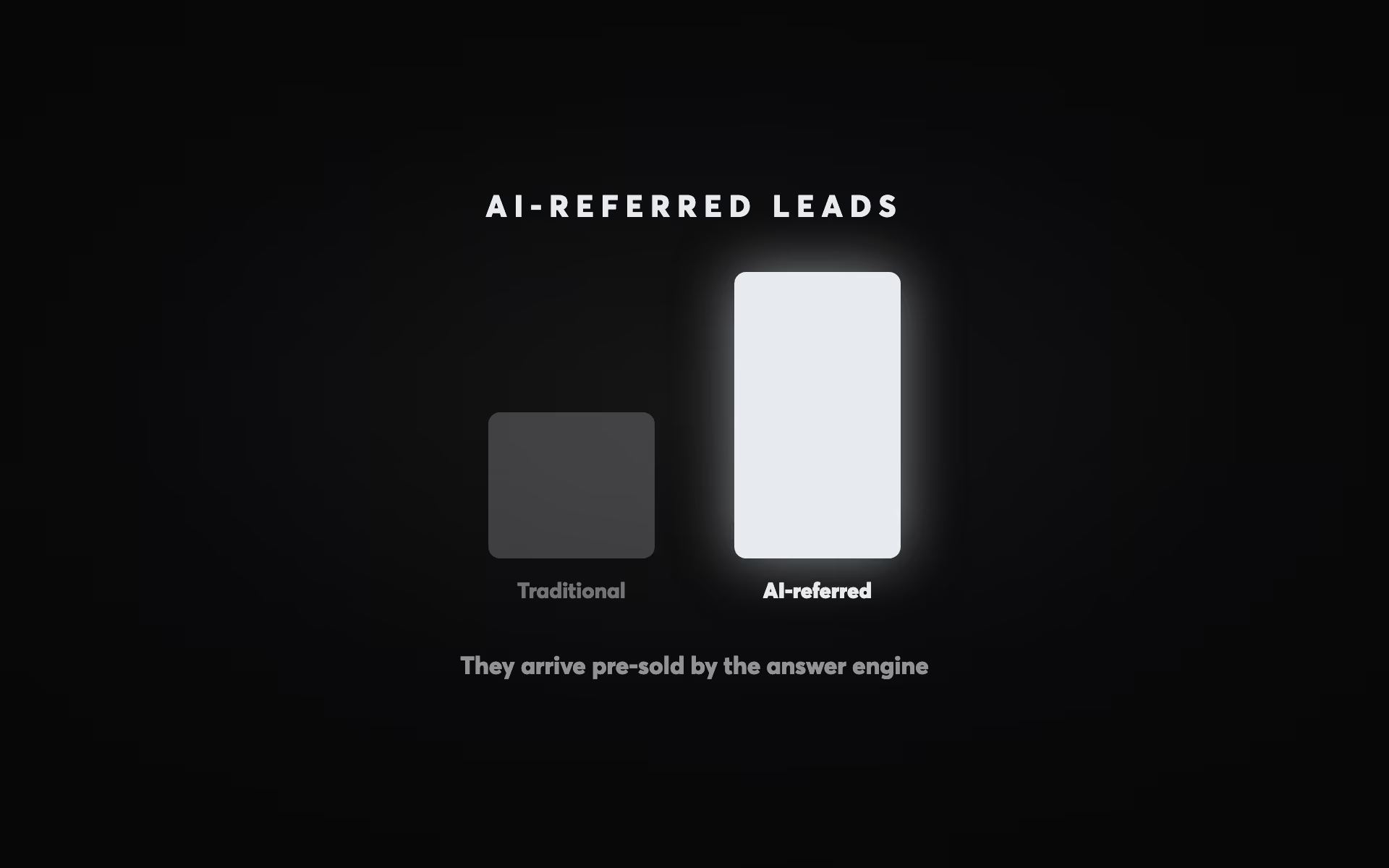
Involve Digital's 2026 performance data shows AI-assisted leads converting 32–68% higher than traditional organic traffic. The offer did not change. The product did not improve. Trust arrived first — and trust is the single highest-leverage conversion factor in high-consideration buying.
This is why Generative Engine Optimisation (GEO) is a revenue discipline, not a content tactic. When AI systems trust your business enough to recommend it, every downstream metric improves.
How AI-Referred Traffic Reduces Sales Friction
The behavioural difference between AI-referred leads and traditional leads shows up immediately in sales conversations.
AI-referred leads typically demonstrate fewer objections because they arrive with pre-established confidence rather than scepticism. They ask better-informed questions because the AI has already framed the context. They have clearer problem definitions because the recommendation was generated in response to a specific need. And they show higher readiness to act because the comparison phase has already been handled.
Sales conversations shift from "Convince me you're worth my time" to "Help me decide how to work with you." That difference reduces sales cycle length, lowers cost per acquisition, and decreases reliance on persuasion as a closing mechanism.
We've seen this pattern consistently across client engagements — the leads that arrive through AI-influenced pathways require less effort from sales teams while producing better commercial outcomes. The work shifts from convincing to guiding.
Why AI-Referred Traffic Changes How ROI Is Measured
If you are still measuring marketing success through sessions, bounce rate, and average time on page, you are measuring the wrong things for AI-driven growth.
AI traffic behaves differently from traditional traffic. Volumes are smaller. Intent is higher. Revenue density is greater. This means the old dashboard metrics will consistently undervalue your best-performing channel.
The metrics that actually capture AI-referred lead performance include:
- Assisted conversions — tracking where AI-influenced traffic appears anywhere in the buyer journey, not just at last click
- Sales velocity — measuring time from first interaction to closed deal, which compresses significantly with AI-referred leads
- Close rate by source — comparing AI-referred leads against other acquisition channels
- Revenue per lead — capturing the commercial value difference, not just the volume difference
This aligns with how GEO success should be measured — through commercial outcomes rather than traffic vanity metrics. When the measurement model is wrong, GEO looks slow. When it is right, GEO looks like the highest-ROI channel in the mix.
Why Most Businesses Misinterpret AI Traffic Performance
Many marketing teams make the same mistake: they judge AI-referred traffic by volume and miss its commercial leverage entirely.
AI traffic is smaller in volume, slower to appear, and dramatically higher in value. This creates a pattern where teams looking at session counts conclude that AI is not working, while the sales team is quietly closing more deals at higher margins from the same period.
The disconnect happens because attribution models built for click-based funnels cannot capture decision-based influence. AI shapes buying decisions before the click — and most analytics tools only start measuring after it.
This is why early adopters of SEO and GEO strategy quietly outperform competitors who are still chasing traffic scale. They are measuring the right thing — revenue quality — while everyone else is optimising for a metric that no longer predicts commercial success.
The Strategic Advantage of AI-Referred Demand
Once AI systems trust your brand, the advantage compounds.
Recommendations build on themselves. Authority reinforces itself. Competitors become harder to displace. This is not a paid media model where you rent attention by the impression — it is an earned trust model where each recommendation makes the next one more likely.
This creates defensible growth that is not dependent on advertising auctions, increasing budgets, or short-term tactical campaigns. The businesses that benefit most are those in high-consideration, trust-based industries where buying decisions carry real consequences — B2B services, professional services, and complex purchases where the buyer cannot afford to choose wrong.
For these businesses, AI-referred demand is not just another channel. It is a structural advantage that compounds over time while competitors continue to fight for diminishing returns from traditional acquisition.
How SEO and GEO Create the Conditions for Higher Conversion
AI-referred lead quality does not happen by accident. It is engineered through the alignment of SEO infrastructure and GEO authority.
SEO builds the infrastructure that makes your business legible to AI systems — crawlable, structured, and parseable. GEO ensures AI systems select you as the safest, most defensible answer. Conversion happens when both layers are aligned and connected to revenue systems.
SEO without GEO produces traffic without trust. GEO without SEO produces authority that cannot be discovered. Revenue requires both. At Involve Digital, we engineer both layers together within a full-funnel growth strategy designed to translate AI visibility directly into commercial outcomes — not content output.
What Should You Do Next?
If your business relies on inbound demand, authority positioning, or high-value client acquisition, understanding AI-referred lead conversion is no longer optional — it is a direct input to your revenue forecast.
Book a GEO Readiness Audit with Involve Digital. We will show you where AI already influences your conversions, how much revenue is being left on the table, and what to fix first to improve close rates in 2026.
Questions