InsightsMeasuring GEO performance
How to Measure GEO Success (What to Track Instead of Rankings)
Why Traditional Metrics Fail and What to Track for GEO
12 July 202513 min readReviewed by Michael Wilkins
Direct answer
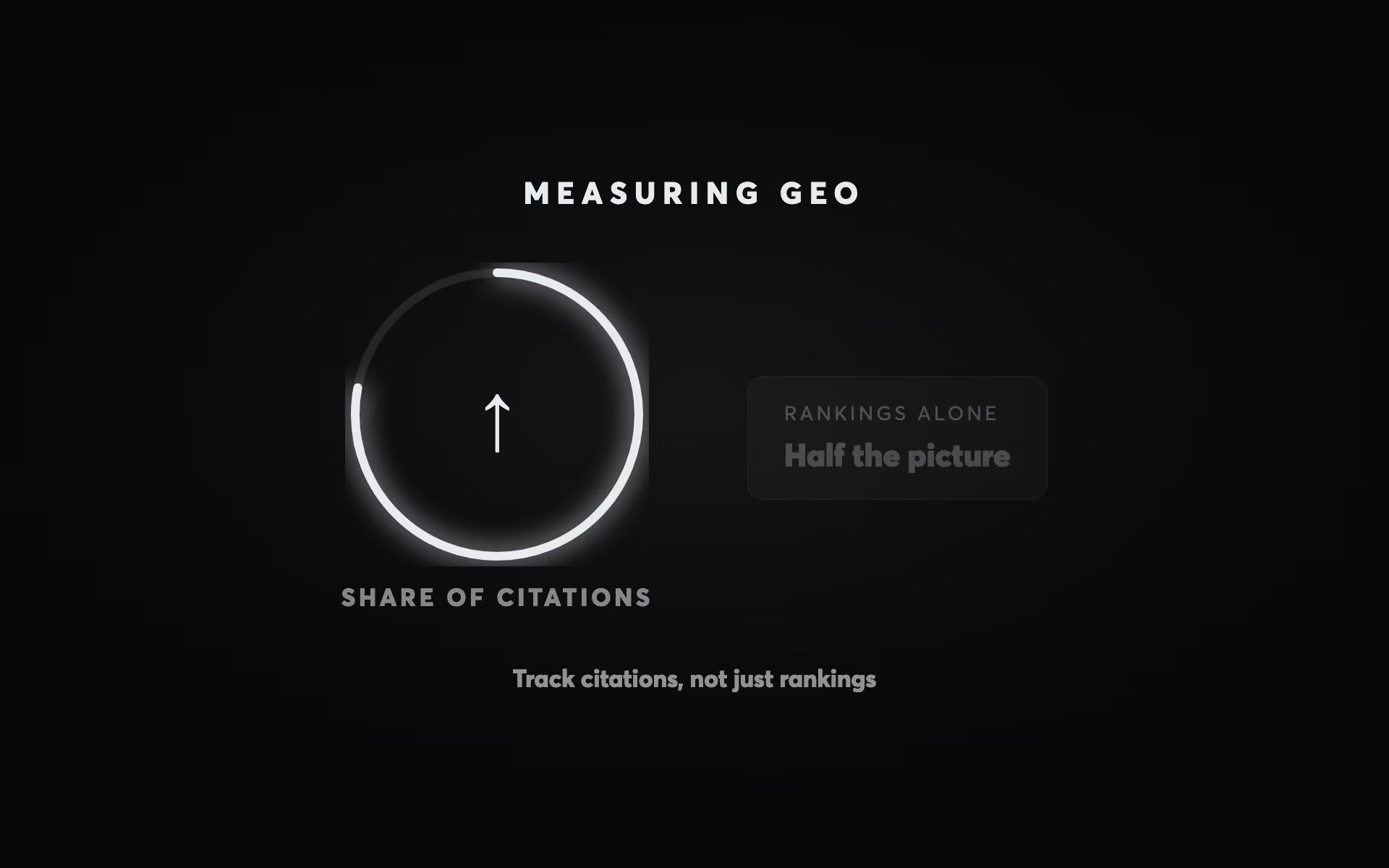
GEO success is measured by commercial impact, not traffic volume. The four core metrics are AI citation frequency, assisted conversions, close rate by source, and sales velocity. Traditional metrics like sessions, bounce rate, and average ranking position were built for a click economy and cannot capture the decision-stage influence that GEO delivers through AI recommendations.
How to Measure GEO Success (What to Track Instead of Rankings)
Measuring GEO with traditional SEO metrics is like measuring a referral programme by counting footfall. The numbers are real, but they miss the point entirely. Rankings, sessions, and impressions tell you whether content exists — not whether AI systems trust it enough to recommend your business.
Most teams abandon GEO too early because their dashboards show the wrong data. They see traffic plateaus and assume GEO is not working, while the actual impact — shorter sales cycles, higher close rates, better lead quality — goes unmeasured. This article replaces the old measurement framework with one built for how Generative Engine Optimisation actually creates value.
Why Traditional SEO Metrics Fail for GEO
Traditional SEO metrics were designed for a click economy. Every metric in the standard reporting stack — sessions, impressions, bounce rate, average position — assumes value flows through clicks on search results.
GEO operates in a decision economy. Value flows through AI-mediated recommendations that influence buying decisions before a click ever occurs. A buyer who asks an AI system "Who should I hire for GEO?" and receives your business name has already been influenced — whether or not they click through from that specific interaction.
This is not a subtle distinction. It changes what success looks like at every level. A GEO-optimised page might generate fewer sessions than a keyword-stuffed alternative, but the sessions it does generate convert at three to five times the rate because they arrive with trust pre-loaded by AI recommendation.
Teams that measure GEO with traffic metrics will always conclude it is underperforming — and they will always be wrong.
The Four Metrics That Actually Matter
GEO measurement requires a fundamentally different dashboard. Four metrics capture the commercial impact that traditional reporting misses entirely.
1. AI Citation Frequency
This is the most direct measure of GEO performance. How often do AI systems — Google AI Overviews, ChatGPT, Perplexity, Gemini — reference your content when answering questions in your category?
Citation frequency indicates whether AI trusts your content enough to use it. A business cited fourteen times per month in AI-generated answers has fundamentally different market positioning than one cited zero times, regardless of how their organic traffic compares.
Tracking methods include manual monitoring of AI responses for category-relevant queries, third-party citation tracking tools that monitor AI outputs, and branded search volume changes that indicate AI-driven awareness.
2. Assisted Conversions
Assisted conversions measure deals where AI-influenced touchpoints appeared in the buyer journey — even if the final conversion came through a different channel.
This is critical because GEO influence often precedes the measurable interaction. A prospect discovers your business through an AI recommendation, validates you through your website, then converts through a direct enquiry or sales call. Traditional attribution credits the last touch. Assisted conversion tracking credits the AI influence that started the process.
3. Close Rate by Source
Not all leads are equal. Close rate by source reveals the quality difference between AI-referred leads and traffic from other channels.
When we compare AI-referred leads against organic, paid, and direct traffic, the pattern is consistent: AI-referred leads convert 32–68% higher because trust is pre-qualified before the first interaction. Measuring close rate by source proves this differential and justifies continued GEO investment.
4. Sales Velocity
Sales velocity measures how quickly leads move from first contact to closed deal. In B2B and high-consideration services, this is often the most commercially significant metric.
AI-referred leads compress the buying cycle because the AI has already handled credibility assessment and vendor evaluation. Our client data shows average sales cycle reductions of 25–40% for AI-referred demand compared to traditional organic leads.
What to Stop Tracking (and Why)
Removing metrics from dashboards is as important as adding them. Legacy metrics actively mislead teams about GEO performance.
Sessions. More sessions does not mean more influence. GEO-optimised content may generate fewer but significantly higher-quality visits. Tracking sessions incentivises traffic volume over decision influence.
Bounce rate. A visitor who arrives from an AI recommendation, reads your service page, and calls your team directly registers as a bounce in analytics. The metric penalises exactly the behaviour GEO is designed to create.
Average ranking position. Rankings measure visibility in traditional search results. AI recommendations operate outside the ranking system entirely. A page can rank poorly in organic results and still be the primary source AI systems cite.
Impressions. Impressions count how often your listing appeared in search results. AI citations are invisible to impression tracking — they happen inside AI interfaces, not on search result pages.
Time on page. A well-structured GEO page answers the question efficiently. Shorter time on page may indicate success, not failure — the visitor found what they needed quickly, exactly as intended.
The principle is straightforward: if a metric was designed to measure click-through behaviour, it cannot measure decision influence. Strip it from GEO reporting.
Building a GEO Measurement Framework
Moving from theory to implementation requires three layers: visibility tracking, influence tracking, and commercial tracking.
Visibility tracking answers the question "Can AI find and cite us?" Monitor which AI platforms mention your business, how frequently, and for which queries. Track branded search volume trends as a proxy for AI-driven awareness. Document which content pages are being cited and which are ignored.
Influence tracking answers "Is AI changing buyer behaviour?" Map the buyer journey to identify AI touchpoints. Implement assisted conversion tracking to credit AI-influenced deals. Survey new leads to understand how they discovered your business — the answer "AI recommended you" is increasingly common.
Commercial tracking answers "What is the revenue impact?" Compare close rates between AI-referred and non-AI-referred leads. Measure sales velocity differences by source. Calculate revenue per lead by channel to understand the true cost efficiency of GEO versus paid acquisition.
Each layer builds on the previous one. Visibility without influence measurement tells you content is being cited but not whether it changes anything. Influence without commercial tracking tells you buyers are finding you through AI but not whether it generates revenue. All three layers together provide a complete picture.
How to Set Up Tracking Without Enterprise Tools
You do not need expensive attribution platforms to start measuring GEO. Practical approaches include structured lead source questions that ask "How did you hear about us?" with an AI-specific option, UTM parameter strategies that tag traffic from AI-referral landing pages, CRM tagging that flags leads originating from AI-influenced pathways, and monthly AI citation audits where you manually query AI systems for your key service categories.
The data will not be perfect initially. That is acceptable. Directional data showing that AI-referred leads close faster and at higher rates is sufficient to prove GEO value — and it compounds in accuracy as your tracking matures.
Why Measurement Timing Matters
GEO measurement operates on different timelines than traditional SEO reporting.
Short-term indicators appear within 30–60 days: AI citation of specific content pages, changes in branded search patterns, and early lead quality signals. Medium-term indicators appear at 60–120 days: measurable close rate differentials, sales velocity improvements, and consistent assisted conversion patterns. Long-term compounding appears after 120 days: sustained authority growth, declining cost per acquisition, and competitive moat effects that make displacement increasingly difficult.
Teams that expect traffic-style results in week one will abandon GEO before the commercial indicators emerge. Setting correct expectations about measurement timelines is not a reporting detail — it determines whether GEO programmes survive long enough to compound.
Reporting GEO to Leadership
Leadership does not care about AI citation counts. They care about revenue, efficiency, and competitive advantage.
Effective GEO reporting translates the four core metrics into language executives understand. AI citation frequency becomes "market positioning in AI-driven search." Assisted conversions become "new revenue influenced by AI visibility." Close rate by source becomes "lead quality improvement." Sales velocity becomes "sales cycle efficiency."
Frame GEO as a commercial programme, not a marketing experiment. The metrics exist to prove it. If your measurement framework is built correctly, the data will show leadership exactly what they need to see: better leads, faster closes, and compounding authority that competitors cannot replicate.
The Cost of Not Measuring Correctly
When GEO goes unmeasured or mismeasured, two things happen. First, teams default to optimising for traffic because that is what their dashboards show — and traffic optimisation often undermines GEO performance by prioritising volume over clarity. Second, leadership loses confidence because the metrics they see do not reflect the commercial impact actually occurring.
The result is predictable: GEO programmes get defunded just as they begin to compound. The common GEO mistakes article covers this pattern in detail — measurement failure is not a reporting problem, it is a strategic failure that kills programmes before they deliver.
The fix is to build the measurement framework before launching the GEO programme, not after. Define what success looks like in commercial terms. Set timeline expectations. And report on the metrics that matter.
What Should You Do Next?
If your current dashboards cannot answer the question "Is AI recommending us, and is it generating revenue?" — you are flying blind on the most important growth channel in 2026.
Book a GEO Readiness Audit with Involve Digital. We will assess your current measurement infrastructure, identify the gaps, and build a reporting framework that proves GEO's commercial value to your team and your leadership.
Questions