The Complete SEO & AIO Strategy Guide for 2026
Search has fractured. The same user who Googled "best accountant Auckland" three years ago might now ask ChatGPT the same question — and the businesses that appear in that AI answer didn't get there by accident. They got there because their SEO foundations and their AI optimisation signals are one and the same. In 2026, the most important insight in digital marketing is this: traditional SEO and AI optimisation (AIO) are converging, and the businesses that understand this convergence will dominate both.
This guide is the strategic north star for the entire Involve Digital SEO/AEO/GEO/AIO content pillar. Whether you're starting from scratch with your search strategy or refactoring an existing approach that was built for a world that no longer exists, this article gives you the complete framework. For a focused look at how AI specifically recommends businesses, see our piece on how AI recommends businesses — and for the GEO-specific layer, read our complete guide to Generative Engine Optimisation.
The New Search Landscape: What Has Actually Changed
The numbers are unambiguous. Google AI Overviews now reach 2 billion monthly users across more than 200 countries, appearing in roughly 40% of queries overall — and rising steeply for informational searches. AI search traffic grew 796% year-over-year in a WebFX analysis of 2.3 billion sessions, while conversions from AI-referred visitors grew an extraordinary 6,432% in the same period. ChatGPT alone processes over 1 billion queries per day and holds approximately 77% of AI-driven website referral traffic globally.
Critically, this isn't a zero-sum game. Google search usage actually increased after ChatGPT adoption — the average Google Search usage rose from 10.5 weekly sessions to 12.6 weekly sessions among users who adopted ChatGPT (Semrush, 2025). The total search pie is growing; what's changing is where different queries land. Google still commands 89.87% of the global traditional search market. But 30% of total search interactions now involve AI tools in some form — and those interactions are structurally different in ways that demand a different optimisation approach.
The quality of AI-referred traffic adds important strategic context. Visitors referred by AI platforms convert at 4.4 times the rate of traditional organic traffic (Semrush), spend 68% more time on-site, and show 54.15% session conversion rates versus 45.23% for organic search (WebFX). The volume is still smaller — AI accounts for roughly 0.18% of total sessions — but the trajectory and conversion quality mean that AI visibility is already strategically critical for high-consideration, high-value businesses.
For NZ businesses, the implication is direct: you need a strategy that wins on Google AND wins in ChatGPT, Perplexity, and Google AI Overviews simultaneously. Fortunately, the signals that achieve both overlap more than they diverge. Understanding that overlap is the foundation of everything in this guide. For the specific GEO/AEO angle, our comparison of SEO vs AEO vs GEO vs AIO explains how each discipline relates to the others.
| Metric | Value | Context / Source |
|---|
Why SEO and AIO Are Converging — Not Competing
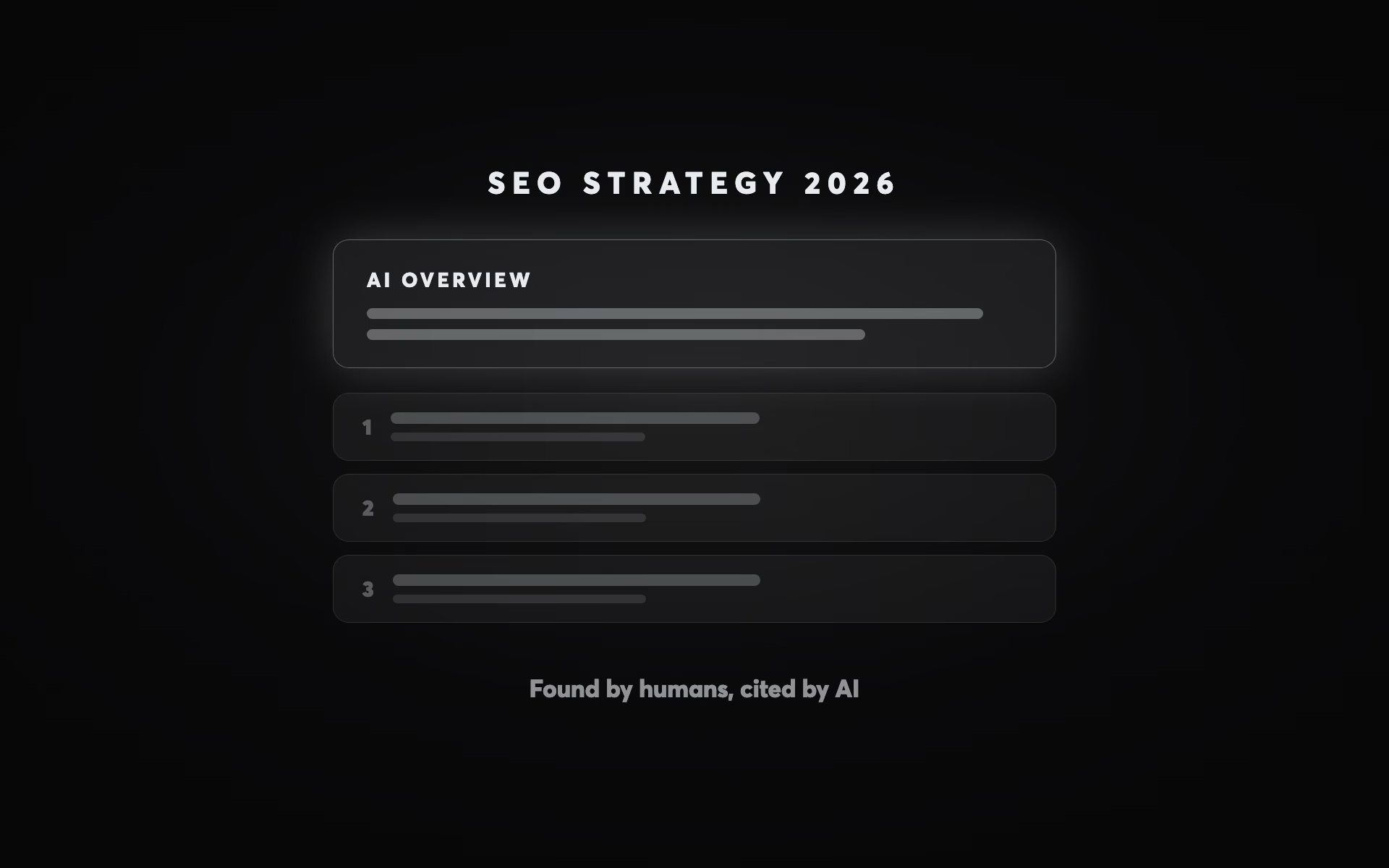
The single most important strategic insight for 2026 is that the signals Google rewards are largely identical to what LLMs cite. Both systems are trying to solve the same problem: identify the most authoritative, trustworthy, and relevant source for a given query. Google does this through its ranking algorithm. ChatGPT, Claude, and Perplexity do this through training data and retrieval-augmented generation. But both ultimately reward the same underlying qualities.
Entity clarity — being clearly and unambiguously associated with a topic or category — matters for Google's Knowledge Graph and for LLM entity recognition. Topical authority — having comprehensive, deep coverage of a subject area — drives Google's E-E-A-T signals and determines which sources LLMs treat as reference-grade. Structured, well-formatted content earns Google featured snippets and earns LLM citations. High-quality backlinks from trusted publications build Google authority and also improve the likelihood that LLMs have encountered your content positively weighted in training data.
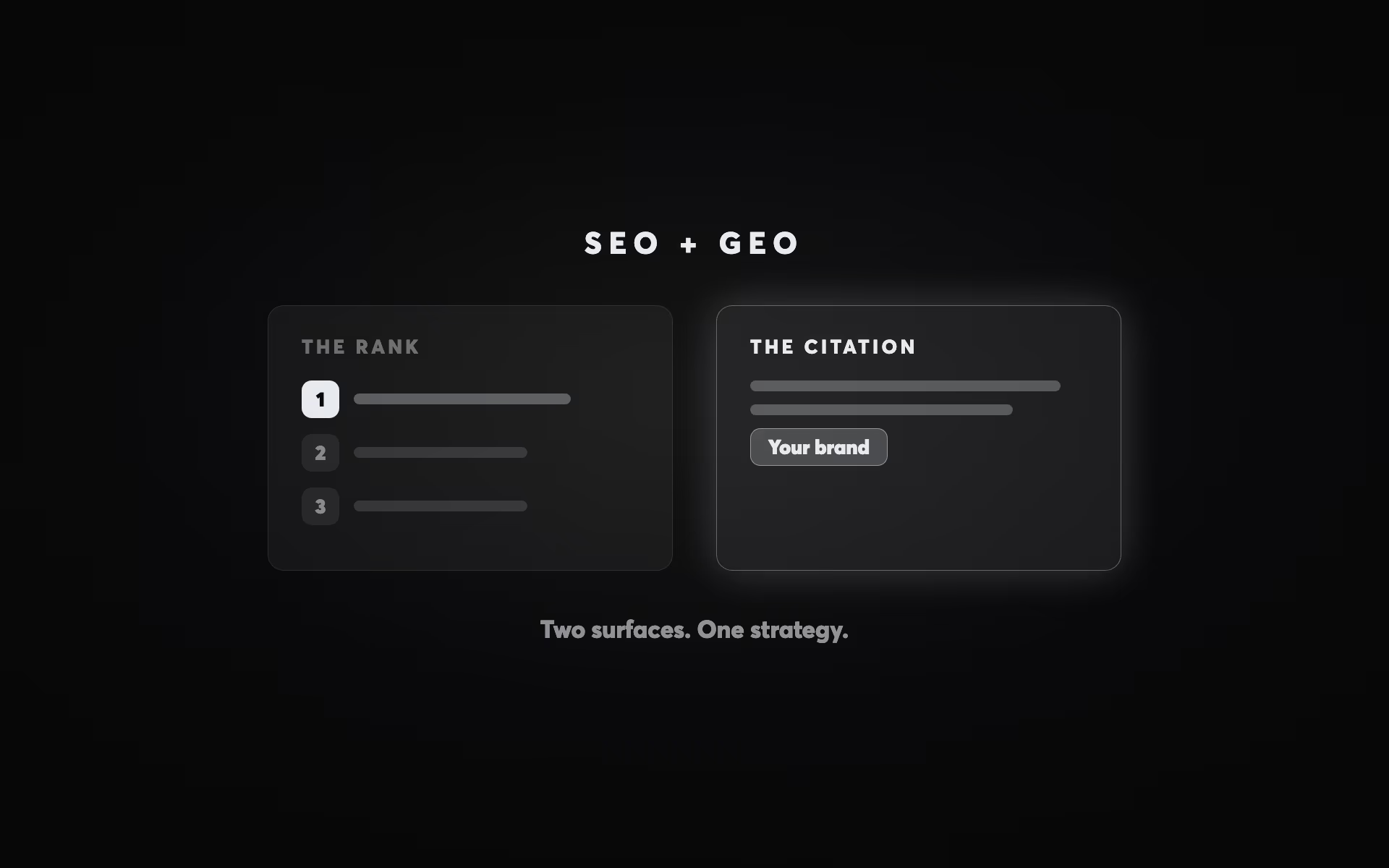
There are meaningful tactical differences between optimising for Google rankings versus AI citations — and we cover these in detail across the cluster articles in this pillar. But the strategic foundation is the same. Build genuine expertise. Structure content clearly. Earn third-party validation. Maintain technical excellence so all crawlers can access your content. These are not two separate disciplines. They are one discipline with two measurement surfaces. For the GEO-specific tactical layer, see our SEO & GEO strategy guide for 2026.
Where the disciplines diverge most significantly is in measurement: traditional SEO is measured by rankings and organic traffic, while AIO requires monitoring brand mention frequency in AI outputs, AI referral traffic in GA4, and entity recognition signals. We address the full measurement framework later in this article — and in detail in our dedicated SEO performance measurement cluster article.
The Four Pillars of SEO Authority in 2026
Strip away all the tactical noise and SEO authority in 2026 rests on four interconnected pillars. Miss any one of them and the others underperform. Get all four right and you build a compounding, difficult-to-replicate advantage.
Pillar 1: Technical Foundation. Your site must be completely accessible, indexable, and fast. This means clean crawl paths, correct canonical implementation, mobile-first architecture, Core Web Vitals within Google's "good" thresholds (LCP under 2.5s, INP under 200ms, CLS under 0.1), and comprehensive schema markup. In 2026, it also means ensuring AI crawlers — GPTBot, ClaudeBot, PerplexityBot — are not inadvertently blocked in your robots.txt. Technical SEO is the non-negotiable foundation. We cover this in depth in our technical SEO foundations guide.
Pillar 2: Content Architecture. Content must be organised into clear topical clusters: a pillar page covering a broad topic comprehensively, surrounded by cluster pages that go deep on specific subtopics, all interconnected with deliberate internal linking. This architecture signals topical authority to Google's algorithm and helps LLMs understand the breadth and depth of your expertise in a subject area. Flat, siloed content structures — even if individual pages are high quality — fail to signal the topical authority that 2026 search demands.
Pillar 3: Authority Signals. Backlinks from trusted, relevant publications remain a core ranking factor. In 2026, authority signals have a dual function: they build Google domain authority AND they increase the probability that LLMs have encountered your content in high-quality training contexts. Brands are 6.5 times more likely to be cited by AI through third-party sources than through their own domains (Position Digital, 2026). This means earning coverage in industry publications, appearing in expert roundups, and generating original research that others cite is more valuable than ever.
Pillar 4: Entity Clarity. Google's Knowledge Graph and LLM entity recognition both depend on your business, brand, and topical associations being consistently and clearly expressed across your website and across the web. Your Google Business Profile, consistent NAP (Name, Address, Phone) data, Wikipedia references (where applicable), industry association listings, and structured data all contribute to entity clarity. Businesses with ambiguous entity signals — unclear what they do, where they operate, who they serve — underperform in both Google local results and AI recommendations. For the GEO angle on entity optimisation, see our guide on what is Generative Engine Optimisation.
Technical SEO: The Non-Negotiable Foundation
Technical SEO in 2026 is the domain of two overlapping concerns: traditional crawlability and indexation excellence, and the new AI-specific technical requirements that have emerged as LLM crawlers become significant traffic sources.
On the traditional side, the fundamentals remain unchanged but the bar has risen. Pages ranking at position 1 are 10% more likely to pass Core Web Vitals thresholds than pages at position 9. This doesn't mean Core Web Vitals are a strong direct ranking factor — they're more of a tiebreaker in competitive niches — but in 2026, with AI-generated content flooding results, technical excellence is an increasingly important differentiator. The sites that combine great content with technical excellence are the ones outpacing the AI content farms.
Core Web Vitals thresholds to target: LCP (Largest Contentful Paint) ≤ 2.5 seconds — measures how quickly the largest visible content loads. INP (Interaction to Next Paint) ≤ 200 milliseconds — replaced FID as the interactivity metric in 2024, measures all user interactions throughout the session. CLS (Cumulative Layout Shift) ≤ 0.1 — measures visual stability as the page loads. Google requires these thresholds to be met for at least 75% of page visits.
Schema markup has become table stakes: 72% of first-page results now use schema markup — and those with properly implemented structured data see 20-40% higher click-through rates from search results. Yet only 31.3% of all websites have implemented any schema. For businesses serious about SEO in 2026, implementing Organisation, LocalBusiness, Article, FAQ, and HowTo schema (where applicable) is one of the highest-ROI technical investments available.
The AI-specific technical layer involves ensuring that GPTBot, ClaudeBot, Claude-SearchBot, PerplexityBot, and Google-Extended are not blocked in your robots.txt. Many websites inadvertently block all non-specified crawlers with wildcard Disallow rules — effectively making themselves invisible to AI systems. In a single month of late 2024, GPTBot and ClaudeBot combined made requests equivalent to approximately 20% of Googlebot's volume. That proportion is growing. Over 560,000 sites have now explicitly added AI bot rules to their robots.txt, indicating widespread awareness — but many businesses still have inadvertent blocks in place worth auditing.
The emerging concept of llms.txt — a machine-readable file that provides structured guidance to AI crawlers about site content and authoritative pages — is not yet widely adopted by major AI platforms. OpenAI's GPTBot, Google's crawlers, and others do not currently check for llms.txt by default. Implementing one is worthwhile as a forward-looking signal, but keeping robots.txt accurate and unblocking AI crawlers is the higher-priority action for most sites today. For the complete technical SEO checklist, see our technical SEO foundations 2026 article.
Content Architecture: Building Topical Authority at Scale
Content architecture is where strategy meets execution. A single great article rarely outranks a well-structured content cluster. Google's algorithms are explicitly designed to evaluate topic coverage breadth and depth, not just individual page quality. LLMs exhibit the same behaviour: they're far more likely to cite and recommend a source that comprehensively covers a subject than one that has a single strong piece surrounded by thin content on adjacent topics.
The pillar-cluster model works as follows. A pillar page (like this one) covers a broad topic comprehensively — providing the strategic overview, key frameworks, and definitions. It links to multiple cluster articles that go deep on specific subtopics. Each cluster article links back to the pillar and to sibling clusters on related topics. This interconnected architecture creates a semantic map that tells search engines: "this website has exhaustive knowledge on this subject area."
The minimum viable topical cluster for authority varies by competitiveness. In less competitive niches, 5-8 pieces of substantial, well-structured content can establish meaningful topical authority. In highly competitive spaces — like SEO itself, financial services, or healthcare — building genuine authority requires 15-30+ pieces before the topical authority signals compound meaningfully. The key metric isn't article count; it's topical coverage completeness: have you answered every significant question a user in your space might have?
Content freshness matters increasingly in 2026. Google and LLMs both weight recency signals — not because old content is inherently worse, but because freshly updated content signals active maintenance and trustworthiness. High-performing pillar and cluster pages should be reviewed and updated quarterly. Adding new data, updating statistics, and expanding sections based on user questions signals that your content is being actively maintained rather than left to stagnate.
Internal linking density is a direct authority signal. Pages with strong internal link equity — many contextual links pointing to them from related content — perform better than orphan pages with few internal links, even when external authority signals are equivalent. As you build your content cluster, map the internal link architecture deliberately: every cluster article should link to the pillar, and the pillar should link to all major cluster articles. Sibling cluster articles should cross-link where topics are related.
The Four AIO Levers: Optimising for AI Citation
AI systems select sources to cite based on four primary levers that content creators can directly influence. Understanding these levers — and how they overlap with traditional SEO — is the key to AIO strategy.
Lever 1: Structure. AI systems parse content to extract quotable passages. The content most likely to be cited is written in a "direct answer first" format: the most important answer or insight appears in the first two sentences of each section, before context or caveats. Section headings should be question-formatted where possible ("How does X work?" rather than "The mechanics of X"). FAQ sections are extremely high-value: they present information in the exact format AI systems prefer for extracting answers to specific queries. This structure also improves traditional SEO — featured snippets and People Also Ask appearances use identical content signals.
Lever 2: Authority. LLMs are trained on web data weighted by source credibility. Content from high-authority domains (industry publications, government sources, university research) has higher weight in training data. Being mentioned and cited by these sources is more valuable for AI visibility than being cited by low-authority blogs. This is why brands are 6.5 times more likely to be cited through third-party sources than their own domains — AI systems trust third-party validation. The implication: digital PR, original research, and expert positioning in industry media are core AIO tactics, not just backlink strategies.
Lever 3: Freshness. AI systems — particularly those with web search capabilities like Perplexity and ChatGPT Search — weight recent content more heavily for time-sensitive queries. Even for LLMs that rely on training data, regularly updated content is more likely to have been encountered multiple times across different sources (as others cite your updates). Publishing date signals, explicit mention of current years and data, and content freshness timestamps all matter. A 2026-dated article with current statistics will outperform a 2022 article with outdated data for AI citation purposes.
Lever 4: Schema. Structured data provides AI systems with explicit, machine-readable context about your content. FAQ schema tells AI exactly which questions your content answers and what those answers are. Article schema establishes authorship and publication context. Organization schema creates entity clarity for your brand. LocalBusiness schema anchors your entity to a specific location and service area. While schema doesn't guarantee AI citation, it dramatically reduces the ambiguity that causes AI systems to skip sources they can't parse confidently.
Entity Optimisation: The Signal That Connects SEO and AIO
Entity optimisation is the practice of ensuring that Google's Knowledge Graph, LLM training data, and the broader web all clearly and consistently associate your brand with specific topics, locations, and expertise areas. It's the mechanism through which "authority" becomes concrete and measurable.
For a business, entity clarity means: your business name appears in consistent form across all platforms. Your address, phone number, and website URL are identical everywhere they appear. Your business is clearly categorised in Google Business Profile with the most accurate primary category. You have Wikipedia or Wikidata presence (for businesses large enough to meet notability standards). You appear in relevant industry directories and association lists. Your key team members have visible, credible online profiles with expertise signals. All of these are entity signals.
The new dimension in 2026 is entity authority for AI systems. LLMs build implicit models of which businesses are recognised experts in which areas based on training data patterns. A business that appears frequently as a positive reference in industry discussions, expert interviews, and authoritative publications develops strong entity associations for its category. One that appears mainly on its own website and a handful of low-authority directories has weak entity associations that AI systems struggle to extract confidently.
Practical entity optimisation steps: Audit your NAP consistency across all directories (Google, Bing, Apple Maps, Yellow NZ, Localist, industry associations). Ensure your Google Knowledge Panel is claimed and accurate. Build your topical association through consistent content on a narrowly defined subject area — breadth of topics dilutes entity signals. Pursue mentions in publications that LLMs are likely to have encountered: industry bodies, trade publications, local news, and professional associations. For the GEO-specific tactical approach to entity building, our SEO & GEO strategy guide goes deeper on the practical implementation.
Keyword Research and Intent in the AI Search Era
Keyword research has undergone the most profound change of any SEO discipline in the AI era. The traditional approach — find high-volume, low-competition terms and create content optimised for those exact strings — has been superseded by an intent-first, topic-cluster approach that reflects how both Google and AI systems actually work in 2026.
The structural shift: AI search queries average 23 words compared to 4 words on traditional Google. Users describe full situations, not fragments. "Best accountant Auckland" has become "What should I look for when choosing an accountant for a small business in Auckland that handles both personal and company tax?" This shift means that content optimised purely for short-tail keywords misses an enormous and growing proportion of AI-mediated discovery — and increasingly misses long-tail Google searches too, as Google's NLP understanding has advanced to the point where it matches intent rather than exact phrases.
The practical implication is that keyword research in 2026 should start with intent mapping: what is the user ultimately trying to accomplish? Then work backwards to the content format and depth that serves that intent. Informational intent queries demand comprehensive, well-structured educational content. Commercial intent queries demand comparison content, feature breakdowns, and decision-support content. Transactional intent demands clear conversion paths with trust signals. Question-format keywords — "how to," "what is," "which is better" — are particularly high-value for both People Also Ask appearances and AI citations.
Topic modelling has supplemented keyword research as a core discipline. Rather than building a list of target keywords, build a map of every question, concept, and subtopic in your space. This map becomes your content roadmap. Tools like Ahrefs' keyword explorer (28.7 billion keyword database), Semrush's Keyword Magic Tool with intent classification, AlsoAsked for question keyword mapping, and Google's People Also Ask section are the core inputs. For the complete keyword research guide, see our dedicated keyword research strategy 2026 article.
Measuring SEO and AIO Performance: The 2026 Metric Stack
The measurement challenge in 2026 is real: traditional SEO metrics are becoming less reliable as AI Overviews drive zero-click searches (now at 60% of all searches, and 83% when AI Overviews appear), and AI citation measurement is still an emerging practice without standardised tooling. The answer isn't to abandon measurement — it's to expand the metric stack.
The core traditional SEO metrics remain essential: organic impressions and clicks from Google Search Console, keyword rankings, organic conversion rate, and backlink growth. These don't tell the whole story anymore, but they're still the most reliable signals of traditional search performance and should be measured and reported.
The AI search metrics layer adds: AI referral traffic in GA4 (identifying traffic from chatgpt.com, perplexity.ai, claude.ai, and similar sources), AI citation frequency (manually testing key queries in ChatGPT, Perplexity, and Google AI Overviews to track brand mention rate), and share of voice in AI responses for target queries. Tools like Semrush's AI Visibility toolkit (part of Semrush One, tracking performance across ChatGPT, Perplexity, and Google AI Overviews) and Ahrefs' Brand Radar provide emerging standardised measurement for AI visibility.
The business impact layer ties search performance to revenue: organic-sourced leads and customers, revenue attributable to organic traffic, CAC from organic compared to paid channels, and LTV of organic-acquired customers. This is the language of business stakeholders who often don't understand impressions or rankings — and it's the framing that makes SEO investment decisions straightforward.
For a comprehensive framework on measuring SEO performance in 2026 — including AI-specific metrics, zero-click accounting, and executive reporting templates — see our dedicated measurement cluster article. For the GEO measurement angle, our how to measure GEO success guide covers the AI citation tracking methodology in detail.
The Complete SEO & AIO Implementation Roadmap
Theory is only useful when it maps to action. Here is the phased implementation roadmap we use with clients building or refactoring their SEO and AIO strategy in 2026. Each phase builds on the previous — attempting to skip phases is the most common reason SEO programs stall.
Phase 1: Foundations (Weeks 1-4). Technical audit and remediation. Crawl the site using Screaming Frog or Semrush; identify and fix crawl errors, canonical issues, redirect chains, and missing meta tags. Audit robots.txt for inadvertent AI crawler blocks. Measure Core Web Vitals in Google Search Console; address the top issues. Implement Organisation and LocalBusiness schema. Claim and verify Google Business Profile. Audit NAP consistency across directories.
Phase 2: Content Architecture (Weeks 4-12). Map the existing content to a pillar-cluster structure. Identify gaps: which subtopics are not yet covered? Which existing pages can be consolidated or redirected to eliminate duplication? Write or rewrite the pillar page for each core topic to be comprehensive and definitively authoritative. Implement deliberate internal linking between related pages. Add FAQ sections to key service pages with FAQ schema.
Phase 3: Authority Building (Months 3-6). Identify link building opportunities: industry associations, local media, directories relevant to your sector. Create original research or data that provides link-worthy content. Pursue expert quotes for industry publication pieces. Grow review velocity on Google and relevant third-party platforms. Monitor brand entity recognition in ChatGPT and Perplexity monthly.
Phase 4: AIO Optimisation (Months 4-8). Reformat key content pieces to "direct answer first" structure. Create or expand FAQ sections on high-priority pages. Implement comprehensive schema. Add AI-specific metadata (llms.txt, explicit author credentials). Create AI visibility measurement: monthly query testing, GA4 AI referral traffic segment, and integration with Semrush AI Visibility or similar tool.
Phase 5: Scale and Compound (Months 6+). Identify topical gaps revealed by Search Console, AI query testing, and competitor analysis. Systematically fill gaps with cluster content. Refresh and update key pages quarterly. Expand authority building through digital PR campaigns. Measure AIO and SEO performance on a unified dashboard and report to business stakeholders in revenue-impact terms.
Common SEO and AIO Mistakes to Avoid in 2026
Knowing what to do matters less than knowing what not to do — particularly in a landscape where several common approaches now actively harm performance. The most prevalent mistakes Involve Digital sees when auditing new client accounts:
Inadvertently blocking AI crawlers. Many websites with aggressive robots.txt configurations — often set up years ago — have wildcard Disallow rules that block all unspecified bots. GPTBot, ClaudeBot, and PerplexityBot are recent arrivals and won't appear in old approved-bots lists. Check your robots.txt file explicitly for this pattern.
Keyword density optimisation in 2026. Google's NLP capabilities mean that over-optimisation for exact keywords is counterproductive. Content that reads naturally, uses semantic variation, and covers topics comprehensively outperforms content that tries to match keyword density targets. AI systems have zero tolerance for keyword-stuffed content — they simply won't cite it.
Thin content in a pillar-cluster structure. Building many short cluster articles to fill a content map without making each article substantive is one of the most common failures. AI systems and Google both evaluate content depth. A 600-word cluster article won't build topical authority. Articles of 1,500-3,000+ words, structured comprehensively, are the minimum for cluster content that contributes meaningfully to topical authority.
Ignoring AIO until traditional SEO "matures." The businesses winning in AI search now are those who started building entity clarity, earning third-party mentions, and structuring content for AI citation 12-18 months ago. The compounding nature of authority means that waiting means giving competitors a head start that is structurally difficult to overcome later. For more on common mistakes in GEO and AIO strategy, see our common GEO mistakes guide.
Measuring SEO with only rankings and traffic. Rankings are increasingly volatile with AI-driven SERP changes. Traffic numbers exclude the growing share of AI-influenced journeys that never result in a click. A business can be appearing in AI recommendations, building brand awareness, and driving eventual conversions while seeing flat or declining traditional SEO metrics. Expand the measurement stack as outlined above.
SEO and AIO for NZ Businesses: The Local Context
New Zealand businesses face a unique competitive context. The NZ SEO services market is valued at USD 300 million, growing as digital marketing budgets are projected to reach NZD 2.5 billion — with 70% of companies allocating 30%+ of marketing budgets to digital channels. Over 1,200 registered SEO agencies are competing for NZ business, making the market competitive for service buyers while also meaning that many NZ businesses have exposure to quality SEO advice.
The AI search adoption curve in NZ broadly follows global trends with a slight lag — New Zealand's geographic position means awareness of AI tools often follows US and UK adoption by 6-12 months. However, the businesses that build AIO-ready infrastructure now will have first-mover advantage in a market where AI search visibility will become a primary discovery channel within 18-36 months.
Local SEO in NZ has some important specificities. Google dominates NZ search at above 90% market share. The key local directories — Yellow NZ, Localist, Neighbourly, and industry-specific associations — are important for both local citation consistency and for appearing in AI-generated local recommendations. NZ-specific media (NZ Herald, Stuff, RNZ, regional outlets) are increasingly important sources that LLMs encounter in training data for NZ-context queries. Building coverage in these publications is the highest-ROI authority-building action for NZ businesses targeting AI local search visibility. For the complete NZ local SEO playbook, see our local SEO NZ guide.
Putting It All Together: Your SEO & AIO Strategy for 2026
The convergence of traditional SEO and AI search optimisation is the defining strategic opportunity for businesses in 2026. The companies that understand this — and invest accordingly — are building search visibility that compounds across multiple channels simultaneously. The companies that treat SEO and AIO as separate, competing disciplines are under-investing in both.
The unified strategy is deceptively simple: build genuine expertise and express it clearly. Get the technical foundations right so all crawlers can access your content. Create comprehensive, well-structured content that answers every significant question in your space. Earn third-party validation through publications, directories, and reviews. Make your brand's entity associations unambiguous. Measure both traditional and AI search performance.
None of these are new ideas. What's new in 2026 is that following them more completely and consistently than your competitors delivers visibility across an expanding range of discovery channels simultaneously — Google organic, Google AI Overviews, ChatGPT, Perplexity, and whatever AI discovery channels emerge next. The fundamentals have never mattered more because they now compound across more surfaces.
For the complete landscape of how different AI systems work and how GEO specifically targets them, see our SEO & GEO complete guide 2026. For understanding the difference between AI-referred leads and traditional search leads, our piece on why AI-referred leads convert better is essential reading.
Ready to audit your SEO and AIO position? Our Growth Plan Generator analyses your business's current digital performance and identifies the highest-priority SEO and AIO opportunities specific to your industry and competitive context. Build your personalised growth plan with Involve Digital.
Get Started Using The Form Below
This pillar article is the foundation of Involve Digital's complete SEO/AEO/GEO/AIO strategy series. For the technical layer, see our technical SEO foundations 2026 guide. For keyword strategy, see keyword research for 2026. For local businesses in New Zealand, our local SEO NZ guide provides the location-specific playbook.
FAQs
What is the difference between SEO and AIO in 2026?
SEO (Search Engine Optimisation) focuses on ranking in traditional Google search results through technical foundations, content quality, and backlinks. AIO (AI Optimisation) focuses on appearing in AI-generated answers from ChatGPT, Perplexity, Google AI Overviews, and other AI search systems. In 2026, the two disciplines are converging — the same signals that Google rewards (topical authority, clear entity associations, well-structured content, third-party validation) are what LLMs use to decide which sources to cite. The tactical implementation differs slightly, but the strategic foundation is the same: build genuine expertise and express it clearly.
How do AI systems like ChatGPT decide which businesses to recommend?
AI systems cite and recommend sources based on four primary signals: (1) Authority — how widely referenced and positively weighted the source appears in training data, with third-party mentions being 6.5x more influential than self-published content. (2) Structure — content written in direct-answer format with clear headings, FAQ sections, and quotable passages is more easily cited. (3) Entity clarity — businesses with unambiguous entity associations (consistent NAP data, clear topical positioning, Google Business Profile accuracy) are cited more reliably. (4) Schema markup — structured data explicitly tells AI systems what the content is about, reducing the ambiguity that causes AI systems to skip sources. The most important finding for 2026: brands are far more likely to be recommended through third-party sources (industry publications, directories, review platforms) than through their own websites alone.
How long does SEO take to show results in 2026?
For traditional Google SEO, the timeline depends heavily on domain age, competitive landscape, and the quality of existing content. New websites typically see meaningful traction in 6-12 months for low-competition queries and 12-24 months for competitive terms. Established websites addressing technical issues or adding new cluster content can see improvements in 60-90 days. For AI citation and AIO, the timeline is different: AI systems with web search capabilities (Perplexity, ChatGPT Search) can index and cite new content within days of publication. Training-data-based recommendations take longer to shift as LLM retraining cycles are measured in months. The compounding nature of authority means that starting the right foundation activities now has outsized value — every month of delay means competitors are building the authority advantages that compound over time.