InsightsProfessional services growth
Scaling a Professional Services Business: The Growth Playbook
The operational and commercial frameworks that allow professional services firms to double revenue without doubling headcount — productising services, systematising delivery, and leveraging technology.
30 January 202620 min read
Direct answer
Scaling a professional services business without proportionally increasing headcount requires three structural changes: productising services into defined deliverables, systematising delivery through documented processes, and leveraging AI to automate administration. Firms that productise their core offering achieve gross margins 15–25% higher and onboard clients in half the time, per Involve Digital's analysis. In 2026, AI tools make the leverage equation more favourable than ever — a senior professional supported by AI can deliver what previously required two or three team members. The ceiling in professional services is almost never market demand — it is the firm's inability to deliver consistently without the founder's direct involvement. — Involve Digital, professional services growth specialists
Scaling a Professional Services Business: The Growth Playbook
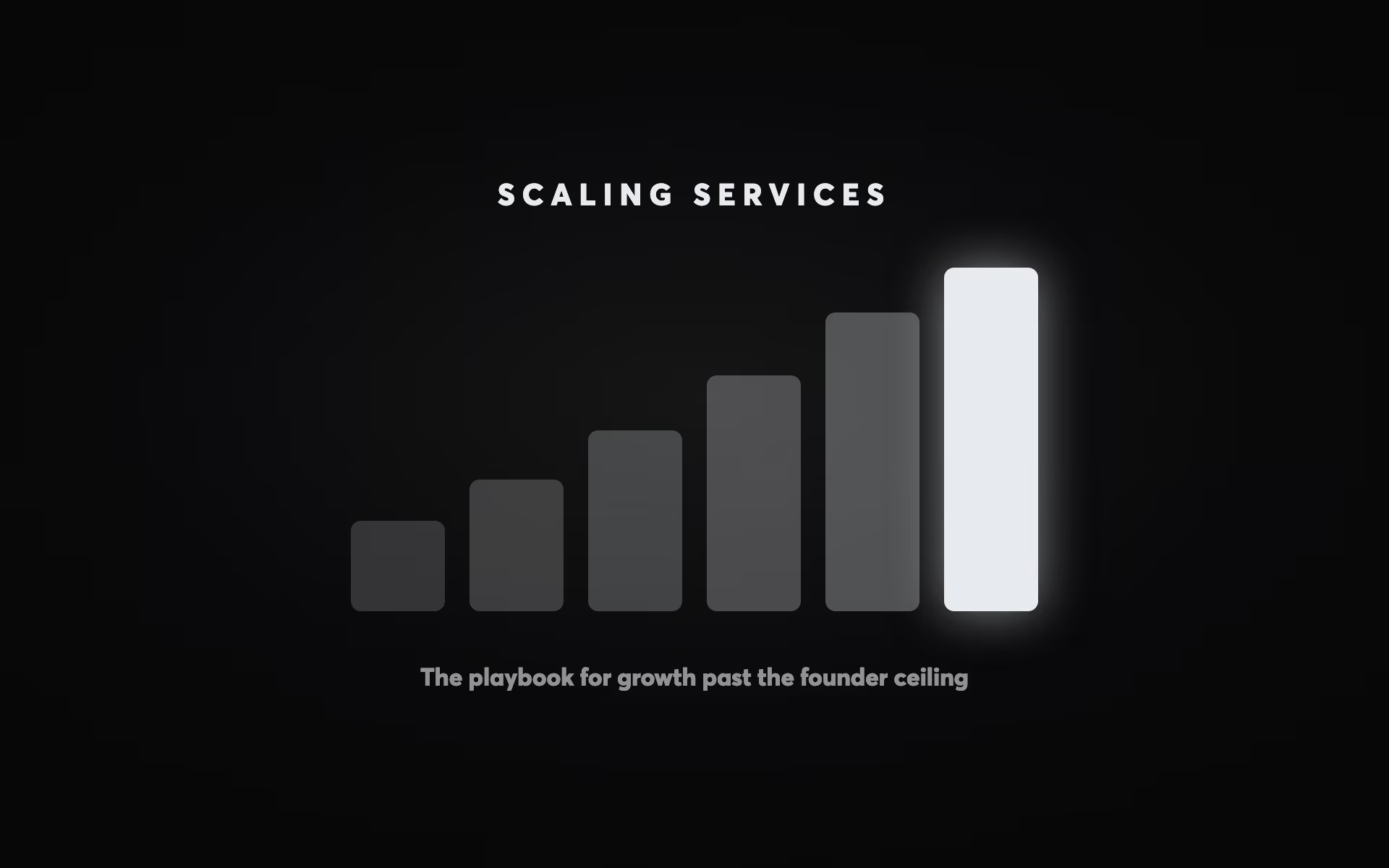
There's a ceiling that almost every professional services firm hits. The business grows to a point — usually somewhere between $500K and $2M in revenue — where the founder or senior partners are personally responsible for delivery quality on every client. New clients can't be onboarded without more senior time. Revenue can't grow without hiring. Margin compresses because the team grows faster than revenue. This is the founder bottleneck, and it's not a personnel problem — it's a structural one.
The firms that break through it don't just hire faster. They redesign the business: packaging bespoke expertise into repeatable service products, building delivery systems that work without constant senior intervention, using technology to multiply what a skilled team can output, and shifting pricing from time-based to value-based. The result is a firm that can grow revenue faster than headcount — the definition of scalable professional services.
This article maps the complete playbook for that transition, covering service productisation, team leverage frameworks, the 2026 AI advantage in delivery efficiency, and the pricing strategy shift that unlocks margin expansion. It sits within Involve Digital's broader business growth framework, connecting to our guides on client retention and revenue operations — because scaling delivery without retention and commercial infrastructure just fills a leaky bucket faster.
The Scaling Problem in Professional Services
Professional services firms face a growth constraint that product companies don't: revenue is fundamentally tied to time. Every hour of senior expertise delivered is an hour that can't be reused. Unlike a SaaS product that can be sold to the 10,000th customer at near-zero marginal cost, a consulting engagement or agency retainer requires human attention at every step.
This creates a characteristic growth ceiling. Analysis of SPI Research's 2026 Professional Services Maturity Benchmark — covering 509 organisations, 245,000+ employees, and $63B in PS revenue — reveals the industry is operating at an average maturity level of just 2.4 out of 5, with industry-wide billable utilisation at 66.4%, an all-time historic low. Project margins across the industry average 37.7%, while EBITDA has fallen to 9.9% — 28% below the five-year average. These numbers describe an industry under structural pressure.
But the top 20% of firms — the High Performance Organisations (HPOs) — tell a different story. They achieve 75% utilisation (versus the industry's 66.4%), project margins above 45% (versus the industry's 37.7%), and EBITDA of 27%+ at the highest maturity levels. The difference isn't primarily talent — it's systems, productisation, and technology adoption. Level 5 firms in the SPI maturity model achieve 55.8% project margins and $317K revenue per project, compared to Level 2 firms at 22.6% margins. Same industry, dramatically different economics.
The scaling gap is a systems gap. Firms that invest in delivery systems, technology leverage, and pricing architecture grow faster with better margins. Firms that don't hit the ceiling and either plateau or burn out their senior team trying to grow through it.
Service Productisation: The Foundation of Scale
Productisation is the process of taking bespoke, time-intensive services and converting them into repeatable, packageable offerings with defined scope, predictable delivery, and transparent pricing. It is the single most impactful structural change a professional services firm can make to enable scale — and in 2026, the competitive pressure to do it is intensifying.
BPM's Professional Services Industry Outlook for 2026 notes that "forward-thinking firms are packaging expertise into repeatable, scalable offerings" and that subscription models, managed services, and value-based pricing are becoming standard rather than alternative approaches. Firms that continue operating on fully bespoke, hourly-billed models are increasingly at a disadvantage on both cost (can't compete with productised competitors on price) and scalability (can't grow without proportional headcount increases).
The productisation framework has three stages:
Stage 1: Service Standardisation. Identify the 20% of your service portfolio that solves 80% of your clients' problems. Document the delivery process step by step — not as a loose methodology, but as a repeatable playbook that any trained team member can execute. Define the standard inputs you need from the client, the milestones, the deliverables, and the timeline. This standardisation is the foundation that makes delegation possible.
Stage 2: Service Packaging. Convert your standardised services into clearly named packages with defined scope, pricing, and outcomes. The most effective packaging structure follows a three-tier model: a foundation tier that covers the core problem, a transformation tier that adds implementation support and iteration (where 70–80% of clients should land), and a partnership tier at 150–180% of the transformation price that includes retainer access and strategic involvement. This packaging removes the endless custom quoting cycle and dramatically reduces the sales-to-close timeline.
Stage 3: Delivery Systemisation. Build the tools, templates, and automation that allow the packaged service to be delivered consistently. This means: client onboarding templates, delivery playbooks, reporting templates, quality checkpoints, and feedback loops. When a delivery system exists, junior team members can execute the routine work, senior people can focus on insight and relationship, and the firm can run more accounts per team member.
The case for productisation is also the case for margin expansion. SPI data shows that Level 2 firms (largely bespoke delivery) achieve 22.6% project margins. Level 4 firms (systematised, partially productised) break 48%. Level 5 firms reach 55.8%. The same expertise, packaged and systematised differently, produces dramatically different economics.
Team Leverage: Growing Revenue Without Proportional Headcount
Leverage in professional services means generating more revenue per person — either by increasing what each person can bill, reducing the cost per unit of output, or shifting the ratio of senior to junior staff while maintaining quality. The firms that scale successfully get better at all three.
Utilisation is the primary operational lever. At the industry average of 66.4% billable utilisation, there are approximately 14 hours per week per person being lost to non-billable activities — administration, internal meetings, unstructured time. HPO firms achieve 75% utilisation by aggressively automating administrative work, standardising internal processes, and building delivery systems that reduce prep time per project. Each percentage point of utilisation improvement at a day rate of $1,035 adds roughly $17,800 in annual revenue per consultant (SPI Research 2026). For a 10-person firm, moving from 67% to 73% utilisation is worth approximately $1M in revenue without a single new hire.
Delegation is the structural lever. Most professional services firms are over-indexed on senior time for routine delivery work. The scaling move is to systematise the routine elements of delivery so that junior and mid-level staff can execute them with high quality and light senior oversight. This requires: detailed delivery playbooks, quality checkpoints, training that gives junior staff real ownership, and senior time explicitly reserved for insight, strategy, and relationship — the work that actually requires their experience. HPO firms run 3.28 concurrent projects per consultant (versus the industry average of 4.15) — they carry lighter workloads per person while generating higher revenue because their systems make each project more efficient.
Revenue per employee is the composite metric. The 2026 SPI benchmark shows top-performing professional services firms generating $225K+ revenue per employee when using AI tools with measurable benefits in Finance and Operations, versus $203K for non-AI users. LinkedIn analysis puts the professional services benchmark at $150,000–$300,000 per employee, with industry leaders pushing above $300K. If your revenue per employee is below $120K, either your pricing is too low, your utilisation is too low, or both.
The AI Advantage in Delivery: Multiplying Output Without Headcount
The single biggest change in professional services scalability in 2026 is AI-enabled delivery leverage. For the first time, it's technically and economically feasible for a professional services firm to deliver significantly more client work per person — not by working longer hours or cutting quality, but by using AI tools to automate the routine cognitive work that fills up senior team members' time.
The numbers from McKinsey's research are striking: professional services leads all sectors in generative AI adoption, with implementation rates rising from 33% in 2023 to 71% in 2024. AI consulting is expected to account for 40% of professional services revenue by 2026, up from 20% in 2024. Firms typically capture only 10–20% of their potential pipeline due to staffing constraints — but AI-enabled delivery models could increase this to 70–90%.
In the SPI 2026 benchmark data, the proof is in the productivity numbers: firms with AI widely used in Finance and Operations generate $225K revenue per employee versus $203K for non-AI users — an 11% revenue-per-person advantage. Their EBITDA also runs at 24.2% versus 8.8% for non-AI users — nearly three times better profitability. These are not theoretical projections. They're observed outcomes across hundreds of professional services firms in 2025/2026.
The practical applications that deliver the most leverage in professional services delivery include:
Research and analysis automation. AI tools (Claude, ChatGPT, Perplexity) can compress hours of research and initial analysis into minutes. For consulting, strategy, and marketing firms, this directly reduces the hours required to onboard a new engagement and produce initial deliverables. Teams report AI tools saving 3–5 hours per person per week on research-intensive work — at scale, that's meaningful utilisation capacity.
Report and document generation. Generating first drafts of reports, proposals, strategy documents, and client communications from structured data or briefs. Senior team members move from writing to editing and refining — a fundamentally different (and faster) workflow. AI automation in professional services and technology teams improves operational efficiency by around 40%, with teams reporting 20–25% productivity improvements from AI integration.
Client communication management. AI tools can draft client emails, meeting summaries, and project updates from CRM notes and meeting transcripts. Account managers report reclaiming 4–6 hours per week previously spent on administrative communication tasks. AI-powered customer support and communication can resolve up to 80% of routine inquiries, cutting response times by around 60%.
Data analysis and reporting. Automated data pulls, analysis, and report population from integrated platforms. For digital marketing agencies, performance reporting that previously took 4–6 hours per client per month can be automated to 30–45 minutes with AI-assisted analysis layered in. This is covered in depth in Involve Digital's AI Implementation practice — see our business growth framework for how AI implementation connects to broader operational scaling.
The GenAI adoption data in professional services is unambiguous: firms that operationalise AI in delivery achieve substantially better economics than those still treating it as a productivity curiosity. The 12-month GenAI ROI in PS firms reached 13.3% in 2025, up 33% from the prior year — and this is the early innings of adoption, not the plateau.
Pricing Strategy: From Time-Based to Value-Based
Hourly billing is the most common pricing model in professional services and the one most hostile to scalability. When you bill by the hour, efficiency becomes a liability — working faster means earning less. AI tools that save 40% of delivery time hurt your revenue rather than helping it. Every improvement in your delivery capability is captured by the client in lower invoices, not by you in better margins.
The shift to value-based pricing is the pricing architecture that makes scalability commercially meaningful. Value-based pricing sets fees based on the outcome delivered to the client — not the time spent delivering it. A strategy engagement that generates $600,000 in savings for the client can be priced at $54,000–$90,000 regardless of whether it takes 40 hours or 80 hours to deliver. The firm captures the efficiency gain.
BPM's 2026 industry outlook identifies this shift explicitly: "Value-based pricing ties fees to strategic outcomes rather than hours worked, creating win-win scenarios where both firms and clients benefit from efficiency gains." Firms adopting value-based pricing report the ability to earn 2–3x more on the same work compared to hourly billing, with stronger client relationships because both parties are aligned on outcomes rather than debating time estimates.
The three-tier value-based pricing model creates a clear commercial architecture: the Foundation tier covers the core problem (entry point, lower-risk engagement), the Transformation tier adds implementation, iteration, and depth (your primary revenue tier at 70–80% of clients), and the Partnership tier provides ongoing retainer access at 150–180% of the Transformation price. This structure removes the single-option pricing dilemma — instead of 'yes or no' on one proposal, clients choose between three well-defined options.
The practical transition from hourly to value-based pricing requires three things: the ability to quantify the outcome you deliver (revenue generated, costs saved, time reclaimed), the confidence to have value discovery conversations before quoting, and productised service packages that make the scope clear enough to price without estimating hours. This is why productisation is the prerequisite for value-based pricing — you can't price an outcome you haven't defined.
For HPO firms, discount rates average 6.0% — 37% less discounting than the rest of the industry (9.6%). This is the commercial expression of pricing confidence: firms with clear value propositions and productised packages negotiate less because clients understand what they're buying and why it's worth the price.
The Growth Infrastructure: Pipeline Predictability
Operational scalability — great delivery systems, high utilisation, productised services — is only half of the scaling equation. The other half is commercial predictability: a consistent, measurable pipeline of new business that doesn't depend on founder relationship calls and doesn't operate in feast-or-famine cycles.
SPI Research's 2026 data shows HPO firms maintain pipeline coverage of 224% of quarterly bookings — they have more than twice their target revenue in active pipeline at any given time. The rest of the industry operates at 158%. This difference in pipeline coverage is why HPO firms hit revenue targets at higher rates (90.1% of firms hit revenue targets) and why they don't need to take poor-fit clients to make their numbers.
Building pipeline predictability for a professional services firm requires combining inbound and outbound systematically. The most effective model in 2026 for professional services lead generation combines three channels: SEO and content authority (high-intent organic search traffic from decision-makers actively researching solutions), LinkedIn thought leadership (positioning senior practitioners as credible voices in their niche), and referral systems built on the retention framework covered in our referral growth engine guide. These three compound over time and become self-reinforcing — unlike paid acquisition, which stops the moment spending stops.
The full B2B lead generation strategy for professional services is covered in our guide to building an automated lead generation system. The critical point for scaling is that pipeline predictability must be built before you saturate your delivery capacity — because once delivery is full, there's no bandwidth to build the inbound machine. Founders who wait until they need leads to build the system are always behind.
| Metric | Industry Average | HPO Benchmark | Context |
|---|
The 90-Day Scaling Sprint: From Founder Bottleneck to Operating System
The transition from founder-dependent delivery to a systematised, scalable professional services firm doesn't happen overnight — but it also doesn't take years. A focused 90-day sprint can transform the structural constraints that are limiting growth.
Month 1: Audit and Identify. Map your current service portfolio against the productisation readiness framework. Which services are most repeatable? Which have the highest margin? Which do you sell most frequently? These are your productisation candidates. Simultaneously, audit your team's time allocation — what percentage of senior time is spent on routine delivery versus insight and relationship? Where are the biggest delegation gaps? Run your scalability scorecard to identify the lowest-scoring dimensions and prioritise accordingly.
Month 2: Build Systems. Select your highest-volume service and build its delivery playbook from scratch: documented process, templates, quality checkpoints, and client communication frameworks. Create the three-tier pricing structure for this service and test it on the next 3–5 prospects. Identify one routine delivery task per team member that can be automated or AI-assisted and implement it. The goal is tangible evidence that systemisation works — not a theoretical framework.
Month 3: Implement and Measure. Run your first fully productised engagements through the new system. Track the key metrics: time per project, margin per project, client NPS, and team utilisation. Compare against your baseline. Identify what worked and what needs refinement. Begin building the pipeline infrastructure — content, SEO, or referral system — that will create the commercial predictability to support growth beyond current capacity.
This sprint is exactly what Involve Digital's Growth Plan Generator is designed to support. The tool takes your current business profile and generates a prioritised 12-month growth plan — covering the specific combination of operational, commercial, and marketing actions that will have the highest impact given your starting point.
For the complete strategic context — how operational scaling connects to lead generation, RevOps, and the full commercial system — see our guide on the complete business growth framework for digital-first companies. And if retention is the constraint rather than delivery capacity, our guide to client retention strategies for professional services covers the frameworks for protecting revenue while you scale.
Ready to build a professional services firm that scales revenue without scaling headcount at the same rate? The Growth Plan Generator creates a tailored, actionable growth plan for your business — covering productisation priorities, pricing strategy, team leverage, and the commercial infrastructure to support scale. Get your free growth plan with Involve Digital.
Get Started Using The Form Below
Scaling a professional services business is fundamentally about shifting from a model where your capacity limits your revenue to one where your systems multiply your capacity. The five levers — productisation, utilisation, delegation, AI leverage, and value-based pricing — all compound when applied together. For the full strategic picture, return to the complete business growth framework, and connect the operational foundations built here to the lead generation and retention systems that complete the growth loop.
Questions