Hero image for Meta Ads Strategy for B2B: Generating Quality Leads on Facebook & InstagramVintage rotary telephone in navy blue with gold accents on a black leather surface, with a digital glitch effect.Black and white photo of a pocket watch with chain, crystal glass, cigar on glass ashtray, leather gloves, and a closed wooden box on a dark surface.Various old rustic tools and gloves arranged on a wooden surface, including a saw, horseshoe, hammer, and a metal pitcher, with digital glitch distortion.

Meta Ads Strategy for B2B: Generating Quality Leads on Facebook & Instagram

l
l
o
r
c
S
Contact

Meta Ads Strategy for B2B: Generating Quality Leads on Facebook & Instagram

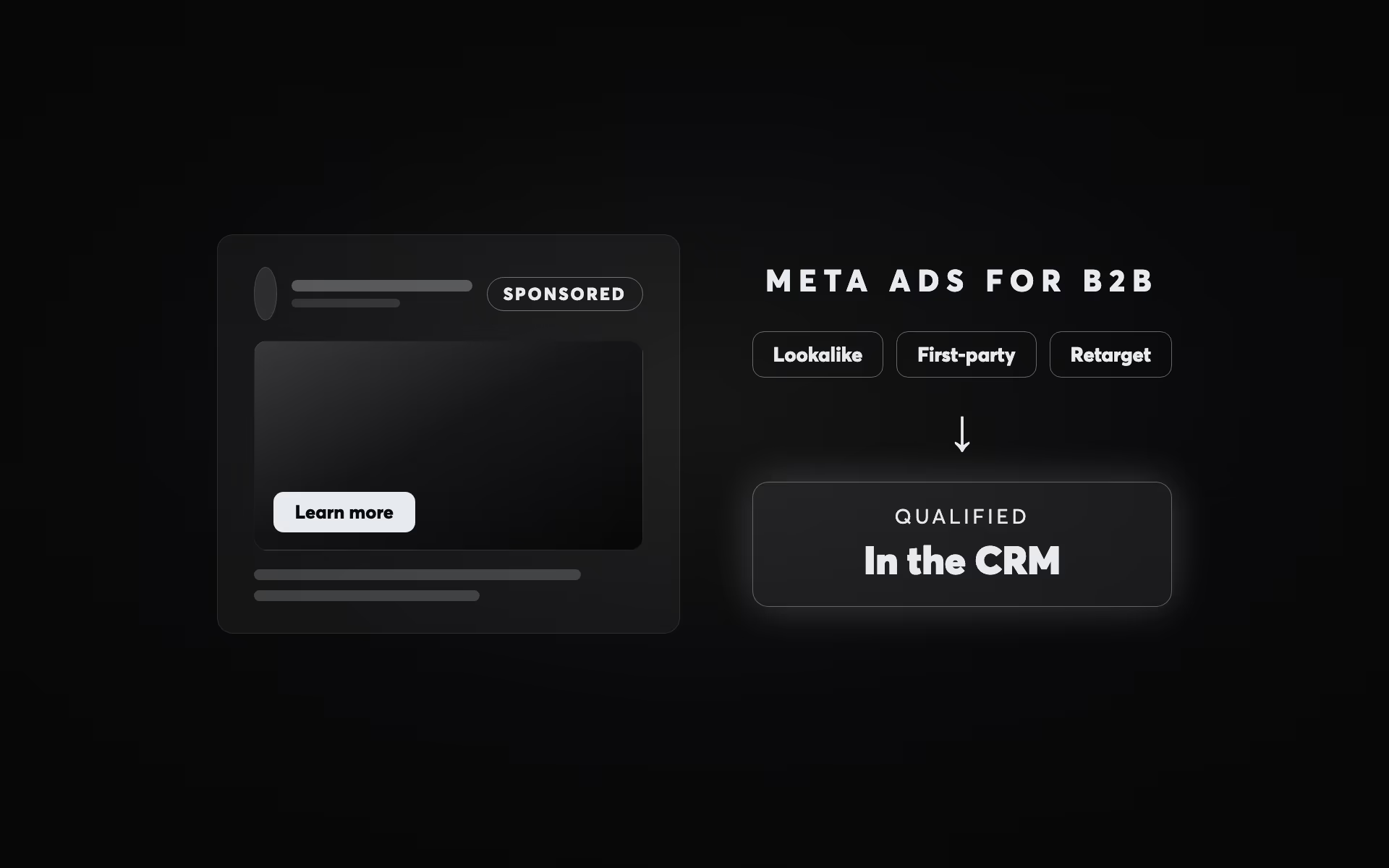
B2B marketers have a complicated relationship with Meta. The prevailing view is that Facebook and Instagram are consumer channels — fine for selling trainers and sunglasses, but not the right environment for selling professional services, software, or business solutions. The data tells a different story. Nearly half (48.5%) of business decision-makers use Facebook for B2B research, and for the right offers and targeting approaches, Meta generates leads at dramatically lower CPL than Google Search — typically 60–70% cheaper per raw lead.

The problem isn't that Meta can't work for B2B. The problem is that most B2B Meta campaigns are set up like B2C campaigns with professional services copy pasted in. They target broad interest audiences with no account-based structure, use generic ad creative that communicates nothing specific to a business buyer, measure success by CPL without accounting for lead quality, and lack any retargeting logic to nurture the long consideration cycles that B2B purchases require.

This guide covers the specific techniques that make Meta profitable for B2B in 2026 — from audience architecture and the Conversions API to creative frameworks and the full-funnel retargeting sequences that turn initial Facebook engagement into qualified pipeline. For the complete digital marketing picture, this article connects directly to our Digital Marketing Strategy Guide for 2026, which covers how Meta fits alongside Google Ads, email, and content in a full-stack strategy.

Why B2B Meta Campaigns Fail

Before covering what works, it's worth being direct about what doesn't — because the failure patterns in B2B Meta advertising are consistent and predictable.

Failure Pattern 1: Interest-only targeting for professional audiences. Meta's interest targeting is built around consumer behaviour signals: pages liked, content engaged with, purchase history. When B2B marketers select interests like "Business Management" or "Entrepreneurship", they're capturing an audience that includes business owners, students studying business, journalists writing about business, and millions of people who once liked a business-related Facebook page. The resulting audience is broad, low-intent, and expensive to convert to qualified leads.

Failure Pattern 2: Driving cold traffic directly to a demo request or consultation page. A business decision-maker seeing a Facebook ad for the first time has no existing relationship with your brand. Asking them to book a call is a high-friction request from a zero-trust starting point. The conversion rate will be low, the CPL will be high, and the perceived value of the channel will be poor — even though the problem is the offer architecture, not the platform.

Failure Pattern 3: No retargeting infrastructure. B2B sales cycles are measured in weeks to months, not hours. A campaign that only runs prospecting ads to cold audiences misses the entire consideration and decision stages of the buyer journey, where the highest-intent conversions happen. Without retargeting, you pay to get someone's attention and then lose them to competitors who do have retargeting sequences in place.

Failure Pattern 4: Optimising for lead volume, not lead quality. Meta's algorithm is excellent at optimising for the conversion event you give it. If you optimise for form submissions and your form submissions include a high proportion of job seekers, students, and irrelevant contacts, the algorithm will find more of those people. Without feeding qualified lead data back to Meta, you're training the algorithm to find the wrong audience. The result is a funnel full of cheap, useless leads.

Failure Pattern 5: No Conversions API implementation. iOS 14.5 changes in 2021 began a multi-year process of signal loss for Meta advertisers, accelerated by browser privacy changes and ad blockers. Advertisers running only the Meta Pixel are now tracking only 60–70% of actual conversions on average. With the algorithm making decisions based on incomplete data, optimisation is systematically miscalibrated. Implementing the Conversions API restores tracking accuracy to approximately 95%, fundamentally improving algorithm quality.

Each of these failure patterns has a specific solution. The following sections address them in sequence, building toward a complete B2B Meta Ads system.

Audience Architecture for B2B on Meta

The audience question is where B2B Meta strategy diverges most sharply from the standard playbook. Because Meta's professional targeting options are less precise than LinkedIn's (which allows filtering by job title, company, and seniority level directly), B2B advertisers on Meta need to construct their audiences through layering and first-party data rather than relying on platform-side targeting alone.

First-Party Data Audiences: The Foundation

The highest-quality B2B audiences on Meta come from your own data, not Meta's targeting options. Upload your CRM contacts, email subscribers, and past customers to create Custom Audiences. CRM list uploads to Meta typically achieve a 60–80% match rate — Facebook matches hashed contact data against its user database to identify the corresponding accounts. This gives you a precision audience that's impossible to replicate through interest targeting.

Segment your CRM uploads by relationship stage:

A Customer List of your existing clients — useful as a suppression list (exclude from prospecting) and as the seed for Lookalike Audiences that find similar companies.

An Active Leads List of contacts currently in your pipeline — useful for retargeting with deal-specific content or case studies relevant to their evaluation stage.

A Cold Prospect List of contacts from ABM target accounts who haven't engaged yet — useful for warm prospecting with relevant outreach via Meta's reach-efficient inventory.

An Inactive or Lost Deals List of contacts from deals that closed-lost — useful for re-engagement campaigns timed to common contract renewal cycles (often 12–18 months after a lost deal).

Lookalike Audiences from CRM Data

Once your Customer List is uploaded, build Lookalike Audiences starting from your best customers, not all customers. If your top 20% of clients by revenue generate 80% of your profit, a Lookalike Audience built from those 20% will produce systematically better results than one built from your full customer list. Meta's machine learning analyses the characteristics common to your seed audience and identifies users across its network who share similar attributes.

Research consistently shows lookalike audiences outperform interest targeting by 25–40% in CPC and CPL for B2B campaigns. The reason is precision: interest audiences are self-selected (people who liked a business-related page), while lookalike audiences are predictive (people whose behaviour patterns match your actual buyers). Regularly update your source lists — adding new customers quarterly — to keep lookalike models current as your customer base evolves.

For B2B accounts with small customer lists (under 100 records), use alternative high-quality seeds: your website's contact form completers, people who watched 50%+ of a video ad, or your email newsletter subscribers who have high open rates. Any seed that represents genuinely engaged or qualified people will produce a better lookalike than a broad list of anyone who ever interacted with your brand.

Interest Layering for Professional Audiences

Interest targeting alone is insufficient for B2B, but it can supplement first-party data audiences in prospecting campaigns, particularly for reaching decision-makers who aren't yet in your CRM. The technique is layering — stacking interest and behaviour filters to narrow an audience toward a more qualified profile.

For a B2B software company targeting operations directors at mid-market companies: start with an interest category related to business software, layer in the job title or seniority interest filters Meta provides (imprecise but directionally useful), and exclude audiences that contain known consumer segments (parents of young children, student interests) if your ICP doesn't include those demographics. The resulting audience is less precise than LinkedIn's job title targeting but reaches a significantly larger potential audience at a CPM of roughly $4 for B2B SaaS — compared to LinkedIn's $25–$60 CPM for equivalent professional targeting.

Advantage+ Audience in 2026

Meta's Advantage+ campaigns represent the platform's push toward full automation — where the algorithm makes all audience decisions based on creative content and conversion data rather than explicit targeting inputs. For B2B, this is more nuanced than for B2C ecommerce where Advantage+ has delivered consistent wins.

Meta's own data shows Advantage+ campaigns delivering a 22% increase in ROAS compared to manual setups on average. However, that average is dominated by ecommerce and high-volume B2C accounts. For B2B accounts with low conversion volume and long sales cycles, Advantage+ needs enough optimization events (approximately 50 conversions per week) to learn effectively — a threshold most B2B campaigns don't reach on a weekly basis. The recommendation for most B2B Meta advertisers in 2026 is to use Advantage+ selectively: test it against manual campaigns once you have conversion volume, and retain manual targeting for retargeting sequences where audience precision matters most.

B2B Meta Audience Strategy Builder
Select your B2B targeting parameters to get a recommended audience layering strategy with estimated reach and CPL guidance.

The B2B Meta CPL Reality Check

Before building your Meta B2B strategy, understanding realistic CPL benchmarks by industry prevents the common mistake of abandoning the channel when early CPL numbers look high relative to uninformed expectations.

The 2026 Meta Ads CPL benchmark data shows significant variance by industry and lead quality level. The average cross-industry Meta CPL increased approximately 20% in 2025, reaching around $27.66 for general lead generation campaigns. But that average conceals the full picture for B2B specifically:

For B2B SaaS, raw lead CPL averages $63.40, but qualified leads (MQLs and SQLs) cost $150–$250, demo requests $80–$250, and free trial signups $30–$80. Enterprise SaaS qualified leads can reach $350–$550 per lead. These numbers sound high until compared to the alternative — B2B SaaS paid CPL across all channels averages $310 according to First Page Sage research covering 2022–2025, making Meta's $63.40 average look competitive for raw volume even at a lower qualification rate.

For professional services, CPL ranges from $25–$70 on Meta, rising to $315+ for high-end consulting services. Compare this to Google Search, where high-intent professional services keywords carry CPCs of $15–$80 and conversion rates of 2–5%, implying CPLs of $300–$4,000 per qualified lead on paid search. Meta's lower CPL requires more qualification work downstream, but the economics can strongly favour Meta when your sales team has a systematic qualification process.

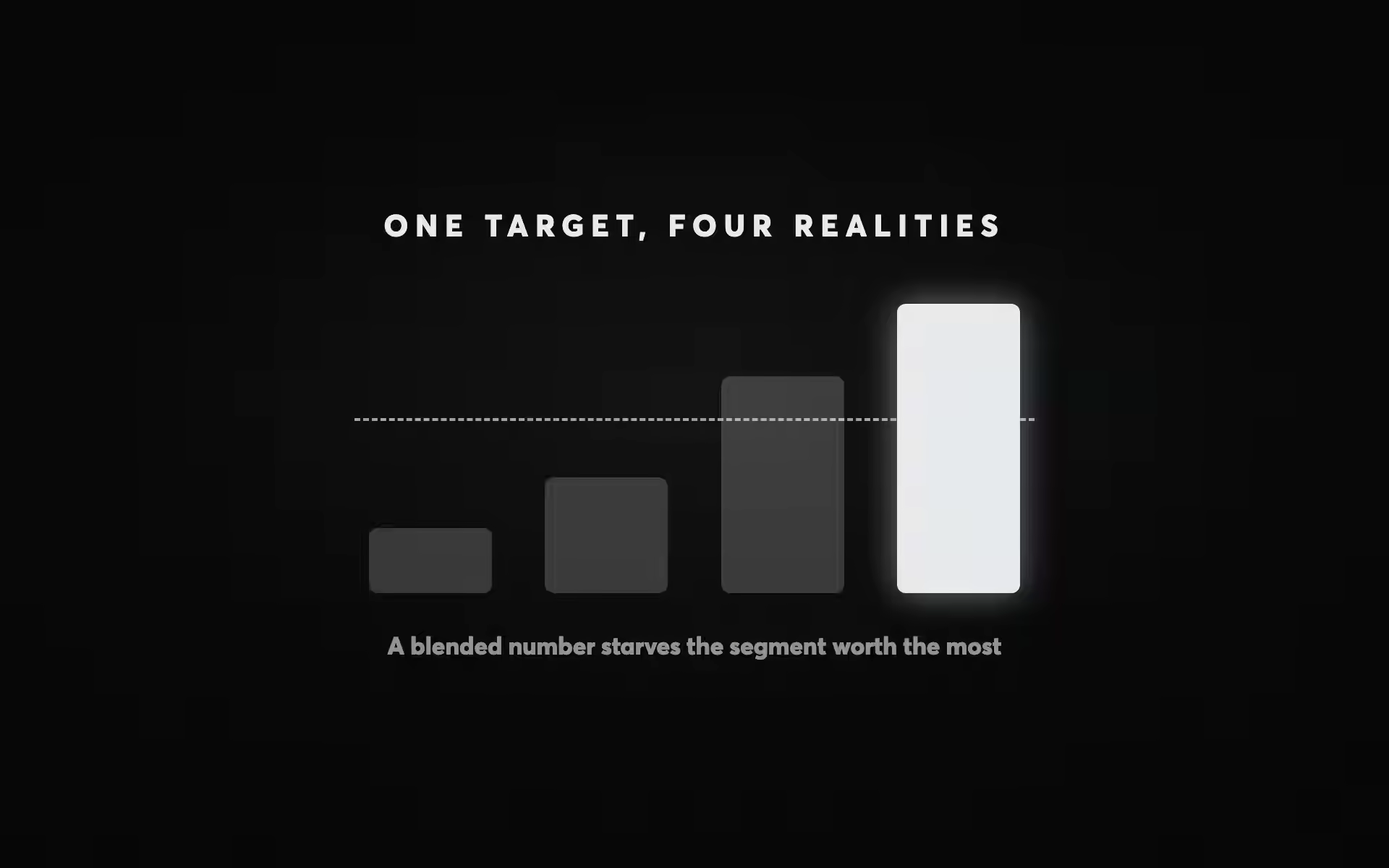
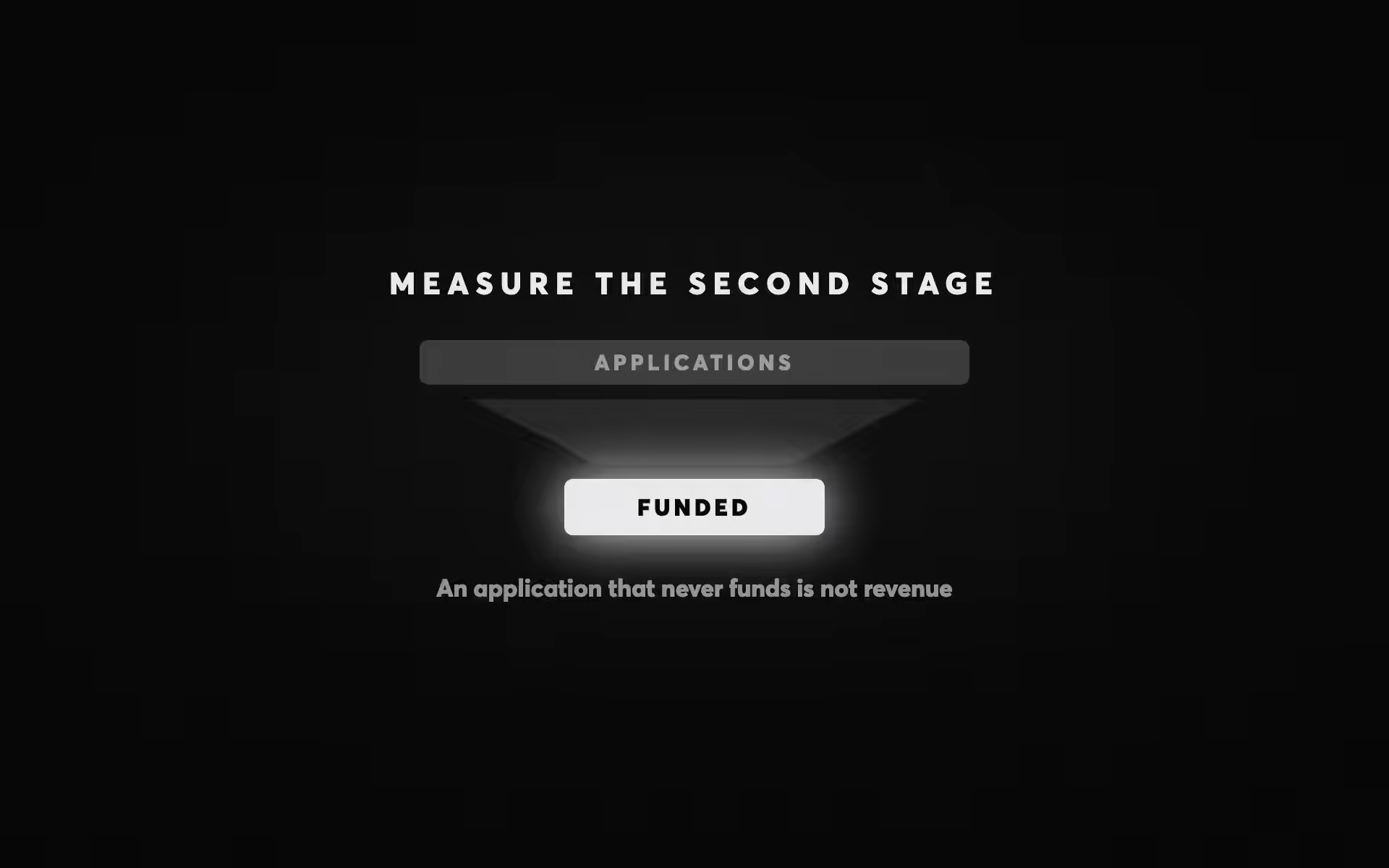
The key insight: Meta CPL should always be evaluated at the qualified lead or customer acquisition level, not the raw lead level. A $30 CPL that produces a 2% qualification rate costs $1,500 per qualified lead. A $90 CPL that produces a 15% qualification rate costs $600 per qualified lead. The higher-CPL approach is more efficient despite the apparent cost disadvantage. This is why tracking setup — particularly Conversions API and offline conversion imports — determines whether your Meta B2B strategy succeeds or fails.

Lead Ads vs Landing Pages: The Quality-Quantity Trade-off

The choice between Meta Instant Forms (Lead Ads) and driving traffic to landing pages is one of the most important decisions in B2B Meta strategy. Both approaches have legitimate use cases, and the data on their performance characteristics helps clarify when to use each.

A WordStream analysis of 3,000+ campaigns covering $9.5 million in ad spend found that Facebook Lead Ad conversion rates average 12.54% compared to 10.47% for landing pages. Lead Ads produce more completions at lower cost per submission — on average 30–50% cheaper per raw lead. The friction reduction is the mechanism: users never leave Facebook, the form is pre-filled with their profile data, and the completion requires minimal effort.

That advantage disappears when you examine lead quality. The same pre-fill mechanism that drives higher completion rates also drives accidental submissions — users who complete the form without genuine intent because it required almost no effort. A clinical case study comparing the two approaches found Lead Ads generating leads at $6 each with a 2% appointment conversion rate ($300 per appointment), versus landing page leads at $18 each with a 17% appointment conversion rate ($106 per appointment). The "cheaper" Lead Ad option was three times more expensive per qualified outcome.

When to Use Lead Ads

Lead Ads are the right choice when: your offer has low friction and wide appeal (free guides, newsletters, webinar registrations, free tool access); your follow-up process is fast — leads contacted within five minutes are nine times more likely to convert than those contacted after 30 minutes, and the average business takes 47 hours to follow up; your CRM integration is immediate so lead data flows directly into your sales sequence without manual processing; and your qualification happens via phone call or email rather than through the form itself.

When to Use Landing Pages

Landing pages are better for B2B offers that require some level of qualified intent: demo requests, free consultations, discovery calls, or any conversion where the quality of the contact matters more than the volume. The extra friction of leaving Facebook self-selects for users who are genuinely interested enough to complete the additional step. Landing pages also allow you to present more information, use social proof elements (testimonials, client logos, case studies), and control the entire user experience rather than being constrained by Meta's form design limitations.

For high-ticket B2B services ($10,000+ contract values), landing pages with multi-step qualifying questions typically outperform Lead Ads on a cost-per-qualified-lead basis, even when the raw CPL is 3–5x higher. Add qualifying questions to the form that naturally filter out non-ideal prospects — asking about company size, current challenges, or timeline signals intent without being off-putting to genuinely interested buyers.

The Conversions API: Why It's Non-Negotiable for B2B in 2026

The Meta Conversions API (CAPI) is the most important technical setup for any B2B Meta advertiser in 2026. Without it, you're running campaigns on fundamentally incomplete data, and the algorithm is optimising based on a biased picture of your actual conversions.

The mechanism: Meta's standard Pixel tracks conversions by firing a browser-side event when a user completes a goal action on your website. This works until the user's browser blocks the pixel (ad blockers, Safari's Intelligent Tracking Prevention), their iOS privacy settings limit cross-app tracking, or a network issue prevents the pixel from firing. The result is that Pixel-only tracking captures only 60–70% of actual conversions — missing 30–40% of the data that the algorithm uses to decide who to show your ads to.

CAPI creates a direct server-to-server connection between your website and Meta, sending conversion events from your server rather than the user's browser. Browser blocking doesn't affect server-sent events. The result is that CAPI + Pixel combined tracks approximately 95% of actual conversions — restoring the data quality that the algorithm needs to make good decisions. Advertisers who implement CAPI report seeing their tracked conversion volume increase 30–50% as previously invisible conversions become visible, improving algorithm optimisation quality substantially.

For B2B specifically, CAPI has an additional capability that Pixel alone can't deliver: offline conversion tracking. When a B2B lead from Meta progresses through your sales pipeline, you can send CRM events (Lead Qualified, Opportunity Created, Deal Won) back to Meta via CAPI. This trains the algorithm to find users who don't just fill out forms — they become customers. The algorithm learns the upstream signals that predict downstream conversion, and begins finding audiences that match your customers, not just your form completers.

CAPI implementation requires a developer or a CRM/CDP integration. Major platforms (HubSpot, Salesforce, Klaviyo, Zapier, and others) offer native CAPI integrations that reduce implementation complexity. For most B2B companies, the time investment pays back within weeks in improved lead quality and algorithm efficiency.

B2B Meta Ads Funnel Planner
Select a funnel stage to see the recommended campaign structure, creative formats, audiences, and KPIs for each stage of a B2B Meta funnel.
Stage 1 — Awareness
Campaign Objective
Awareness or Video Views. Optimise for reach and video completion rather than immediate conversion.
Audience
Lookalike audiences (1–3%) from customer list. Interest + behaviour layering for your ICP. Exclude existing leads and customers.
Creative Formats
Video: 30–60 sec problem/insight content. Carousels: multiple insight cards. Single image: bold stat or provocative question. Goal: stop the scroll, communicate one clear idea.
Messaging Angle
Problem identification, industry insights, "you're not alone" empathy content. Never a hard sell at this stage — you haven't earned trust yet.
Primary KPIs
CPM, video completion rate (target 25%+), reach, frequency (2–4x for ToF)
Budget Allocation
30–40% of total Meta B2B budget. Seeds retargeting pool. Lower CPM than conversion campaigns = efficient awareness building.
Stage 2 — Consideration
Campaign Objective
Traffic or Engagement for content; Lead Generation for gated assets. Warming audiences toward conversion.
Audience
Video viewers (25%+ completion, 30–90 days). Website visitors (30–60 days). Engagers of your page or ads. Exclude converters.
Creative Formats
Instant Forms for guides/reports/webinars. Video case studies and testimonials. Carousels for multi-step proof (before/after, ROI examples, client results).
Messaging Angle
Solution education, social proof, "results like yours" case studies. Low-friction lead gen: guides, checklists, webinar registrations. Starting to introduce your brand as the solution.
Primary KPIs
CPL (guide/webinar), lead form completion rate (target 10–15% for Instant Forms), link click CTR (target 0.8–1.2%)
Budget Allocation
40–50% of total budget. Primary lead generation stage for B2B. Feeds qualified audience into BoF retargeting.
Stage 3 — Conversion
Campaign Objective
Conversions (demo, consultation, proposal request). Optimise for highest-value conversion action using CAPI-fed offline events if possible.
Audience
Pricing page visitors (last 14 days). Service page visitors (last 30 days). MoF lead form completers. Active leads from CRM. Tight windows = highest intent.
Creative Formats
Single image/video with direct CTA. Testimonials from recognisable companies/logos. Risk-reduction messaging (free consultation, no obligation, money-back guarantee). Dynamic creative testing 3–4 variants.
Messaging Angle
Address specific objections (risk, time, cost). Social proof from similar clients. Clear value proposition and offer. Urgency where genuine (limited availability, deadline).
Primary KPIs
CPL (demo/consultation), CTR (target 1.2–1.8% for retargeting), conversion rate on landing page (target 15–25% for warm traffic)
Budget Allocation
20–30% of total budget. Smaller audiences but highest conversion efficiency. Frequency caps (3–5x) prevent ad fatigue on tight retargeting windows.
Re-engagement & Winback
Campaign Objective
Conversions or Lead Generation for winback. Target past leads who didn't convert and lost deals approaching renewal windows.
Audience
Lost deals (60–180 days post-loss). Inactive leads (90+ days no activity). Lapsed customers (12+ months since last purchase). Time-based audience windows aligned to contract cycles.
Creative Formats
"What's changed" video — new features, results, proof points since last contact. Case studies from companies they recognise. New offer or risk-reduction incentive not present in original pitch.
Messaging Angle
Acknowledge time has passed. Lead with what's new or different. Remove the original objection if known. Reintroduce at a lower-commitment entry point.
Primary KPIs
Re-engagement rate, CPL vs original CPL (should be lower), pipeline reactivation rate from CRM
Budget Allocation
10–15% of total budget. Often the highest ROI activity — these contacts already know you. Particularly valuable for subscription and retainer businesses.

Creative Strategy for B2B Meta Ads

Creative is the most variable element of Meta performance — and the most frequently underinvested in B2B Meta campaigns. While B2C advertisers have learned that creative quality is the primary performance differentiator on Meta, B2B advertisers often default to static graphics with a headline and logo, treating Meta like a billboard rather than a conversation platform.

The Creative Framework for B2B

Effective B2B Meta creative follows the same fundamental principle as effective B2B content: it must address a specific, recognisable pain point that your target audience experiences in their professional role. Generic messaging about "growing your business" or "improving efficiency" doesn't stop a scroll. Specific, credible, relevant claims do.

The hook is everything. In Meta's feed environment, you have less than three seconds to prevent a user from scrolling past your ad. For B2B audiences, the most effective hooks fall into four categories:

Specific data points: "73% of professional services firms say lead quality is their biggest paid media challenge" — if the number is accurate and relevant, business decision-makers stop to read because it validates a problem they're experiencing.

Contrarian statements: "Your Google Ads campaigns are probably measuring the wrong things" — challenges an assumption the audience holds, creating cognitive dissonance that demands resolution.

Direct qualification: "If you're spending $5,000+ per month on Google Ads and not running offline conversion tracking, you're optimising for the wrong leads" — immediately tells the target audience whether this message is for them.

Peer validation: Client result claims with specific metrics and recognisable context ("[Company type] reduced their CPL by 40% in 90 days") — social proof from a recognisable peer context is highly compelling for risk-conscious B2B buyers.

Video Creative for B2B

Video is increasingly the highest-performing creative format on Meta across both B2B and B2C — video ads see 10–15% view-through rates at 25% completion benchmarks. For B2B specifically, there's nuance: B2B buyers watch longer video when it delivers clear, concrete value (evidence, methodology, proof) rather than brand storytelling. A 90-second case study walkthrough with specific numbers will outperform a 30-second brand awareness video for converting B2B consideration traffic.

Effective B2B video formats include: talking head content from founders or senior team members (authenticity beats production value for B2B trust-building), screen recordings demonstrating software or process (particularly effective for SaaS), client testimonial interviews (specifically naming the result, not generic praise), and problem walkthroughs that describe a common scenario the target audience recognises and then pivot to the solution.

Video production doesn't need to be expensive for B2B Meta. Clean audio, good lighting, and a clear, specific script consistently outperform expensively produced generic content. The B2B buyer is evaluating credibility and competence, not production polish.

Creative Fatigue and Refresh Cadence

Meta creative fatigues faster than most B2B advertisers expect. At meaningful spend levels, an audience seeing the same ad more than 3–5 times in a two-week period shows declining CTR and increasing CPL — the signal that creative refresh is needed. For prospecting audiences, refresh creative every 2–4 weeks at a minimum. For retargeting audiences (smaller pools, higher frequency), refresh creative every 1–2 weeks.

The practical approach: always have 4–5 creative variants running per campaign, using Meta's Dynamic Creative feature to automatically serve the best-performing combination of headlines, images, and body copy. This extends the effective lifespan of each creative concept while providing statistically meaningful data on which elements drive performance.

B2B Meta Benchmarks: What Good Looks Like in 2026

Understanding benchmark ranges for B2B Meta performance helps calibrate expectations and identify where improvement is possible. The following benchmarks reflect 2025–2026 data from B2B-focused Meta advertising:

CTR benchmarks: Prospecting campaigns typically achieve 0.6%–1.0% CTR; retargeting campaigns frequently hit 1.2%–1.8% CTR due to higher intent from pre-existing brand exposure. Lead generation objective campaigns average 2.53% CTR across all industries — the highest objective CTR on the platform, reflecting the platform's optimisation for engaged, conversion-intent users.

Conversion rate benchmarks: B2B landing page conversion rates for warm traffic run 3%–8% depending on offer quality and targeting precision. Meta Instant Forms convert at approximately 10%–15% after click for well-configured forms. Landing pages receiving cold traffic typically convert at 1%–3%.

CPL benchmarks by industry (2026): B2B SaaS $63.40 average ($150–$250 for qualified leads). Professional services $25–$70 on average. Legal services $72.40. Finance $58.70. Healthcare $41.60. Home services $34.00. These represent raw lead CPLs — qualified lead CPLs are 2–4x higher across all verticals.

CPM benchmarks: B2B SaaS CPM runs around $4.00 on Meta — significantly lower than LinkedIn ($25–$60 CPM for professional targeting). This CPM advantage is why Meta generates cheaper raw leads than LinkedIn even with lower targeting precision: the economics of cheap impressions delivered to a partially relevant audience can outperform expensive impressions delivered to a precisely relevant audience depending on your offer's conversion rate at each stage.

B2B Meta Ads Benchmarks — 2025/2026
Filter by metric category. All figures represent B2B-oriented campaigns. General consumer benchmarks will differ.
MetricBenchmarkContext
Sources: AdAmigo Meta CPL Benchmarks 2026 · Lever Digital B2B Meta Stats 2026 · AmpiFire Social CPL Comparison 2025 · Focus Digital Facebook CTR Report 2026 · LeadSync Lead Ads vs Landing Pages Study 2026 · Meta Automated Ads Analysis 2026

Retargeting Sequences That Convert B2B Prospects

A single ad exposure rarely converts a B2B prospect. The consideration cycle for business purchases is measured in weeks to months, involving research, internal discussions, competitive evaluation, and risk assessment. A retargeting sequence addresses this reality by maintaining visibility throughout the consideration cycle with progressively more relevant and conversion-focused messaging.

The Time-Based Retargeting Architecture

0–14 days (hottest): Prospects who visited your website in the last two weeks are your highest-intent retargeting audience. Serve direct conversion offers: demo booking, consultation scheduling, or a specific case study relevant to the pages they visited. Frequency can be higher here (3–5 impressions per week) without causing fatigue, because the offer is highly relevant to recent behaviour. If they visited your pricing page, serve a "let's talk numbers" style ad. If they visited a specific service page, serve a case study from a similar client.

15–30 days (warm): Slightly cooler but still engaged. Serve social proof content — testimonials from companies similar to theirs, specific result claims, or "how we work" content that builds confidence in your process. The goal here is maintaining brand visibility and providing incremental trust-building information rather than pushing for immediate conversion.

31–90 days (nurture): Longer-window retargeting for the consideration and research phase. Serve thought leadership content, industry insight pieces, and comparison content that positions your approach against alternatives. At this stage, you're maintaining presence in a buyer journey that may still be 4–8 weeks from decision. The offer can be lower-commitment: a guide download, webinar invitation, or newsletter signup that keeps them in your ecosystem.

91–180 days (reactivation): For audiences who engaged but never converted, reactivation campaigns with a fresh angle — new case studies, product updates, or seasonal offers relevant to their business cycle. Many B2B purchases are driven by timing triggers (budget approval, contract renewals, team changes) that may not have been present during initial engagement.

Segmented Retargeting by Engagement Signal

Match retargeting messages to engagement signals rather than treating all retargeting audiences as a single group:

Pricing page visitors: They're evaluating cost. Address the ROI and payback period in your ad — "Our average client sees $X in savings/revenue within Y months" is more relevant than a generic testimonial.

Feature/service page visitors: They're evaluating fit. Serve a case study from a business like theirs that uses exactly the feature or service they researched.

Blog readers: Earlier in consideration. Serve a higher-value lead gen offer (downloadable guide, webinar) that progresses their research journey rather than asking for a purchase decision they're not ready for.

Form abandoners: High intent, something stopped them. Simplify the offer — offer a lower-commitment alternative to whatever form they abandoned, or address the objection that most commonly stops form completions in your category.

Advantage+ Campaigns for B2B: When and How

Meta's Advantage+ represents the platform's push toward full automation — all audience, placement, and creative decisions handled by Meta's AI rather than advertiser inputs. The headline claim is compelling: internal Meta data shows Advantage+ campaigns delivering 22% better ROAS than manual campaigns. But for B2B specifically, the conditions under which Advantage+ outperforms manual targeting are narrower than the platform implies.

Advantage+ works best when there is sufficient optimization event volume for the algorithm to learn quickly (typically 50+ conversions per week), when audiences are broad and the business model is high-volume (ecommerce, subscription services), and when creative variety is provided to allow meaningful testing within the automated framework. Most B2B campaigns don't meet the conversion volume threshold — a B2B SaaS company generating 20–30 qualified leads per week from Meta doesn't provide enough signal for the Advantage+ algorithm to reliably identify the conversion patterns that matter.

The recommended 2026 approach for B2B: test Advantage+ against your best-performing manual campaigns with identical budgets over a 4-week period. If Advantage+ delivers equivalent or better qualified lead CPL, adopt it for prospecting. Retain manual targeting for retargeting sequences where audience precision (specific page visitors, CRM segments) is the mechanism of relevance. The two approaches are not mutually exclusive — many accounts benefit from Advantage+ for prospecting and manual control for retargeting.

Account Structure Best Practices for B2B Meta

B2B Meta account structure should follow a logical funnel architecture with clear separation between cold and warm audiences, and between campaign objectives at each stage.

Campaign-level budget allocation: Use Campaign Budget Optimisation (CBO) for prospecting campaigns where Meta's algorithm should allocate budget across multiple ad sets. Use Ad Set Budget Optimisation (ABO) for retargeting campaigns where you want direct control over how much is spent on each specific retargeting audience. For a typical B2B account: 40–50% of budget to a prospecting CBO campaign; 30–40% to a consideration campaign targeting video viewers, engagers, and website visitors; 20–25% to conversion retargeting targeting high-intent signals.

Exclusion management: Always exclude current customers from prospecting campaigns to avoid wasting acquisition budget on already-converted accounts. Exclude active leads from prospecting once they enter your CRM pipeline. Exclude recent converters (past 30–60 days) from conversion retargeting to avoid redundant ad spend on people who have already taken the desired action.

Creative testing structure: Run 4–5 creative variants per campaign using Dynamic Creative. After 2 weeks, pause the lowest-performing variant and introduce a new one. This creates a rolling creative refresh cycle that prevents fatigue without requiring complete campaign rebuilds.

B2B Meta Ads Setup Checklist
Assess your Meta B2B setup across tracking, audience, creative, and funnel structure. Check off what's in place.
Score: 0 / 0

Measuring B2B Meta Ads: The Right Metrics at Each Funnel Stage

The most common B2B Meta measurement mistake is evaluating the channel purely on raw CPL, then deciding Meta "doesn't work" when CPL looks high compared to expectations. Proper B2B Meta measurement requires tracking at multiple funnel levels and attributing final business outcomes — pipeline created, deals won, revenue generated — back to Meta's contribution.

At the awareness stage, the right metrics are CPM, video completion rate (25%+ is strong for B2B), reach, and frequency (2–4 impressions per week is the sweet spot for ToF — below this, reach is too thin; above this, you're fatiguing the audience). The awareness stage's primary deliverable is a retargeting pool, not immediate conversions.

At the consideration stage, track CPL for lower-friction offers (guide downloads, webinar registrations), Instant Form completion rate (10%–15% is healthy), and lead quality signals — are these the right job titles and company sizes? If not, the targeting or offer needs adjustment before moving these leads to conversion retargeting.

At the conversion stage, track demo or consultation CPL, landing page conversion rate (15–25% is achievable for well-targeted warm traffic), and frequency (3–5 impressions per week for tight retargeting windows without causing fatigue).

At the business level, track Meta-attributed pipeline value (deals influenced or sourced from Meta leads), Meta-attributed revenue (closed deals from Meta leads), and CPL at the qualified lead level (MQL, SQL, Opportunity) rather than raw lead level. These metrics require CRM integration and offline conversion tracking via CAPI — which is precisely why those technical setups are the foundation of any B2B Meta investment worth making.

Meta vs LinkedIn vs Google: The B2B Channel Comparison

Meta doesn't exist in isolation — most B2B advertisers run Meta alongside Google Ads and LinkedIn, and the allocation question (how much to each platform) is one of the most important strategic decisions in B2B paid media.

The fundamental differences: Google Ads captures intent — users actively searching for solutions are further along the buying journey and closer to conversion. LinkedIn provides professional precision — job title, company, and seniority targeting are unmatched, but CPMs of $25–$60 and CPCs approaching $100+ in competitive B2B categories make it the most expensive lead generation channel for high-value enterprise targets. Meta provides reach efficiency — CPMs of $4–$8 for B2B audiences, access to decision-makers outside their professional context (evenings, weekends, personal device usage), and remarkably capable lookalike and interest targeting when combined with strong first-party data.

The recommended allocation framework for most B2B businesses: Google Ads for intent capture (the channel for high-intent search traffic from prospects actively researching your category), Meta for awareness and retargeting (building brand familiarity at lower cost, retargeting website visitors across the consideration cycle), and LinkedIn for targeted account-based outreach (when you have specific target accounts or job titles that justify the premium CPM for precise audience access).

Our Social Media Advertising Strategy for NZ Businesses covers platform-by-platform benchmarks and allocation frameworks in more detail, including NZ-specific audience sizes and CPM benchmarks. Our Google Ads for B2B SaaS guide covers the intent-capture side of the equation, and our Campaign Optimisation Guide provides the systematic framework for improving performance across all channels simultaneously.

NZ-Specific Considerations for B2B Meta

New Zealand's smaller market size creates specific dynamics for B2B Meta advertising. Total addressable Meta audiences for B2B targeting in NZ are smaller — a Lookalike Audience built from 200 NZ customers will produce a total audience pool of 50,000–150,000, compared to millions in US or UK markets. This affects both reach potential and the precision of lookalike matching.

Practical implications for NZ B2B Meta advertisers: Lookalike audience sizes above 3%–5% become less reliable in NZ due to the smaller pool size. Use 1%–3% Lookalikes for highest precision. Frequency caps for retargeting audiences should be set lower than global benchmarks — with smaller audiences, ad fatigue occurs faster. Consider Trans-Tasman targeting (Australia + New Zealand) for SaaS and professional services businesses where Australian prospects represent a viable expansion market, as combined targeting dramatically increases audience scale without compromising relevance.

B2B Meta budgets in NZ should be calibrated to these smaller audiences. A campaign targeting 20,000 qualified prospects needs a different budget structure than one targeting 500,000 — the campaign will exhaust its audience faster at a given spend level, requiring either lower spend, lower frequency, or broader targeting to maintain sustainable reach over time.

The Privacy-First Evolution: What's Changing in 2026

Meta's advertising ecosystem is evolving rapidly in response to privacy regulations, platform policy changes, and advertiser pressure. In the first quarter of 2026 alone, Meta consolidated detailed targeting options, deprecated legacy campaign APIs, rolled out its Andromeda ad delivery engine globally, and changed how click-through conversions are counted. Each of these changes has practical implications for B2B advertisers.

The consolidation of detailed targeting options means some interest and demographic targeting categories that previously provided useful B2B audience signals are no longer available. The response is to rely more heavily on first-party data (Customer Match, website visitor audiences, CRM segments) and less on platform-side interest categories — a transition that actually benefits sophisticated B2B advertisers who have invested in CRM and tracking infrastructure, while disadvantaging those who relied entirely on Meta's targeting tools.

The Andromeda delivery engine changes represent Meta's most significant shift toward AI-driven delivery optimisation — prioritising algorithmic audience finding over manual targeting. The practical implication is that the quality of your conversion data matters more than your targeting settings. CAPI implementation, offline conversion imports, and conversion event quality become the primary competitive advantage as Meta's algorithm assumes more control over delivery.

The direction is clear: B2B Meta advertising success in 2026 and beyond will be determined by data quality and funnel architecture, not targeting cleverness. Advertisers with clean CRM data, robust CAPI implementation, and well-structured conversion value signals will outperform those relying on platform-side targeting that is progressively being removed or deprecated.

Ready to build a Meta Ads strategy that actually generates qualified B2B leads? The Campaign Optimiser diagnoses your current paid media performance across Meta and other channels, identifies the highest-priority improvements, and gives you a prioritised action plan. Run your free Campaign Optimiser assessment with Involve Digital.

Get Started Using The Form Below

B2B Meta Ads works best as part of a connected paid media strategy. For the complete picture of how Facebook and Instagram advertising fits alongside Google, email, and content, see our Digital Marketing Strategy Pillar for 2026. If you're also running or considering LinkedIn advertising for B2B, our LinkedIn Marketing Strategy for B2B guide covers the integrated organic and paid approach. For B2B lead generation strategy across all channels, our B2B Lead Generation for Professional Services guide provides the full framework.

FAQs

Can Meta Ads actually work for B2B lead generation, or is it just a B2C channel?

Meta absolutely works for B2B lead generation when the strategy accounts for the platform's specific dynamics. Nearly half of business decision-makers use Facebook for B2B research, and Meta's CPM for B2B audiences is roughly $4 — compared to LinkedIn's $25–$60 — making it significantly more reach-efficient for awareness and consideration campaigns. The keys are: using first-party CRM data (Customer Match and Lookalike Audiences) rather than interest-only targeting; building a multi-stage funnel with retargeting sequences that match the long B2B consideration cycle; measuring success at the qualified lead level rather than raw CPL; and implementing the Conversions API to restore the signal quality that Meta's algorithm needs to find the right audiences. B2B Meta doesn't replace Google Ads intent capture or LinkedIn's professional precision — it complements them by providing efficient reach and retargeting throughout the consideration phase.

What is the Meta Conversions API and do I really need it for B2B campaigns?

The Meta Conversions API (CAPI) is a server-to-server tracking tool that sends conversion data directly from your website or CRM to Meta without relying on the user's browser. It's not optional for serious B2B Meta campaigns. The standard Meta Pixel now captures only 60–70% of actual conversions due to iOS privacy changes, ad blockers, and browser tracking prevention. The missing 30–40% of conversion data is what Meta's algorithm uses to decide who to show your ads to — so without CAPI, your algorithm is systematically optimising based on an incomplete and biased dataset. CAPI implementation restores tracking accuracy to approximately 95%, significantly improving algorithm quality and campaign performance. For B2B specifically, CAPI also enables offline conversion tracking — sending CRM events (qualified lead, opportunity, won deal) back to Meta so the algorithm can optimise for business outcomes rather than just form completions.

Should I use Meta Instant Forms or drive traffic to my website for B2B lead generation?

It depends on your offer and your lead qualification process. Meta Instant Forms (Lead Ads) generate 30–50% cheaper raw CPL and achieve 10–15% form completion rates, but typically produce lower-quality leads because the friction reduction that drives completions also enables accidental submissions. Landing pages produce fewer leads at higher raw CPL but deliver significantly better lead quality — research comparing the two approaches found Lead Ad contacts converting to appointments at 2%, versus 17% for landing page contacts, making landing page leads 3x cheaper per qualified outcome despite appearing more expensive per lead. The practical recommendation: use Instant Forms for low-commitment offers (guides, webinar registrations, newsletter signups) where volume matters and qualification happens downstream. Use landing pages for high-value conversion actions (demo requests, consultation bookings) where lead quality is the primary concern. Whichever format you use, have a follow-up process that reaches leads within 60 minutes — leads contacted within 5 minutes convert 9x better than those reached later.

CONTACT

Thank you! Your submission has been received!
Oops! Something went wrong while submitting the form.

MANIFESTO

impressive
Until
the
absolute