Hero image for The Complete Digital Marketing Strategy Guide for 2026Vintage rotary telephone in navy blue with gold accents on a black leather surface, with a digital glitch effect.Black and white photo of a pocket watch with chain, crystal glass, cigar on glass ashtray, leather gloves, and a closed wooden box on a dark surface.Various old rustic tools and gloves arranged on a wooden surface, including a saw, horseshoe, hammer, and a metal pitcher, with digital glitch distortion.

The Complete Digital Marketing Strategy Guide for 2026

l
l
o
r
c
S
Contact

The Complete Digital Marketing Strategy Guide for 2026

Digital marketing in 2026 is not what it was two years ago. 76% of marketers say their industry has changed more in the past two years than in the previous fifty combined — and that pace is accelerating, not stabilising. AI has rewritten the rules of search, audience targeting, creative production, and campaign optimisation. Third-party cookies are functionally dead. Organic reach on social platforms continues its decade-long decline. And yet — for businesses that build the right strategy — the opportunity has never been larger.

This guide is a complete, channel-by-channel digital marketing playbook for 2026, designed for business owners, marketing managers, and growth teams who want to build a strategy that works across the full funnel — from first impression to closed revenue. We cover paid search, paid social, email marketing, content, and attribution — with data-driven benchmarks, 2026-specific strategic shifts, and practical frameworks you can implement immediately. For NZ businesses specifically looking at how each channel maps to a growth strategy, this guide works alongside our broader Google Ads for Business Growth resource and our SEO and GEO Strategy Guide.

Why Most Digital Marketing Strategies Underperform

Before diving into channels, it is worth diagnosing why most digital marketing strategies fail to deliver consistent ROI. The most common cause is not budget — it is architecture. Businesses run disconnected campaigns on individual channels, optimise for the wrong metrics (impressions, clicks, vanity engagement), and make budget decisions based on incomplete attribution data. The result is spending that feels productive but does not compound.

The second failure mode is treating digital marketing as a series of tactics rather than a system. A blog post. Some Google Ads. A monthly email. These activities can generate individual results, but without a coherent strategy tying them together — a shared ICP definition, consistent messaging, connected measurement, and deliberate funnel design — they rarely add up to sustainable growth.

The businesses achieving the best returns in 2026 treat digital marketing as a growth engine rather than a cost centre. They invest in the infrastructure — conversion tracking, CRM integration, first-party data collection — before scaling spend. They measure the right metrics: pipeline, revenue, LTV:CAC ratio, not surface metrics like impressions and followers. And they focus on a small number of channels, executed exceptionally well, rather than spreading thin across every platform.

This guide gives you the strategic framework to build that system, channel by channel.

Digital Marketing Budget Allocator
Enter your total monthly budget and goals to receive a recommended channel allocation with expected outcomes.

The Channel Stack: An Overview

A complete digital marketing strategy for 2026 spans five core channels, each with a distinct role in the customer journey. No single channel does everything — the art is in selecting the right channels for your business model, audience, and funnel stage, then connecting them with shared data and consistent measurement.

Here is how each channel contributes to the growth engine:

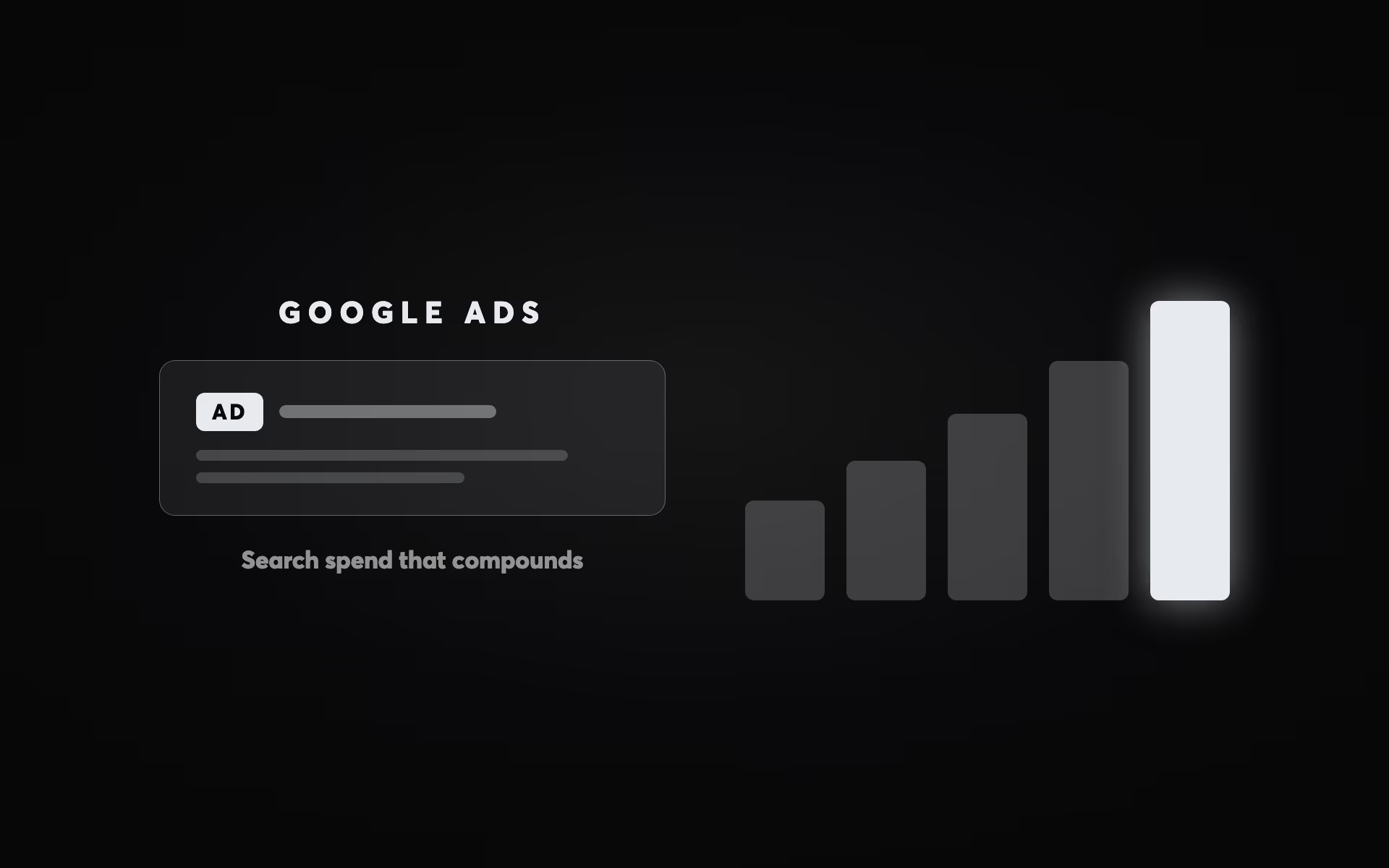
Paid Search (Google Ads) captures existing demand — people who are actively searching for solutions. It is the highest-intent channel available, and for most B2B services and local businesses, it is the fastest path to qualified leads. The tradeoff is cost: CPCs in competitive categories like legal, financial services, and SaaS can exceed $15-$50 per click, making conversion rate optimisation critical.

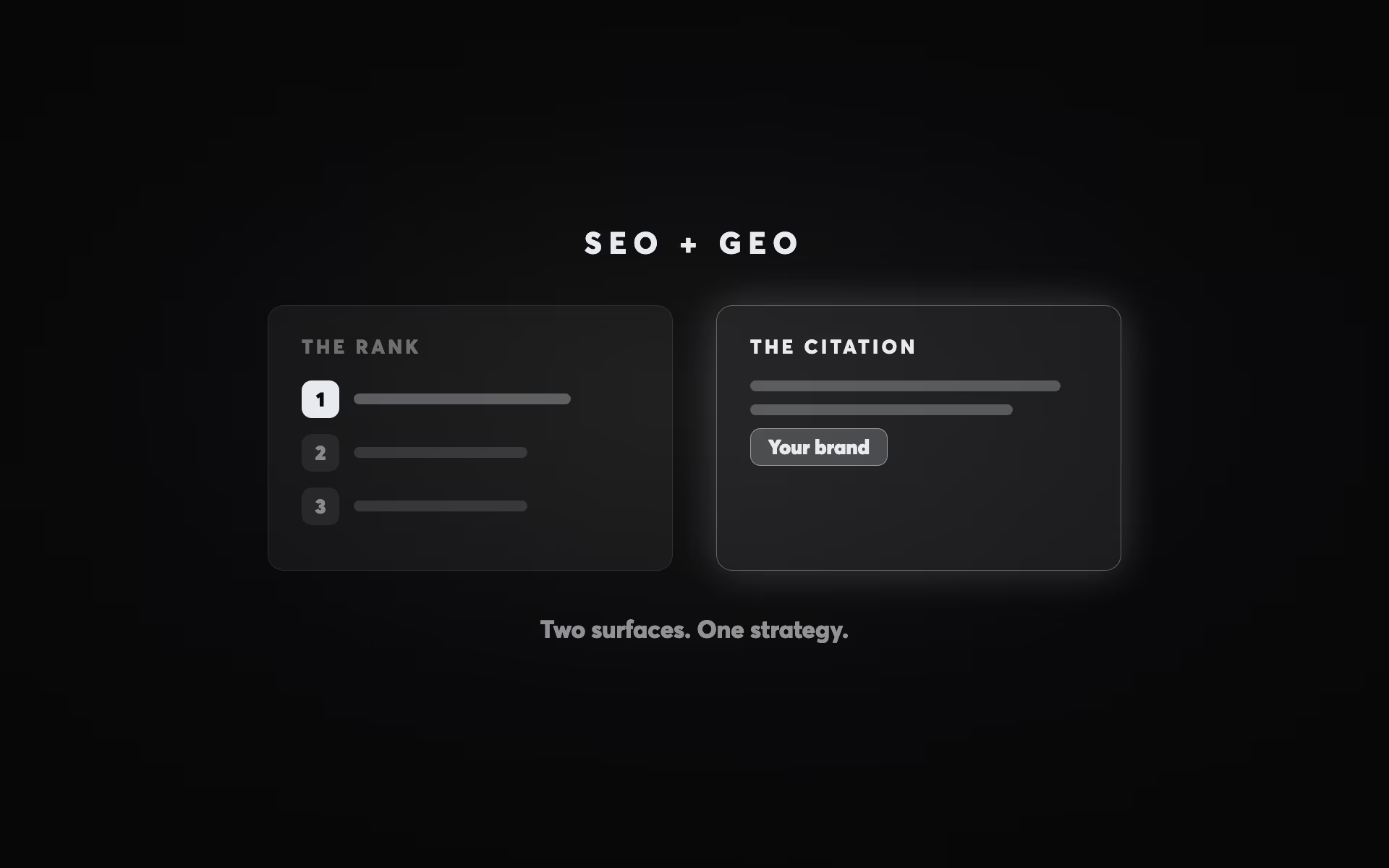
Content Marketing and SEO builds compounding authority. Content published today continues generating traffic and leads for years — making it the highest long-term ROI channel at 748% B2B ROI according to First Page Sage's 2026 report. In 2026, content must simultaneously rank in traditional search and earn citations in AI-generated answers — a new discipline known as Generative Engine Optimisation (GEO). See our full guide to Generative Engine Optimisation and how to choose between SEO, AEO, GEO and AIO.

Email Marketing remains the highest-ROI owned channel — generating $36-$42 for every $1 spent according to 2026 benchmarks. It does not generate demand on its own, but it nurtures and converts the demand captured by other channels. Sophisticated email automation in 2026 uses AI-driven segmentation and predictive personalisation to increase that return further.

Paid Social (Meta, LinkedIn, TikTok) creates demand and builds awareness. Where paid search captures people already looking for you, paid social reaches people who do not know they need you yet. ROI is lower on a direct basis (1.5:1 to 3:1 typically) but the value is in expanding your addressable audience and warming cold prospects before they reach search intent.

Marketing Attribution and Analytics is the infrastructure layer. Without accurate measurement connecting channel spend to pipeline and revenue, every other decision is made in the dark. In 2026, last-click attribution is systematically misleading — most businesses are significantly undervaluing SEO, email, and brand content while over-crediting paid search.

Paid Search Strategy for 2026

Google Ads remains the cornerstone of most digital marketing strategies — and for good reason. Over 75% of marketers plan to increase or maintain their investment in paid search in 2026, according to HubSpot's State of Marketing report. The channel delivers intent at scale: when someone actively searches for an accountant or web design firm, they are looking for a solution right now.

But paid search in 2026 is considerably more complex than it was in 2020. The average CPC has risen to $5.26 across all industries, and competitive verticals like legal services see CPCs of $8.50-$30+ per keyword. AI Overviews are changing the SERP landscape — paid CTR on queries with AI Overviews dropped significantly for organic results, pushing more qualified traffic toward paid positions. And campaign management has shifted dramatically toward AI-driven automation, with Performance Max now accounting for a significant share of Google's total conversion volume.

Campaign Structure Principles

The foundation of a high-performing Google Ads account is clean campaign structure. In 2026, the principle of fewer, better-funded campaigns with sufficient conversion data outperforms the old approach of tightly segmented ad groups. Here is the structure that works across most business types:

Brand Campaigns: Protect your branded terms. These convert at the highest rate (often 8-15%) and at the lowest CPC. Never leave branded terms unprotected — competitors can and will bid on your name.

Non-Brand Search Campaigns: Core service or product terms, organised by intent level. High-intent terms in one campaign, problem-aware terms in another. Separate budgets allow you to prioritise the intent levels that match your current funnel.

Competitor Campaigns: Target searches for specific competitors with alternative-positioning ads. These require dedicated budgets and landing pages, but can generate highly qualified leads at acceptable CPLs when prospects are already in the consideration phase.

Performance Max Campaigns: For businesses with sufficient conversion data (30+ conversions per month), PMax campaigns can extend reach beyond Search into YouTube, Display, Gmail, and Discover. They work best when fed with rich first-party audience data and clear conversion values tied to revenue outcomes.

Smart Bidding and AI in 2026

Manual bidding is now the exception, not the rule. Google's smart bidding strategies — Target CPA, Target ROAS, and Maximize Conversion Value — outperform manual bidding once sufficient conversion data is in place. The critical requirement: at least 30 conversions per month per campaign for smart bidding to function effectively.

For lead generation businesses, the evolution from tCPA to value-based bidding is the most important strategic shift in 2026. Rather than telling Google to minimise cost per lead, you assign different values to different conversion actions — a booked discovery call might be worth 5x a general contact form submission. This teaches the algorithm to optimise toward quality, not just volume.

Offline conversion tracking is essential for this to work. If your leads close in person or over the phone, you need to upload won deals back to Google Ads via CRM integration or manual uploads so the algorithm understands what a high-quality conversion actually looks like. Businesses that implement offline conversion tracking consistently report 20-35% improvements in lead quality at the same or lower CPL.

Google Ads Benchmarks by Channel Goal (2026)

Understanding where your campaigns stand relative to industry benchmarks is the first step in any optimisation process. The benchmarks below provide a baseline — your actual performance should be evaluated in context of your specific vertical, audience, and funnel structure. For a deeper look at Google Ads performance in B2B SaaS contexts, see our article on Google Ads for B2B SaaS; for ecommerce-specific benchmarks, see our Google Ads Ecommerce Strategy Guide.

Digital Marketing Channel Benchmarks 2026
Filter by channel. Use these benchmarks to evaluate your current performance and identify optimisation opportunities.
MetricBenchmarkContext
Sources: HubSpot State of Marketing 2026 - WordStream Google Ads Benchmarks 2025 - First Page Sage Marketing ROI Report 2026 - ALM Corp 2026 Budget Allocation Guide - WebFX PPC Benchmarks 2026 - BrightBid Google Ads Benchmarks 2026

Content Marketing and SEO in 2026

Content marketing has a compounding quality that no paid channel can replicate. An article published today that earns strong organic rankings will generate traffic and leads for years — the per-lead cost decreases over time while quality typically improves as your domain authority grows. SEO delivers 748% ROI for B2B businesses over a 2.7-year average campaign, making it the highest-performing marketing channel when measured on a full-duration basis.

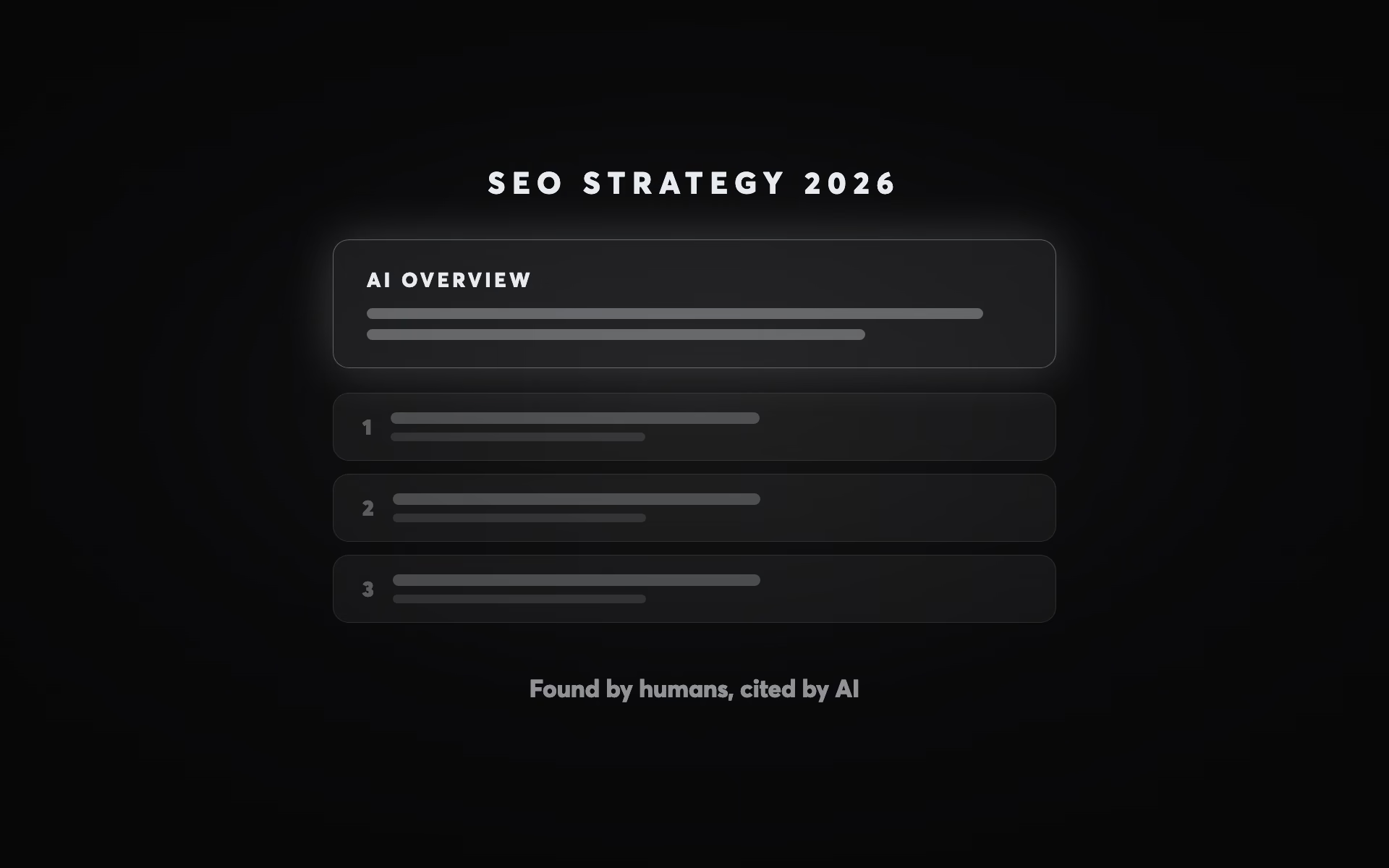
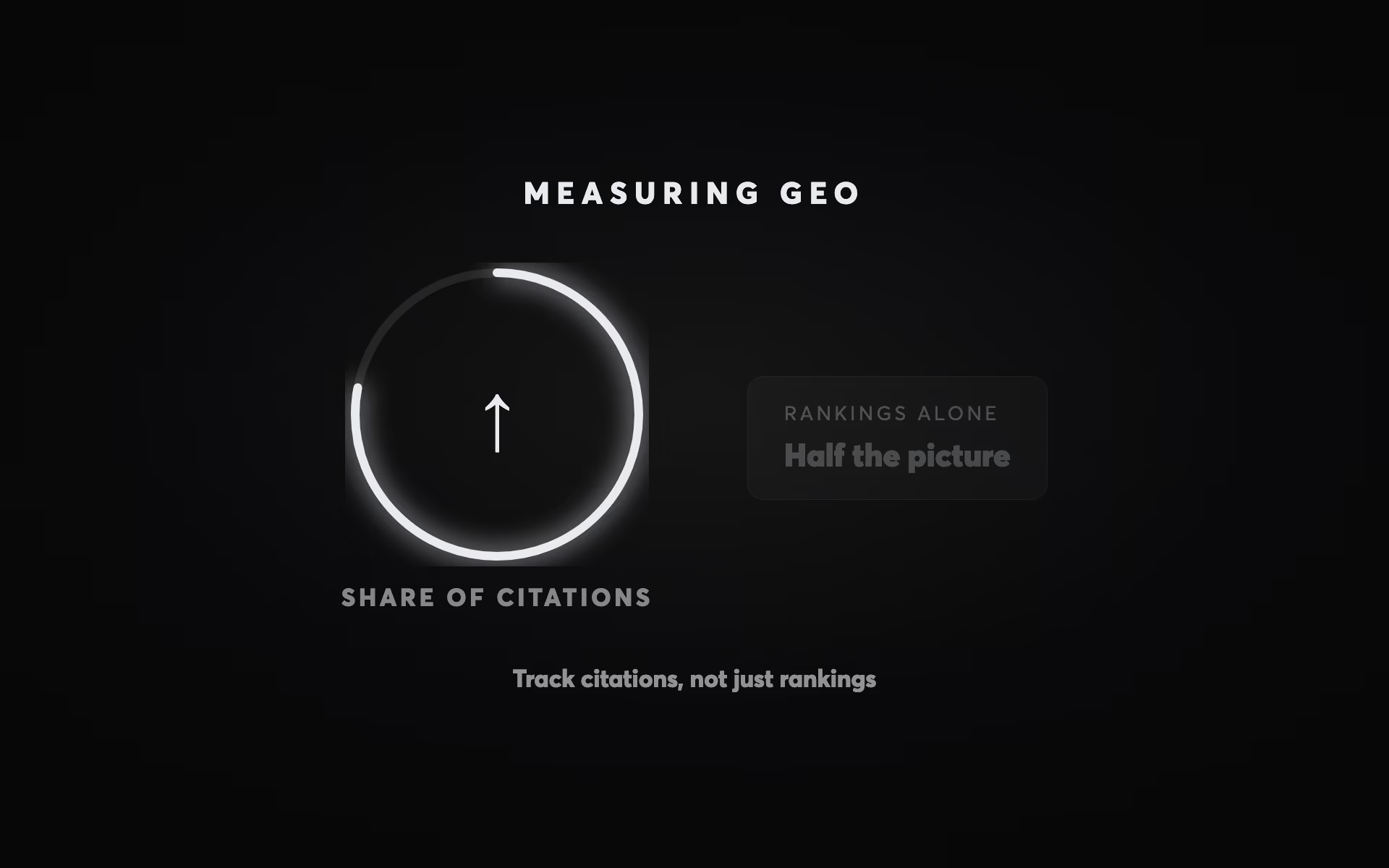
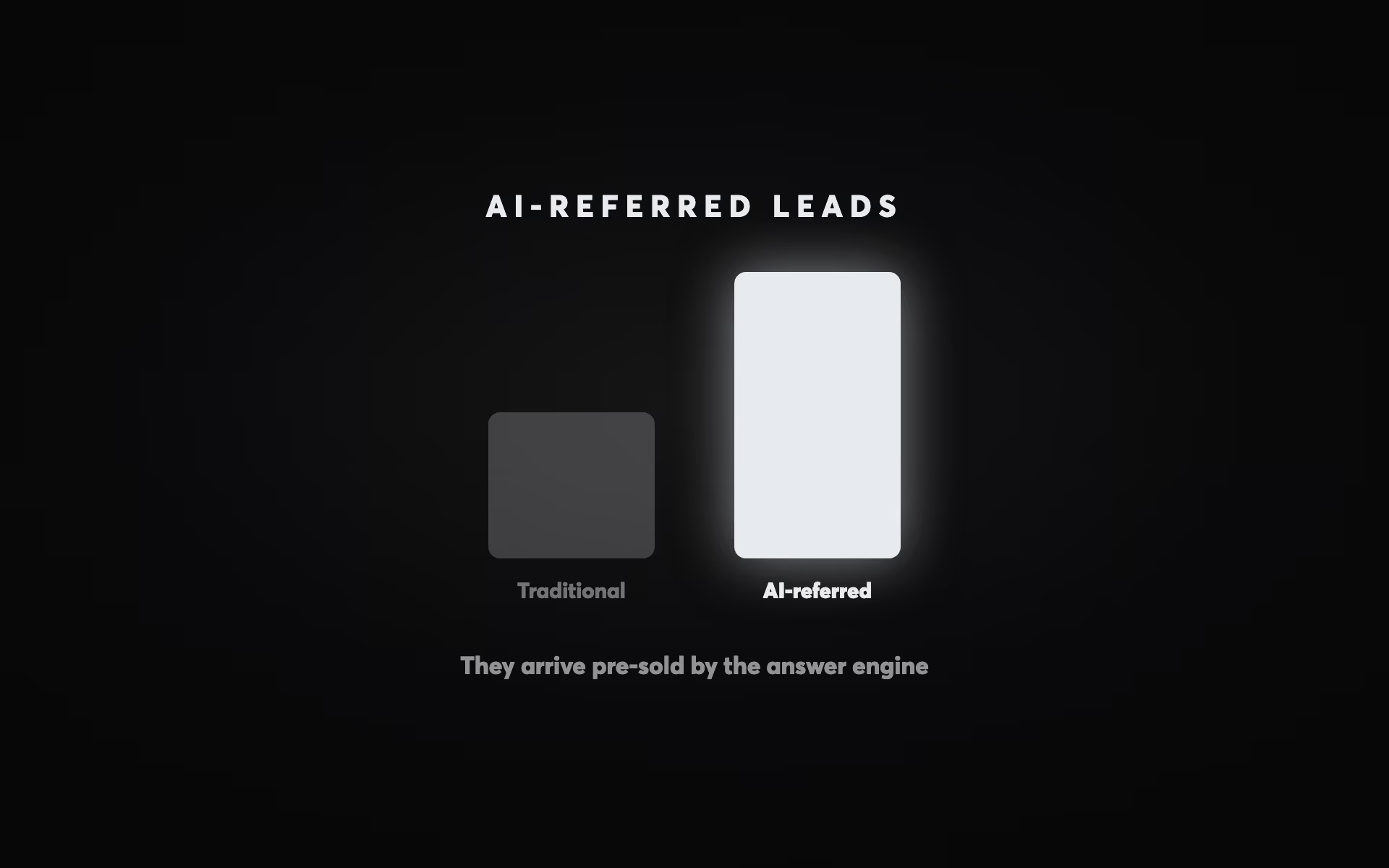
But 2026 has introduced a new dimension to content strategy: you are no longer optimising purely for Google Search rankings. AI-powered search experiences — Google's AI Overviews, ChatGPT, Perplexity, and similar tools — now cite specific web pages in their answers. Being cited in an AI answer for a query relevant to your business drives significant qualified traffic, but the optimisation technique (Generative Engine Optimisation, or GEO) requires a different approach than traditional SEO.

The Pillar-Cluster Architecture

The most effective content structure for 2026 is the pillar-cluster model. A single comprehensive pillar article covers a broad topic at depth (like this guide). Multiple cluster articles cover specific sub-topics in detail, each linking back to the pillar. This architecture signals topical authority to both Google's ranking algorithms and AI systems that crawl the web to build their knowledge bases.

For a business like an accounting firm or management consultancy, this might look like: a pillar article on small business accounting in New Zealand linking to clusters on GST filing, Xero setup, tax deductions, and end-of-year accounts preparation. The depth and interconnection of the content signals genuine expertise — which is exactly what both Google's E-E-A-T framework and AI systems are designed to evaluate.

The key difference between content that ranks in 2026 and content that gets cited by AI is the presence of quotable passages — specific, declarative statements that answer a question completely in one or two sentences. AI systems are designed to extract and cite these passages. Building them deliberately into your content is the core GEO technique. Read more in our guide to SEO and GEO: The Complete Guide for 2026.

First-Party Data and Content

As third-party cookies have faded from practical use, first-party data has become the most valuable asset in digital marketing. Your email list, CRM contacts, website visitor data, and purchase history are audience assets no algorithm change can take away. Content marketing is one of the most effective mechanisms for growing first-party data: high-value lead magnets (guides, tools, assessments) that trade content for contact information.

In 2026, the smartest content strategies treat each piece of content as both an organic traffic asset and a first-party data collection mechanism. A well-designed calculator or assessment embedded in a blog post can convert 5-15% of readers into identifiable prospects — even when those readers came from organic search and would otherwise remain anonymous.

Email Marketing: The Compounding Channel

Email marketing sits at a unique intersection: it does not generate demand, but it converts demand into revenue more efficiently than any other channel. The economics are compelling — email generates $36-$42 for every $1 spent, and it operates on an owned audience that is not subject to algorithm changes or rising CPCs. The businesses that are most resilient to digital marketing disruption are those with large, engaged email lists.

The Essential Email Automation Flows

In 2026, effective email marketing is not about monthly newsletters — it is about automated flows triggered by behaviour. Every business should have, at minimum, these foundational sequences running:

Welcome Sequence (3-5 emails over 7-10 days): The highest-engagement emails you will ever send. New subscribers are most interested immediately after signing up. Use this sequence to establish your value proposition, share your best content, and qualify intent. Welcome emails generate 3-5x the revenue of standard broadcast emails.

Lead Nurture Sequence (6-12 emails over 4-8 weeks): For prospects who downloaded content or expressed interest but have not converted to a consultation or purchase. Educate, address objections, share social proof, and make a direct offer. This sequence does the work of a sales team for lower-value or self-serve products.

Re-Engagement/Win-Back Sequence (3 emails over 2 weeks): Target subscribers who have not opened in 90+ days. A three-email sequence with a compelling offer and a clear choice to stay or leave cleans your list and reactivates dormant subscribers. Clean lists improve deliverability for all your sends.

Post-Purchase or Onboarding Sequence: For ecommerce, this drives repeat purchase and referral. For service businesses, it sets expectations, delivers early value, and reduces churn.

For a detailed breakdown of all eight essential email automation flows including trigger logic and success metrics, see our dedicated Email Marketing Automation Guide for 2026.

AI Personalisation in Email

The headline number: AI-personalised email campaigns generate 41% more revenue than standard batch-and-blast campaigns. In 2026, AI personalisation in email goes far beyond name insertion in subject lines. Modern platforms like Klaviyo, HubSpot, and ActiveCampaign use machine learning to predict the optimal send time for each individual subscriber, dynamically rewrite subject lines based on what each subscriber has previously engaged with, score subscribers for purchase probability or churn risk using predictive models trained on your own data, and automatically segment subscribers into micro-cohorts based on behaviour patterns the human eye would never spot.

The practical implication for most businesses: if you are not using a platform with AI personalisation capabilities, you are leaving significant email revenue on the table.

Paid Social: Creating Demand at Scale

Where paid search captures existing demand, paid social creates it. This distinction is critical for understanding how to measure and budget paid social correctly. You are showing ads to people who are not actively looking for your product — which means the creative work has to do more, the funnel requires more touch points, and the measurement window needs to be longer.

That said, paid social plays an irreplaceable role in a complete marketing strategy — particularly for businesses that want to grow beyond the search volume ceiling. In most competitive B2B categories, there are only so many people searching for your service at any given moment. Paid social lets you reach potential customers before they reach search intent, building the familiarity and trust that makes them more likely to click your Google Ad when the time comes.

Platform Selection in 2026

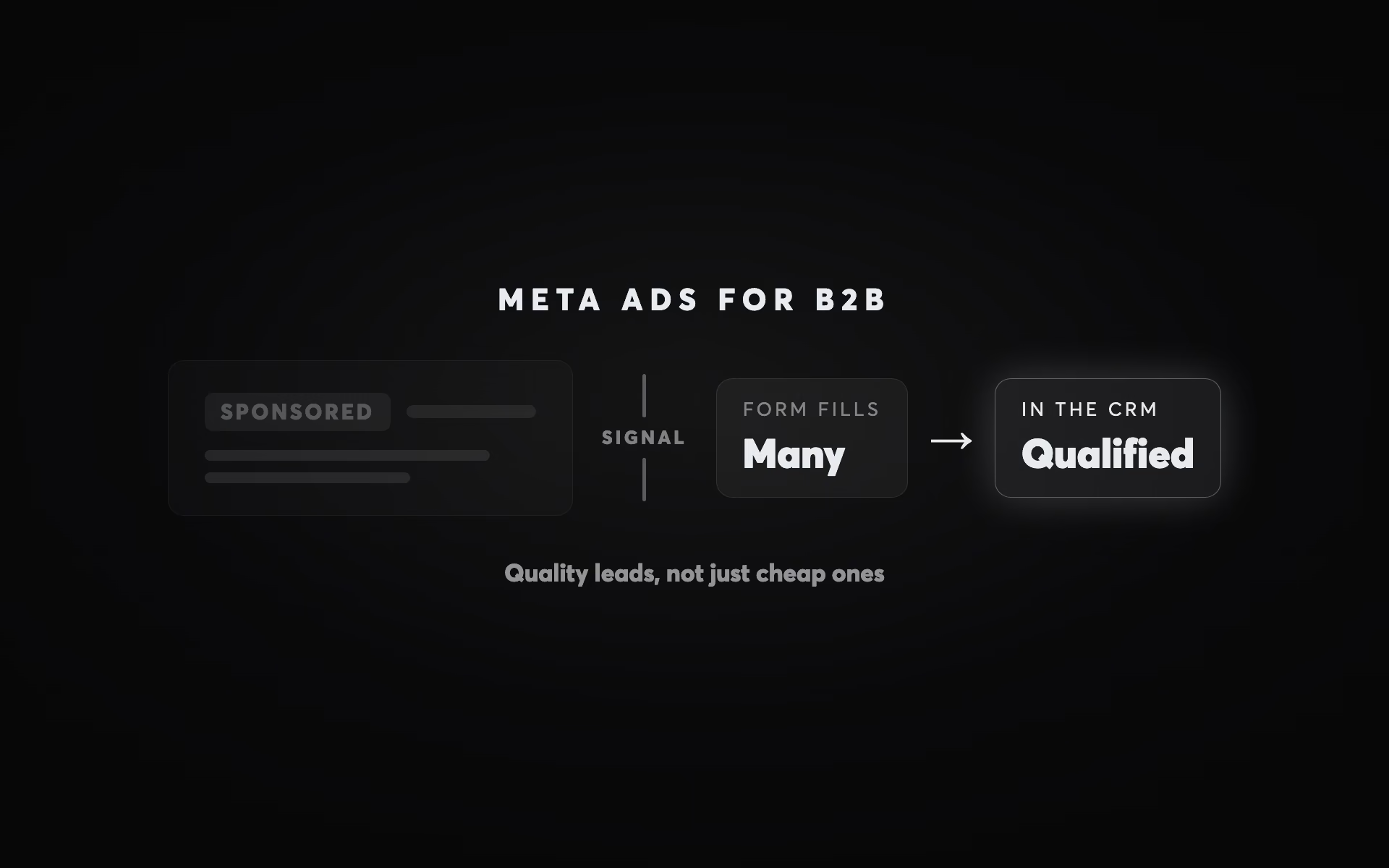
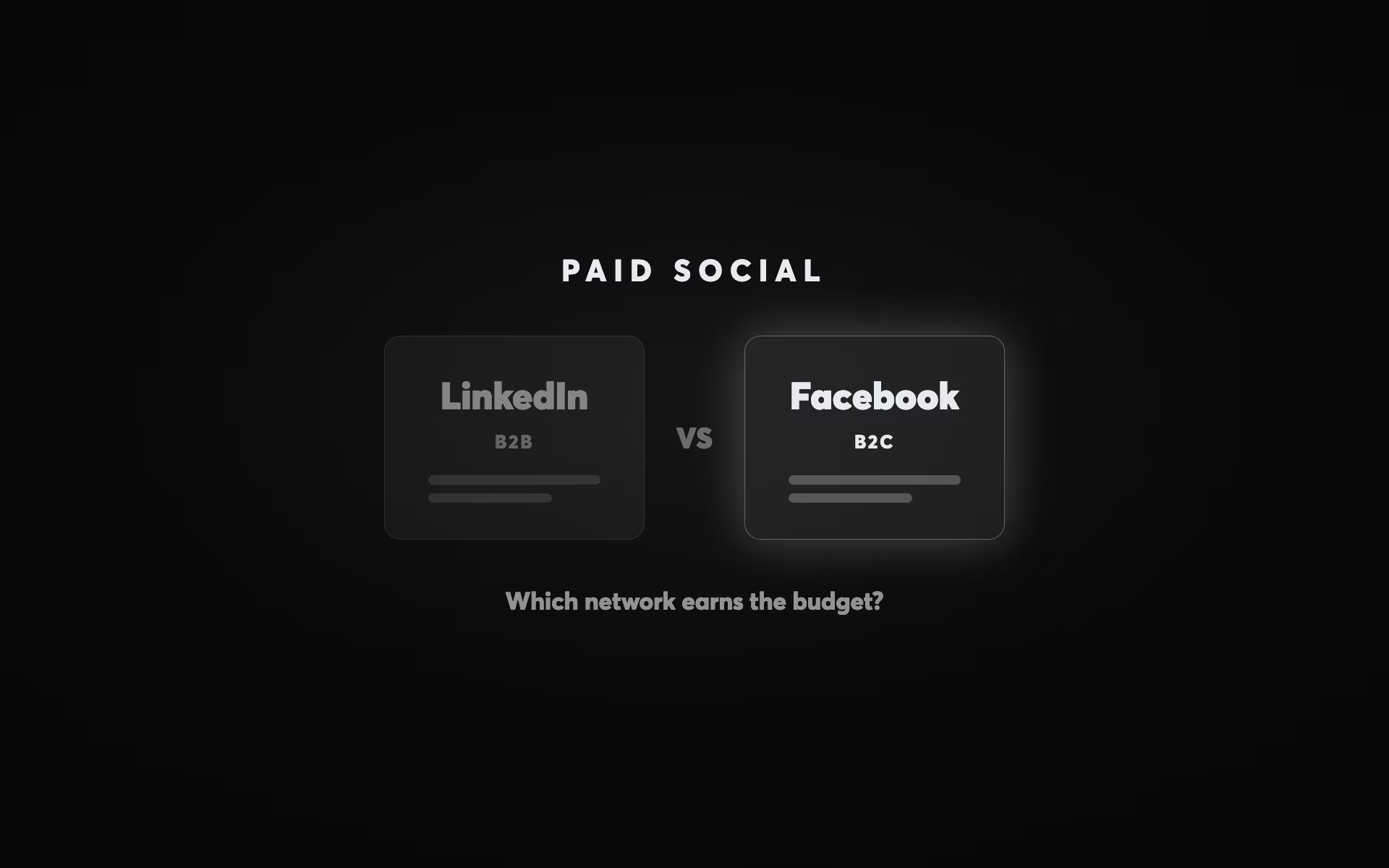
Meta (Facebook and Instagram) remains the most scalable social advertising platform for both B2C and B2B. Advantage+ campaigns — Meta's AI-driven campaign type — are delivering strong results by combining audience signals with automated creative testing at scale. For B2C and ecommerce businesses, Meta is often the second-most-important channel after Google. For B2B, it can deliver quality leads at lower CPL than LinkedIn when targeting is set up correctly.

LinkedIn is essential for B2B businesses targeting senior decision-makers. The CPCs and CPMs are significantly higher than Meta ($25-$60 CPM vs $8-$15 for Meta in the NZ market), but the targeting precision is unmatched — you can target by company size, industry, job title, seniority, and skills simultaneously. Thought Leadership Ads — which promote content from personal profiles rather than company pages — are generating strong organic-like engagement at paid distribution scale.

TikTok has emerged as a serious contender for consumer-facing businesses targeting under-45 demographics. Its algorithm-first content discovery means well-created content can reach audiences far beyond your follower count organically, with paid amplification available at comparatively low CPMs. For professional services and B2B businesses, TikTok's penetration into the NZ market is growing but remains secondary.

For NZ-specific platform benchmarks and detailed social advertising strategy, see our guide to Social Media Advertising Strategy for New Zealand Businesses.

Digital Marketing Strategy Audit
Work through each section to assess your current digital marketing maturity and identify your highest-priority improvements.
Score: 0 / 0

Marketing Attribution: Measuring What Actually Drives Revenue

Attribution is the most underinvested area of digital marketing for most NZ businesses — and it is the lever with the highest downstream impact on strategy quality. If you are making budget decisions based on last-click attribution data, you are systematically misallocating spend.

Last-click attribution credits the last touchpoint before conversion with 100% of the value. In a typical B2B journey, the last touchpoint is often branded search — the person who found you through a blog post three weeks ago, got retargeted on LinkedIn, signed up for your email list, and then searched your company name before booking a call. Under last-click attribution, Google Ads brand search gets all the credit. The blog post, the LinkedIn ad, and the email get zero. Budget gets shifted toward brand campaigns, and content investment gets cut. The strategy deteriorates over time.

Better Attribution Models for 2026

Data-driven attribution (DDA) in Google Ads uses machine learning to assign fractional credit to each touchpoint based on its actual contribution to conversion likelihood. It is the default recommendation for 2026 and should be enabled in both Google Ads and GA4 for any account with sufficient conversion volume.

CRM-based multi-touch attribution is more complex but more complete. By capturing UTM source data on every lead at the point of contact, and tracking that lead through to close in your CRM, you can attribute closed revenue (not just leads) back to marketing channels. HubSpot, Salesforce, and Pipedrive all support this natively to varying degrees. See our comparison guide to HubSpot vs Salesforce vs Pipedrive for details on attribution capabilities by platform.

The survey supplement: even the best technical attribution cannot track everything. Dark social (people sharing links in WhatsApp, Slack, Discord), word of mouth, and podcast mentions do not generate trackable UTMs. A simple open-text question on your booking or contact form captures this dark social signal and consistently surprises — it is not uncommon to find that 15-25% of leads have a primary discovery source that technical attribution never captured.

For a dedicated deep dive into attribution models and measurement infrastructure, see our upcoming guide on Marketing Attribution in 2026.

The 2026 Digital Marketing Landscape: AI and Structural Shifts

Several structural changes in 2026 are reshaping digital marketing strategy in ways that go beyond individual channel tactics.

AI-Assisted Campaign Management

AI is now embedded in every major advertising platform — not as an optional feature, but as the default mode of operation. Google's smart bidding, Performance Max, and AI-generated ad creative. Meta's Advantage+ campaigns. LinkedIn's Predictive Audiences. These AI systems can outperform manual management when they are properly configured with quality data signals, but they can also amplify waste dramatically when given poor inputs.

The shift in the digital marketer's role: less manual optimisation (bid adjustments, audience exclusions), more strategic configuration (conversion event quality, audience signal quality, creative variety). The human job is to give the AI the right goals, the right signals, and the right creative inputs — and to override it when it makes systematic errors such as allocating budget to brand searches instead of net-new customer acquisition.

92% of businesses plan to invest in generative AI tools for marketing in 2026 according to the Digital Marketing Institute. The practical applications range from AI-generated first drafts of content, to AI-driven A/B testing at creative scale, to predictive lead scoring that routes high-value prospects to sales faster.

First-Party Data as the New Competitive Moat

The practical death of third-party cookies — accelerated by iOS privacy changes, GDPR enforcement, and Chrome's gradual deprecation of cookie-based tracking — means that advertisers who built their targeting strategies on third-party audiences are facing structural disadvantage. The businesses winning in 2026 are those with large, clean, first-party data assets: email lists, CRM databases, customer match audiences.

First-party data advantages compound over time. A business with 50,000 segmented email subscribers can build significantly more accurate Meta lookalike audiences, upload higher-quality customer match data to Google Ads, and retarget more precisely than a competitor starting from scratch. Every piece of first-party data you collect today is a durable asset that no platform policy can take away.

The strategic implication: prioritise first-party data collection in every channel. Trade content and value for contact information. Build lead magnets. Offer email subscriptions at every touchpoint. CRM-gate your best resources. The business with the best audience data wins in 2026.

The Shift from Click Optimisation to Revenue Optimisation

The most significant strategic shift in digital marketing is the movement from optimising for clicks and leads to optimising for revenue. This is enabled by the combination of better conversion tracking infrastructure, smart bidding algorithms, and CRM integration.

In practice, this means: do not optimise your Google Ads for the cheapest cost per lead — optimise for the lowest cost per closed customer. A campaign generating 100 leads at $50 CPL looks better than 50 leads at $80 CPL until you discover the $80 leads close at 25% while the $50 leads close at 5%. The more expensive leads generate 2.5x the revenue at 60% lower cost-per-customer.

This intelligence only becomes available when you have the full-funnel data infrastructure in place: CRM tracking from lead to close, offline conversion upload to Google Ads, and revenue attribution in your reporting dashboard.

Full-Funnel Revenue Calculator
Enter your key funnel metrics to see where leads are dropping off and what improvement would mean in revenue.

Building a Unified Digital Marketing Strategy

A unified digital marketing strategy is not the sum of individual channel tactics — it is a connected system where each channel informs and amplifies the others. Here is how to build that system for your business in 2026:

Step 1: Define Your ICP and Funnel Stages

Before touching any channel, you need a clear Ideal Customer Profile (ICP) — a specific description of the type of customer who generates the most revenue at the lowest acquisition cost. Not a demographic sketch but a specific profile: company size, industry, problem set, buying trigger, and decision-making process.

Once your ICP is defined, map their buying journey to funnel stages: Awareness (they do not know you exist) through Consideration (they are evaluating options) to Decision (they are choosing a provider) and Retention (they are a customer). Each stage requires different content, different channel emphasis, and different conversion actions.

Step 2: Choose Two or Three Channels and Execute Well

The most common strategic error is spreading thin across every available channel. A business with a $5,000 per month marketing budget cannot execute effectively on Google Ads, LinkedIn, Meta, TikTok, SEO, and email simultaneously. Depth on two or three channels outperforms shallow presence on six.

For most NZ service businesses at growth stage with a B2B focus: Google Ads plus Content/SEO plus Email is the highest-return combination. Google Ads captures immediate demand. Content builds compounding authority. Email nurtures and converts. For ecommerce businesses: Google Ads plus Meta plus Email covers intent, discovery, and retention respectively.

Step 3: Connect the Measurement Infrastructure

Before scaling spend on any channel, ensure the measurement infrastructure is in place. This means: GA4 with correct conversion events configured, UTM parameters consistently applied to all paid traffic, CRM capturing lead source, and a dashboard that connects marketing spend to pipeline value and closed revenue.

Without this infrastructure, you are driving blind. With it, every dollar of spend becomes a data point that makes the next dollar more effective.

Step 4: Set a Testing and Optimisation Cadence

Effective digital marketing requires a regular optimisation cadence — not daily reactive changes (which interfere with smart bidding algorithms) but weekly and monthly structured reviews. A practical cadence for most businesses:

Weekly: Review campaign performance against targets. Flag anomalies (CTR drops, CPC spikes, CVR changes). Check search term reports for negative keyword additions. Review email delivery rates and flag issues.

Monthly: Full channel performance review against prior month and prior year. Update creative and ad copy where fatigue is showing. Adjust budget allocation based on channel performance data. Review content publishing schedule and update based on performance signals.

Quarterly: Strategy review — is the channel mix still appropriate for current business stage and goals? Review ICP definition against what is actually closing. Major creative refreshes. Annual planning input for next quarter budget.

For a systematic approach to campaign performance improvement, see our guide to Campaign Optimisation: How to Improve Ad Performance Without Increasing Budget.

New Zealand Digital Marketing Context

Building a digital marketing strategy in New Zealand requires accounting for a few structural realities that differ from global benchmarks:

Smaller audience sizes affect every paid social platform. Meta lookalike audiences built from NZ customer lists are less precise than in markets with 10x the population. LinkedIn audience sizes in specific B2B niches can be very small — sometimes under 5,000 people — which affects both CPMs and statistical significance in A/B testing.

The NZ ad market is growing — projected at +3.2% to reach $1B NZD in 2026 according to Guideline's country forecast — but remains significantly smaller than Australian equivalents. This means some platform features may be limited or unavailable for NZ-targeted campaigns.

Most NZ small businesses should allocate 5-12% of gross revenue to marketing, with digital channels representing the majority of that spend. For businesses in growth mode targeting aggressive expansion, that can reasonably push to 15-20% of revenue during the investment phase.

Competition intensity is lower than in comparable Australian or UK markets — which means CPCs and CPMs are often lower, and there is more opportunity to establish organic authority before major competitors enter your keyword space. NZ businesses that invest in digital marketing infrastructure now are building moats that will be expensive to replicate later.

Campaign Optimisation: Getting More From What You Have

The fastest improvement in most digital marketing strategies is not adding more budget — it is optimising what is already running. Research consistently shows that poorly configured campaigns waste 30-50% of their budget on unqualified traffic, low-quality placements, and mismatched audience targeting.

The most impactful quick wins, in order of typical impact:

1. Fix conversion tracking first. If you do not know what is converting, you cannot optimise for it. Many NZ businesses are running smart bidding on incomplete conversion data — which teaches the algorithm to optimise for the wrong signals.

2. Add negative keywords aggressively. For most Google Ads accounts, 20-30% of spend goes to irrelevant search queries. A thorough negative keyword audit typically improves CPL by 15-25% with no additional budget.

3. Align landing pages to ads. Message match — the degree to which your landing page headline reflects the specific ad that drove the click — is one of the highest-leverage conversion rate improvements available. A single targeted landing page per campaign type consistently outperforms sending all traffic to a homepage or generic services page.

4. Refresh creative. Ad creative fatigue is real. When CTR drops and CPCs rise, the issue is often that your target audience has seen your ads too many times. Refreshing creative every 4-8 weeks maintains engagement and performance.

For detailed optimisation techniques across Google Ads, Meta, and email, our dedicated Campaign Optimisation Guide walks through the complete diagnostic framework.

The Role of Video in Your 2026 Strategy

91% of businesses include video in their marketing strategy in 2026 — because the engagement data is overwhelming. Video content generates higher engagement than static alternatives across every major platform. YouTube is now the second-largest search engine. Short-form video (TikTok, Instagram Reels, YouTube Shorts) drives organic reach that static content cannot match.

But the barrier that held back most NZ businesses from video — production cost and complexity — is collapsing. AI video tools like Sora, HeyGen, and Synthesia allow professional-quality video production without studios or large teams. And the most effective video formats for business growth (founder-led talking heads, client testimonial recordings, screen recordings of demos) require nothing more than a smartphone and good lighting.

The channel-specific video strategy: YouTube for long-form search intent (tutorials, explainers, case studies); LinkedIn for B2B authority content (founder insights, team stories, industry commentary); TikTok and Reels for brand awareness and top-of-funnel; video in email for 30% higher CTR. Prioritise based on where your ICP spends time.

Your 2026 Digital Marketing Roadmap

Building a complete digital marketing strategy is a multi-month process. Here is a practical sequencing for businesses starting or rebuilding their digital marketing engine:

Month 1: Infrastructure. Fix conversion tracking. Set up GA4 correctly. Ensure CRM captures lead source. Deploy UTM tagging framework across all paid channels. This sounds unglamorous, but it is the foundation everything else depends on.

Month 2: Foundation Channels. Launch or optimise Google Ads with correct conversion data flowing. Start or refresh email marketing sequences (welcome, nurture, re-engagement). Begin producing content consistently (minimum 2 articles per month on pillar topics).

Month 3: Optimise and Add. Review the first two months of data. Identify the highest-performing conversion actions and invest more budget there. Add a paid social channel if appropriate. Begin measuring content performance against organic traffic and lead contribution goals.

Months 4-6: Scale. With clean data, optimised campaigns, and growing content authority, scale spend on the channels demonstrating positive ROI. Introduce Performance Max if Google Search campaigns are converting well. Begin building more sophisticated email segmentation. Start planning the pillar-cluster content architecture.

Months 7-12: Compound. SEO starts delivering compounding returns. First-party data assets grow. Attribution data reveals actual channel contribution. Budget allocation decisions become data-driven rather than assumption-based. The growth engine is running.

Ready to build your digital marketing strategy with expert guidance? The Campaign Optimiser from Involve Digital analyses your current marketing mix, benchmarks your performance against industry standards, and generates a prioritised recommendation for where to invest to maximise your returns. Run your campaign audit with Involve Digital.

Get Started Using The Form Below

This pillar guide covers the full digital marketing landscape for 2026. For deeper dives into specific channels, explore our dedicated cluster articles: Google Ads for Professional Services, Email Marketing Automation, Social Media Advertising Strategy for NZ, and Campaign Optimisation. Each goes deeper on the specific tactics and benchmarks for that channel.

FAQs

What is the most important digital marketing channel for NZ businesses in 2026?

There is no single best channel — the right mix depends on your business model, budget, and audience. However, most NZ businesses at growth stage achieve the highest ROI by prioritising Google Ads (to capture immediate search demand), content and SEO (for compounding long-term returns at 748% B2B ROI), and email marketing (the highest-ROI owned channel at $36-42 per $1 spent). The mistake most businesses make is spreading thin across every channel rather than executing two or three channels exceptionally well. Start with the channels where your ideal customers are actively looking for solutions, then layer in awareness and nurture channels as budget and data quality grow.

How much should a NZ small business spend on digital marketing in 2026?

Most NZ small businesses should allocate 5-12% of gross revenue to marketing, with digital channels representing the majority of that spend. For businesses in active growth mode, this can reasonably increase to 15-20% of revenue during the investment phase. The specific allocation by channel should reflect your goals: lead generation businesses typically prioritise paid search and content, while ecommerce businesses allocate more to paid search and paid social. Critically, the first investment should be in measurement infrastructure — making sure conversion tracking, CRM integration, and attribution are properly configured before scaling spend.

How is AI changing digital marketing strategy in 2026?

AI is transforming digital marketing in three key ways. First, AI-driven campaign management (Google's smart bidding, Performance Max, Meta's Advantage+) can outperform manual management when given quality conversion data and audience signals — shifting the marketer's role from manual optimisation to strategic configuration. Second, AI has changed the content landscape: AI Overviews in Google Search and AI tools like ChatGPT and Perplexity are now cited sources, meaning content must be optimised for AI citation (GEO) alongside traditional SEO. Third, AI personalisation in email and website experiences is driving 41% more revenue for businesses using it compared to standard campaigns. The strategic response is to invest in data quality (first-party data, conversion tracking) and content quality (authoritative, quotable passages) — because AI systems amplify quality content while ignoring thin or low-authority material.

CONTACT

Thank you! Your submission has been received!
Oops! Something went wrong while submitting the form.

MANIFESTO

impressive
Until
the
absolute