InsightsAI sales automation
How to Automate Your Sales Process with AI: From Lead to Close
How forward-thinking sales teams use AI to automate prospecting, personalise outreach, score leads, and close deals faster — without losing the human touch that wins trust.
21 November 202521 min read
Direct answer
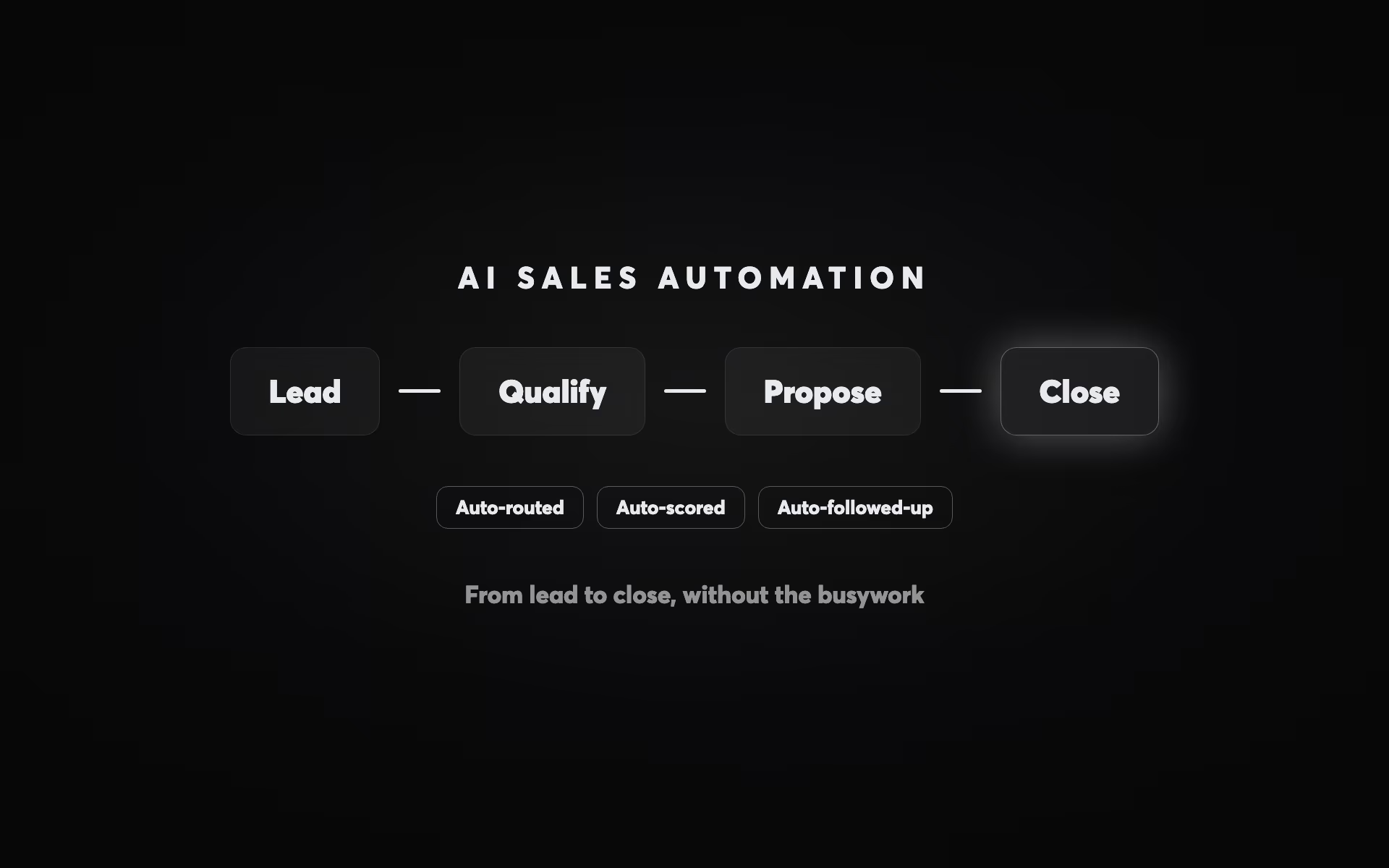
AI sales automation in 2026 spans the full pipeline: AI prospecting identifies high-intent accounts, personalised outreach scales at volume, and lead scoring models prioritise conversations by close probability. Sales teams using AI-assisted prospecting report 2–3× higher reply rates and 30% shorter sales cycles, according to Involve Digital's SMB implementation analysis. The most impactful integrations connect intent data platforms like Apollo or Clay with CRM automation in HubSpot or Salesforce. The non-negotiable constraint is human oversight: AI automates research and sequencing — never the relationship-building conversation that wins trust and closes deals. — Involve Digital, sales automation specialists
How to Automate Your Sales Process with AI: From Lead to Close
Sales reps spend only 28% of their time actually selling. The rest — prospecting, data entry, follow-up scheduling, CRM updating — is administrative overhead that compounds with every new hire and every additional lead in the pipeline. In 2026, AI is dismantling that overhead entirely, shifting the time-to-selling ratio in favour of the conversations that actually close deals. Teams using AI-driven automation are making 23% more calls per day, closing deals 20% faster, and seeing overall efficiency jump by 33% compared to teams without automation. The gap between AI-enabled and non-enabled sales organisations is widening quickly — and it will only accelerate.
This guide maps the complete AI sales automation stack across every stage of the sales process, from the first prospecting signal to the closed-won notification in your CRM. It covers the tools that are delivering real results in 2026, the implementation sequence that gets you to ROI fastest, and the critical balance between AI efficiency and the human relationship-building that ultimately wins trust. For a broader implementation context, see our complete AI implementation guide for business.
The Modern Sales Process Has an AI Layer at Every Stage
Before diving into tools, it helps to see where AI is being applied across the full sales funnel. The transformation is not happening in one place — it is happening at every handoff, every decision point, and every piece of manual work that used to eat a rep's time.
At the top of the funnel, AI is rebuilding prospecting from scratch. Platforms like Clay and Apollo are replacing the old model of manually researching prospects on LinkedIn with automated enrichment workflows that pull data from 75–100 sources simultaneously — company size, tech stack, funding status, hiring signals, recent news — and generate personalised first-line messages based on that context. The result: signal-personalised outreach achieves 15–25% reply rates compared to the 3–5% industry average for cold email, according to research published by Autobound in 2026.
In the middle of the funnel, AI lead scoring is transforming how teams prioritise pipeline. Machine learning lead scoring reports 75% higher conversion rates compared to traditional scoring methods, with high-performing companies using AI scoring reaching 6% conversion rates versus the 3.2% industry average. Crucially, leads contacted within the first hour of expressing interest are 7x more likely to qualify — and AI-powered routing makes that response speed possible at scale.
At the bottom of the funnel, call intelligence tools like Gong and Fireflies are analysing every sales conversation, surfacing winning patterns, flagging deal risk, and feeding coaching insights back to reps and managers. 83% of sales teams using AI automation report increased productivity, and among companies using AI consistently, 83% reported revenue growth compared to 66% of teams without AI.
| Metric | AI-Enabled Benchmark | Context |
|---|
AI Prospecting: Building the Pipeline Machine
The old prospecting model was fundamentally broken: a sales development rep (SDR) would spend 3–4 hours manually researching prospects, pulling data from LinkedIn, company websites, and news sources, writing a personalised first line, and then sending a cold email that got a 2% reply rate. The economics were painful. AI has rebuilt this from the ground up.
Clay is the most powerful enrichment-first platform in this space. Rather than owning a proprietary database, Clay aggregates data from 75–100 sources using waterfall enrichment — when one source fails to find a record, Clay automatically queries the next, achieving match rates above 90%. Its standout feature is Claygent, an AI research agent that visits prospect websites, extracts specific information, and feeds it into personalised outreach templates automatically. Users report 3–5x higher response rates using Clay's AI-powered personalisation.
Apollo takes the all-in-one approach. With 280 million contacts and 73 million companies in its proprietary database, Apollo is the fastest path from zero to a prospecting list. It scores 9.0 on G2 for ease of use and includes built-in email sequencing, a native dialer, and CRM sync. The trade-off: Apollo's enrichment is less deep than Clay's multi-source approach, but for teams that want prospecting, outreach, and follow-up in a single platform, Apollo is hard to beat. Increasingly, high-performance teams use both — Clay for ICP research and enrichment, Apollo for outreach execution.
The critical variable in 2026 AI prospecting is buying signals. The teams seeing 15–25% reply rates are not sending AI-personalised messages based on static firmographic data — they are triggering outreach based on live signals: a company posting a job for a head of RevOps (signals scale-up), a competitor's customers posting complaints (signals dissatisfaction), a funding round announcement (signals spend capacity), or a key contact joining a new role (signals a fresh buying window). Platforms like Amplemarket, Clay, and Keyplay are building signal detection into their core workflows.
AI Lead Scoring: Prioritising the Pipeline That Matters
Traditional lead scoring assigns points based on demographic fit and behavioural triggers: company size gets 10 points, visited pricing page gets 20 points, attended webinar gets 15 points. The problem is the weighting is arbitrary — built on assumption rather than outcome data. The result is a scoring model that correlates loosely with conversion and misleads sales reps into chasing leads that never close.
Machine learning lead scoring fundamentally changes this. Instead of human-assigned weights, ML models are trained on historical conversion outcomes — all the leads that did and did not close — to identify the patterns that actually predict conversion. The performance difference is significant: ML lead scoring reports 75% higher conversion rates compared to traditional scoring methods, with early adopters reporting conversion rate improvements of up to 30% compared to their previous models.
In practice, modern AI lead scoring integrates with your CRM to score every record in real time as new data arrives. A contact's score updates when they visit your pricing page, when their company posts an expansion announcement, when they open three emails in a row, or when a trigger event fires in an intent data platform like Bombora or G2. The sales rep's daily priority list becomes the output of this model — they open the CRM and their top five prospects are identified automatically.
HubSpot's predictive lead scoring uses historical data to surface patterns and score leads automatically. Salesforce Einstein does the same for enterprise teams. For B2B businesses with larger deal sizes, 6sense and Demandbase add account-level intent signals — showing which companies in your ICP are actively researching solutions in your category right now. Reps who effectively partner with AI tools are 3.7× more likely to meet quota than those who do not, according to Gartner's 2024 seller survey.
AI-Powered Outreach: Personalisation at Scale
The core tension in modern sales outreach is volume versus quality. Automated mass outreach is cheap to send and easy to ignore. Highly personalised, researched outreach converts at 10–15x the rate — but takes hours per prospect. AI has resolved this tension by making deep personalisation scalable.
The mechanism works in stages. First, a data enrichment workflow (Clay, Apollo, or similar) pulls structured prospect data: company description, recent news, technology stack, headcount growth, job postings, LinkedIn posts from the decision-maker. Second, an AI model uses this context to generate a personalised opening line and angle for the email — referencing the specific trigger that makes this outreach timely: "Saw you just hired your 10th sales rep — here's how teams at your stage typically automate their prospecting." Third, the message is sent through an outreach platform (Instantly, Smartlead, Outreach, Salesloft) and replies are tracked, responded to with AI draft suggestions, and logged in the CRM automatically.
Multi-signal stacked personalisation — combining two to three intent signals with behavioural context — achieves 25–40% reply rates on cold outreach, according to Autobound's platform data. This is compared to the 3–5% average for generic cold email. The jump is not marginal; it fundamentally changes the economics of outbound sales. Sales teams leveraging AI for personalised outreach generate 2x higher engagement rates overall, and automated follow-ups increase lead response rates by 250%.
The discipline that separates high performers is signal specificity. The best AI outreach is not about volume; it is about identifying the precise moment a prospect becomes receptive — a new funding round, a competitor acquisition, a job change, a relevant hiring signal — and reaching them with a message that demonstrates you understand their context. AI makes the research instant; your job is to define which signals matter for your ICP.
For email sequencing, tools like Klaviyo (B2C), ActiveCampaign, and Salesloft (B2B) offer AI-driven send-time optimisation that delivers messages when each individual prospect is most likely to engage. AI send-time optimisation lifts open rates by 26% and click-through rates by 41% compared to fixed-schedule sends. When combined with personalised subject lines — which drive 26% higher open rates — the cumulative effect on engagement is substantial. For more on AI email automation, see our guide to AI tools for marketing teams.
CRM Automation: Eliminating the Admin Tax
CRM adoption failure is one of the most expensive and under-acknowledged problems in sales. When data entry is manual, it does not happen consistently — reps shortcut the process, log calls without notes, skip contact enrichment, and leave pipeline stages stale. The result is a CRM that is simultaneously the most important system in the business and the least trusted source of truth.
AI CRM automation attacks this problem at the source by eliminating the manual work entirely. Automatic call logging: tools like Gong and Fireflies join sales calls, transcribe the conversation, extract action items and next steps, and push structured meeting notes to the CRM without anyone typing a word. Automatic contact enrichment: every new lead that enters the CRM is automatically enriched with firmographic data, LinkedIn profile, company tech stack, and intent signals. Automatic pipeline updates: deal stages update based on conversation signals, email engagement, and time in stage rather than requiring manual rep input.
The downstream impact on sales effectiveness is significant. CRM automation reduces admin time by 17% per rep, and businesses using CRM see a 29% increase in sales, 34% improvement in productivity, and 42% increase in forecast accuracy. Critically, 65% of salespeople using mobile CRM hit their quotas, compared to just 22% of those who don't — suggesting that CRM quality is one of the strongest predictors of rep performance, and AI automation is the lever that makes quality CRM data achievable in practice.
For teams building on HubSpot, the AI-powered CRM features include predictive lead scoring, email draft suggestions, meeting summarisation, and deal health scoring that flags at-risk opportunities based on engagement patterns. Salesforce Einstein adds the same capabilities at enterprise scale. Pipedrive's AI assistant analyses your pipeline and proactively recommends the next best action for each deal. For a detailed CRM comparison, see our HubSpot vs Salesforce vs Pipedrive guide.
Call Intelligence: Learning From Every Conversation
Every sales call contains data. What questions did the prospect ask? Which objections came up? At what point did they disengage? Which talk tracks correlated with forward movement, and which correlated with stalls? Before AI call intelligence, this data lived in individual reps' heads and was lost the moment the call ended. Now, it is captured, analysed, and turned into institutional knowledge.
Gong is the category leader for enterprise teams. With a G2 rating of 4.7/5 based on 5,000+ reviews, Gong captures and analyses every conversation, links signals to pipeline movement in near-real-time, tracks competitor mentions across all calls, and validates forecasts using actual call data rather than rep CRM entries. The trade-off: Gong starts at approximately £950–£1,200 per user per year, positioning it for larger sales organisations with dedicated RevOps functions. For a 10-person sales team, that is £9,500–£12,000 annually before implementation costs.
For growing teams with 5–100 reps, alternatives like Fireflies.ai, Avoma, and Cirrus Insight deliver core call intelligence — transcription, action item extraction, CRM sync — at significantly lower price points. Fireflies starts at $10/seat/month; Avoma from $19/seat/month. The core value proposition is identical: every call becomes searchable, every action item is automatically captured, and managers can review rep conversations without sitting in on calls.
The most valuable application of call intelligence is pattern discovery at scale. When you have transcripts of 500 calls, you can identify: which objections are most common in deals that stall at the demo stage, what language high-performers use when discussing pricing, whether prospects who ask about implementation timeline are more or less likely to close, and which competitor names come up in your strongest pipeline. This is coaching intelligence that would take a sales manager months to gather manually — AI surfaces it in minutes.
The Human-AI Balance: Where Technology Ends and Relationship Begins
The risk of over-automating sales is real. Buyers are sophisticated and increasingly attuned to generic outreach, automated follow-up, and the feeling of being processed rather than engaged. The statistics on AI adoption are compelling, but the businesses extracting the most value from AI automation are using it to amplify human engagement, not replace it.
The framework that works in practice is this: AI handles everything that does not require a human. Research, enrichment, data entry, scoring, send-time optimisation, follow-up sequencing, note-taking, pipeline updating — all automated. The rep's attention is freed for the activities where human judgment and relationship quality directly determine the outcome: discovery calls, demos, complex objection handling, negotiation, multi-stakeholder alignment, and the relationship-building that converts a first purchase into a long-term account.
AI-empowered sales teams see 42% higher conversion rates when the technology amplifies human efficacy rather than replacing human interaction. The reps meeting quota in 2026 are those who have mastered the interface between AI tools and human relationships — using AI to show up to every conversation better prepared, more informed about the prospect's context, and unburdened by administrative work. For a broader view of AI implementation principles, see our complete AI implementation guide.
This balance requires intentional design. The businesses that implement AI sales automation most successfully have documented their sales process first — understanding which steps are rule-based and automatable, and which require human judgment. They implement automation incrementally, measuring its impact on conversation quality and win rates, not just on activity metrics like calls made and emails sent. Process documentation is the foundation; automation is the layer on top. See our guide to building an AI-ready business for the foundational principles.
The AI Sales Automation Implementation Sequence
The order in which you implement AI sales automation matters significantly. Implement in the wrong sequence and you end up with a prospecting machine generating leads that the rest of the process cannot handle, or a CRM automation layer with no clean data to automate. The right sequence compounds on itself — each layer makes the next more effective.
Phase 1 — Data foundation (weeks 1–4): Clean your CRM. Standardise contact and company fields. Implement data enrichment on all existing records. Set up call recording and transcription. This phase has no flashy results, but it determines whether everything else works.
Phase 2 — Scoring and routing (weeks 5–8): Implement ML lead scoring on your existing lead database. Configure routing rules to ensure high-scoring leads are prioritised and contacted within the hour. Set up deal health alerts in CRM for stalled opportunities. The output of this phase: reps are working better-qualified pipeline in better priority order.
Phase 3 — Outreach automation (weeks 9–14): Build enrichment workflows for inbound leads. Set up personalised email sequences. Configure signal-based prospecting for outbound. Enable send-time optimisation. By this phase, your reps are spending significantly less time on manual research and follow-up, and response rates should be improving.
Phase 4 — Intelligence and optimisation (month 4+): Use call intelligence data to identify winning patterns. Refine scoring models with outcome data. Build a/b tests into outreach sequences. Implement AI-assisted forecasting. This is the phase where the compounding returns on AI sales automation become visible in the pipeline and revenue numbers.
For the tools referenced throughout this guide — Clay, Apollo, Gong, Fireflies, HubSpot, Salesforce Einstein — the investment is real but measurable. Teams using AI consistently report 83% revenue growth compared to 66% for non-AI teams. The payback period on well-implemented sales automation is typically 3–6 months. For guidance on calculating your specific ROI, see our guide to AI cost-benefit analysis.
Measuring AI Sales Automation ROI
The businesses that fail to realise ROI from AI sales tools are typically those that measure the wrong things. Activity metrics — emails sent, calls made, sequences enrolled — go up immediately when automation is implemented. Revenue metrics take longer to move. The measurement framework needs to be forward-looking enough to capture the real impact.
The metrics that matter most for AI sales automation ROI fall into three categories. Efficiency metrics: time-to-first-contact on new leads, admin hours per rep per week, percentage of reps hitting activity targets. These should improve in the first 30–60 days. Pipeline quality metrics: MQL-to-SQL conversion rate, lead-to-opportunity conversion rate, average days in stage. These should improve in 60–90 days as better scoring and routing take effect. Revenue metrics: win rate, average deal size, sales cycle length, quota attainment rate. These are the lagging indicators that reflect whether the upstream improvements are translating to revenue, and typically show movement in 90–120 days.
Predictive analytics can boost win rates by 14.5% compared to teams without it, and companies that automate lead nurturing campaigns see a 10%+ revenue increase within 6 to 9 months. The key is benchmarking your pre-automation baseline accurately before you start — otherwise you cannot attribute the gains to the specific tools and processes you implemented. See our AI ROI calculation guide for a full cost-benefit framework, and explore how agentic AI workflows are taking automation even further.
Ready to map your sales process's highest-value automation opportunities? Involve Digital's AI Implementation Discovery session analyses your current sales workflows, identifies the specific tools and automation sequences that will have the greatest impact, and builds you a prioritised implementation plan. Get your free growth plan with Involve Digital.
Get Started Using The Form Below
AI sales automation is one component of a comprehensive AI implementation strategy. For the broader context, explore our complete AI implementation guide, our guide to AI workflow automation for other business processes, and our overview of building an AI-ready business — the data and systems foundation that determines whether every AI tool in your stack actually delivers.
Questions