InsightsEcommerce GEO
GEO for Ecommerce: Getting Your Products Recommended by AI
Why AI is becoming the new product discovery channel for shoppers — and how ecommerce brands optimise their product content, reviews, and entity presence to get AI-recommended.
18 September 202521 min read
Direct answer
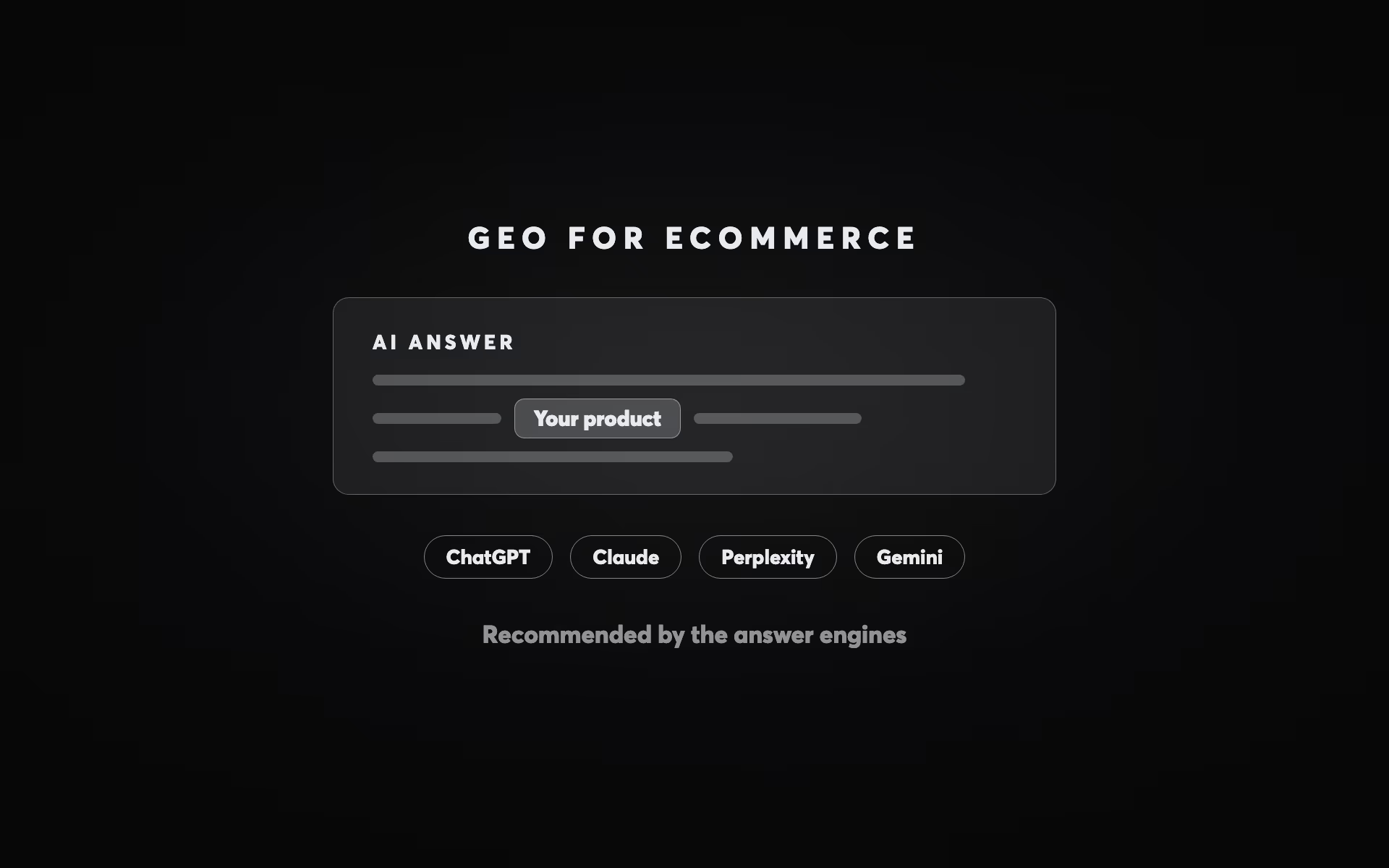
Generative Engine Optimisation (GEO) for ecommerce structures product content, review signals, and brand entity data so AI systems recommend specific products when shoppers ask for buying guidance. In 2025, 27% of online shoppers used an AI tool for product research before purchase — a figure Involve Digital projects will exceed 40% by end of 2026. The highest-impact GEO tactics include: Product schema with rich attributes, verified review aggregation on third-party platforms, and brand entity pages that establish category authority. Brands appearing in AI product recommendations share a common profile: consistent structured data, high review volume, and clear category-specific content that answers purchase decision questions. — Involve Digital, ecommerce GEO specialists
GEO for Ecommerce: Getting Your Products Recommended by AI
The most important shift in ecommerce discovery in 2026 isn't happening on Google Shopping or social media — it's happening inside AI chat interfaces. Generative AI traffic to US retail sites increased 4,700% year-over-year through mid-2025 (Adobe Digital Insights). Shoppers are asking ChatGPT "what's the best running shoe for flat feet under $200" and receiving curated product recommendations before they ever open a browser tab. The brands appearing in those recommendations are not the ones with the biggest ad budgets. They are the ones whose product data is structured, authoritative, and machine-readable.
This article is a practical guide to Generative Engine Optimisation (GEO) for ecommerce — specifically how AI systems select products to recommend and what you need to do at the product page, schema, review, and entity level to appear in those recommendations. For the foundational context on GEO, our guide to what is Generative Engine Optimisation covers the principles. For B2B service context, GEO for B2B high-consideration services applies the same framework to service businesses.
The AI Product Discovery Revolution
AI-powered product discovery isn't a future trend — it is the present reality for a rapidly growing segment of shoppers. According to G2's 2025 Buyer Behaviour Report, generative AI chatbots are now the #1 influence over vendor shortlists, ahead of review sites, vendor websites, and salespeople. For B2C, Yotpo's research found that 66% of frequent online shoppers now regularly use AI assistants to inform purchase decisions, with 34% specifically using ChatGPT for initial product discovery.
ChatGPT launched its Shopping Research feature using a specialised GPT-5 mini variant that achieves 52% product accuracy on complex multi-constraint queries. OpenAI's Merchant Program allows businesses to submit product feeds directly, improving the likelihood that ChatGPT can access accurate, structured product information. ChatGPT is reported to have 900 million weekly active users, and product discovery queries — "best CRM for startups", "lightweight camping gear for solo trips", "ethical skincare under $50" — are among its fastest-growing use cases.
The conversion data makes AI product discovery impossible to ignore. LLM traffic converts at 2.47%, ranking it fourth among all measured ecommerce acquisition channels — above Google Shopping (1.95%) and paid search (1.82%), and it costs zero ad spend (Alhena AI, 329 brands, Q4 2024–Q1 2026). AI traffic grows 40% quarter over quarter. AI-referred ecommerce visitors spend 68% more time on site and have a 27% lower bounce rate than traditional search visitors (Adobe Digital Insights), arriving with strong purchase intent and prior research context.
The mechanism matters: when AI recommends your product, it has already synthesised the user's requirements, compared relevant options, and selected your product as a match. The visitor arrives pre-qualified in a way that no other acquisition channel achieves at scale.
| Metric | Benchmark | Context / Source |
|---|
How AI Systems Select Products to Recommend
Understanding how AI product recommendation systems work is the foundation of GEO for ecommerce. The selection process is not primarily algorithmic in the traditional sense — AI systems don't crawl a price comparison database and surface the cheapest option. They synthesise information from multiple sources and apply language model reasoning to match products to user intent.
The core AI product recommendation factors:
1. Query relevance and semantic matching. AI systems perform semantic intent matching, not keyword matching. A product page that explicitly states its use case for specific contexts will outperform one with generic claims. "Lightweight trail running shoe for overpronation and flat feet, with a 4mm drop" matches a query about "flat feet running shoes" far more effectively than "comfortable running shoe suitable for all foot types."
2. Structured data completeness. AI crawlers like OAI-SearchBot and PerplexityBot process schema markup at crawl time and researchers have observed these bots "crawling JSON data more than HTML." 65% of pages cited by Google AI Mode and 71% cited by ChatGPT include structured data (SE Ranking). Incomplete schema is a disqualification signal, not just a missed opportunity.
3. Review signal quality. AI systems use review content to verify product claims and assess purchase confidence. A product with ten detailed reviews covering specific use cases ("I bought this for trail running with plantar fasciitis — the arch support is excellent") gives AI systems far more to work with than a product with one hundred one-word reviews. Detailed, use-case-specific review content directly feeds AI comparison engines.
4. Third-party validation. AI recommendation systems pull from multiple sources — editorial reviews, comparison site rankings, Reddit discussions, and specialist publications. A product that appears positively across multiple independent sources is more confidently recommended than one where the brand's own website is the only mention. This is the ecommerce application of the same entity authority principles that govern how AI recommends businesses generally.
5. Data freshness and accuracy. If pricing, availability, or product specifications are stale, AI systems that connect to real-time search will identify the discrepancy. Perplexity, which handles 1.2 billion monthly queries, weights freshness heavily — stale product data is a citation disadvantage. Real-time Offer schema that syncs pricing and availability is the technical solution.
The Product Schema Foundation
Complete, accurate Product schema is the non-negotiable foundation of ecommerce GEO. Without it, AI systems cannot reliably extract and verify product information. It is not an optional enhancement — it is the price of entry for AI product recommendation visibility.
Google's AI Overviews now appear on 14% of shopping queries — a 5.6× increase in four months. The brands appearing in those overviews have structured data that AI systems can parse at crawl time. The ones that don't, don't appear regardless of price, quality, or relevance.
Required Schema Fields for AI Citation Eligibility
The four schema types central to ecommerce AI visibility:
Product schema — Tells AI systems what you sell: name (must exactly match H1), description (specific, use-case-focused, not marketing language), brand, SKU, GTIN or MPN (product identifiers AI systems use to match against global databases), images, and material/attributes.
Offer schema — Communicates price (in local currency using ISO 4217 codes), availability (real-time where possible), and item condition. Real-time Offer schema reduces cart abandonment by 36.2%. AI agents that complete purchases on behalf of shoppers rely on accurate Offer schema — without it, your products don't exist in their comparison workflows.
Review schema — Provides granular sentiment data. Each individual review structured as Review schema (not just AggregateRating) gives AI systems specific use-case examples to reference. Ten detailed reviews with Review schema outperforms 100 reviews with only aggregate rating for AI recommendation quality.
AggregateRating schema — The summary rating and review count that AI comparison engines use when generating shortlists. For queries like "best running shoes under $200 with high ratings," AggregateRating schema is the filter mechanism that determines whether your product makes the consideration set.
High-Impact Optional Fields
Beyond the required fields, these attributes significantly improve AI recommendation relevance:
- Product attributes: Colour, material, size, weight, intended purpose — these match long-tail, conversational queries
- hasMerchantReturnPolicy: AI shopping agents surface return policies at the recommendation stage
- shippingDetails: Delivery time and cost are active factors in AI purchase recommendations
- GTIN/MPN: Universal product identifiers allow AI systems to match your product against external databases and price comparisons
A controlled experiment showed a 19.72% increase in AI Overview visibility over two months by applying entity linking to structured data. Pages with complete structured data are cited 3.1× more often in AI Overviews than pages without. The investment in schema completeness pays measurable dividends in AI recommendation frequency.
Review Strategy for AI Recommendation Optimisation
Reviews are more important to ecommerce GEO than any other single factor after schema. AI systems use reviews to verify product claims, generate comparative analysis, and build the confidence signals that determine recommendation quality. A product with comprehensive review content is more easily recommended because the AI has more evidence to work with.
The Review Quality Framework
Volume matters, but depth matters more for AI. For traditional search, the number of reviews is important. For AI recommendation systems, the depth and specificity of review content is the primary factor. An AI asked to recommend "the best laptop for video editing on a budget" will extract from reviews that mention video editing performance, render times, and budget benchmarks — not from reviews that say "Great laptop! Very happy with my purchase."
The practical implication: actively encourage reviewers to be specific. Post-purchase email sequences should ask customers to mention: (1) what they bought the product for, (2) whether it met their specific needs, and (3) any particular features that were especially useful. Responses to "Did our [product] work well for [use case]?" produce far more AI-citable content than open-ended "Tell us what you think" prompts.
Review platform diversification is essential for AI recommendation reach. AI systems pull review data from multiple sources. A product with strong reviews only on your own site is less confidently recommended than one with consistent positive signals across your website, Google Shopping, Trustpilot, and any relevant specialist review platforms. Each additional trusted source providing consistent positive signals increases recommendation probability.
Responding to Reviews for AI Signal Value
Review responses create additional indexable content that AI systems can extract. When you respond to a review that mentions a specific use case, your response can confirm and expand on that use case — creating a second AI-citable passage about that product application. This is a low-effort, high-value content opportunity that most ecommerce brands ignore.
Example: A reviewer writes "I bought these earbuds for running in rain — they've survived three months of daily wet-weather use." A strong response: "[Reviewer name], we're glad the IPX7 waterproofing is holding up for your runs. Our testing showed [specific durability metric] in sustained water exposure — your real-world result confirms our lab findings." This response now contains extractable AI content about this product's wet-weather durability.
Comparison Content: The AI Recommendation Multiplier
One of the most valuable GEO tactics for ecommerce is creating comparison content that positions your products favourably in AI-generated roundups and recommendation responses. When AI systems answer queries like "What are the best sustainable activewear brands under $100?" or "Compare the top running shoes for plantar fasciitis," they draw from comparison content that exists on the web.
Creating your own comparison content establishes your brand's voice in comparisons. A guide titled "Best Running Shoes for Flat Feet in 2026: [Your Brand] vs Top Competitors" creates citable comparison content that AI systems can extract when answering the inevitable buyer questions about how different products compare. This content should be honest and specific — AI systems will not cite content that reads as pure marketing.
The format matters: structured comparison tables with specific, objective criteria (weight, drop height, arch support type, waterproof rating, price) are extracted more reliably than prose comparisons. Each row of a comparison table is a separately extractable data point that AI systems can reference when answering specific feature-based queries.
Category-level buying guides are particularly effective. A guide titled "How to Choose Running Shoes for Flat Feet: Complete 2026 Guide" that legitimately covers the buying criteria — and includes your products where they genuinely fit — positions your brand as an authoritative source whenever AI systems answer related queries. For deeper context on this approach, our SEO and GEO strategy guide covers content authority architecture for both traditional and AI search.
Optimising for ChatGPT Shopping vs Google AI Overviews
ChatGPT Shopping and Google AI Overviews are the two largest AI product discovery surfaces, and they have meaningfully different optimisation requirements.
ChatGPT Shopping Optimisation
ChatGPT's Shopping Research feature, powered by a specialised GPT-5 mini shopping model, triggers on approximately 9% of all queries — but on 12.1% of open-ended product queries (Profound analysis of 260 million prompts). The critical insight from this research: "ChatGPT Shopping is a discovery surface, not a search engine. You don't win by being the brand someone searches for. You win by showing up in the consideration set when users are still in discovery mode — describing what they need but haven't decided what to buy yet."
For ChatGPT Shopping visibility: submit product feeds via OpenAI's Merchant Program (direct catalog access), ensure pricing information is publicly accessible on your website (pricing pages attract concentrated AI traffic), and describe your products in terms of use cases and problems solved rather than features and specifications. ChatGPT matching relies on semantic intent — a product described as "ideal for long-distance commuters who need a waterproof backpack with laptop protection" will match conversational queries about commuting backpacks far better than one described with dimensions and material specifications only.
Google AI Overviews for Shopping
Google AI Overviews now appear on 14% of shopping queries — up 5.6× in four months — and these appearances are driven by Google's Merchant Center data as well as on-page schema. Ensure: (1) Google Merchant Center feed is current with accurate pricing and availability, (2) Product schema matches Merchant Center data exactly, (3) Category and buying guide pages are indexed and have structured content that AI can extract for overview answers, and (4) Google Business Profile is complete if you have a physical retail presence.
The June 2026 query fan-out data shows that AI Overviews increasingly cite pages outside the top 10 organic results — meaning strong Product schema and content quality can earn AI Overview citations even for brands without dominant organic rankings. This is particularly significant for smaller NZ retailers competing with established international brands. Our complete GEO guide covers the technical optimisation framework in full.
The NZ Ecommerce GEO Opportunity
For New Zealand ecommerce brands, AI product discovery represents a rare opportunity to compete on equal terms with international retailers that dominate traditional search through advertising spend and domain authority. AI product recommendation systems reward data quality and specificity over brand awareness and ad budgets. A small NZ retailer with meticulously structured product data, authentic customer reviews, and clear use-case-focused content can appear alongside international brands in AI recommendations for relevant queries.
NZ-specific context matters for AI recommendations. When a NZ shopper asks ChatGPT about "waterproof hiking boots available in New Zealand," a brand with explicit NZ availability, NZD pricing, and NZ shipping information in its schema has a native advantage over international brands that don't surface these signals. Localised content — availability, delivery times, NZ-specific use contexts (e.g., NZ weather conditions, NZ outdoor activities) — creates relevance signals that AI systems recognise and weight when answering region-specific queries.
Agentic Commerce: The Next Frontier
AI product discovery is already transforming ecommerce. But the next wave — agentic AI commerce — goes further: AI agents that not only recommend products but research, compare, and purchase on behalf of users. 24% of shoppers are already comfortable with AI agents buying for them (rising to 32% among Gen Z) (Alhena AI, 329 brands).
OpenAI launched the Agentic Commerce Protocol in March 2026, enabling richer, more visually immersive shopping experiences within ChatGPT. Shopify and Etsy merchants can now enable instant checkout within ChatGPT — meaning a shopper asking ChatGPT to find them a product can complete the purchase without leaving the chat interface. The stores that agentic AI endorses will be those that can be swiftly parsed, verified from multiple sources, and engaged with seamlessly due to consistent facts, clear promises, and an unambiguous purchasing journey (Forbes, February 2026).
Preparing for agentic commerce now means: complete schema markup, real-time inventory and pricing accuracy, clear return and shipping policies surfaced in structured data, and product naming and identifier consistency across every platform where your products appear. These are not future optimisations — they are the same foundations that determine AI recommendation visibility today, applied to the agentic commerce layer that will become standard within 12–24 months.
Measuring GEO Performance for Ecommerce
Ecommerce GEO performance measurement combines AI-specific metrics with the commercial outcomes that justify the investment.
AI discovery metrics: Monthly AI recommendation citation rate across your query set (methodology above). Share of voice vs key competitors in AI recommendations for your top product categories. Brand mention volume across third-party review, comparison, and editorial sites.
Traffic metrics in GA4: Create a custom channel grouping in GA4 for AI traffic sources (perplexity.ai, chatgpt.com, bing.com/aichat). Track sessions, engagement rate, pages per session, and conversion rate. Segment by landing page to identify which product categories attract most AI referral traffic.
Commercial outcomes: Revenue attributed to AI referral traffic. Average order value from AI-referred sessions (often higher due to stronger purchase intent). Customer acquisition cost from AI channels versus paid search. These metrics make the business case for ongoing GEO investment and justify schema and content improvement resource allocation.
The trajectory is clear: AI product discovery is moving from early-adopter to mainstream in 2026, and the brands with complete schema, high-quality reviews, and structured comparison content are building recommendation advantages that compound over time. Our guide to common GEO mistakes covers the most frequent errors that prevent ecommerce brands from appearing in AI recommendations.
Ready to get your products recommended by AI? Our Growth Plan includes a full ecommerce GEO audit covering schema completeness, review strategy, content architecture, and a prioritised 90-day implementation roadmap. Get your free growth plan with Involve Digital.
Get Started Using The Form Below
AI product discovery is the most significant structural shift in ecommerce since the introduction of Google Shopping — and unlike paid channels, it rewards genuine product quality and data completeness over ad spend. Explore the full GEO strategy framework in our complete SEO and GEO guide for 2026, and understand the broader AI recommendation ecosystem in our guide to how AI recommends businesses.
Questions