InsightsEcommerce AI personalisation
Personalised Ecommerce: Beyond 'Hello, [First Name]'
How ecommerce businesses use AI to deliver 1:1 personalised experiences across product recommendations, email, search, and retargeting — at scale and without an enterprise budget.
13 November 202521 min read
Direct answer
AI personalisation in ecommerce dynamically adapts product recommendations, email content, on-site search, and ad creative to each shopper's individual behaviour in real time — far beyond name insertion. Stores using AI-driven recommendations generate 15–35% of total revenue from those recommendations; personalised email flows outperform batch sends by 3× on revenue per recipient, per Involve Digital benchmarks. Mid-market brands access this capability through Klaviyo, Nosto, and Rebuy — without enterprise budgets. The foundational requirement is clean, unified behavioural data — personalisation is only as smart as the signals fed into it. — Involve Digital, ecommerce growth specialists
Personalised Ecommerce: Beyond 'Hello, [First Name]'
Amazon generates 35% of its total revenue from its recommendation engine. Netflix attributes over 80% of content consumption to its personalisation algorithms. Spotify's Discover Weekly has been called the most powerful music discovery tool ever created — and it runs entirely on AI. These are not edge cases or exceptional businesses with unlimited engineering budgets. They are proof of what AI personalisation at scale looks like when done right — and in 2026, the underlying technology has become accessible to ecommerce businesses of every size.
The personalisation gap in ecommerce remains staggering. 71% of consumers feel frustrated by impersonal shopping experiences, and 52% of consumers say they will switch brands if emails are not personalised. Yet the majority of ecommerce businesses still personalise at the surface level — a first name in the subject line, a generic "you might also like" section that shows the same products to every visitor, and batch-and-blast email campaigns that go to the entire list on the same day at the same time. The gap between consumer expectations and current ecommerce practice represents one of the largest untapped revenue opportunities in digital commerce today.
This guide covers the complete AI personalisation stack for ecommerce: product recommendation engines, dynamic email personalisation, on-site behavioural adaptation, search personalisation, and retargeting. Each section includes platform recommendations across budget tiers and practical implementation guidance for 2026. For the broader AI implementation context, see our complete AI implementation guide for business.
The Personalisation Revenue Opportunity: What the Data Shows
The revenue case for AI personalisation is among the most thoroughly documented in digital marketing. The numbers are significant enough that even conservative estimates justify substantial investment.
Companies using AI personalisation earn 40% more revenue than organisations without personalisation capabilities, according to McKinsey research. Personalised product recommendations increase conversion rates by 288% compared to generic product displays. Sessions with recommendation engagement show significantly higher average order value — basket sizes increase when customers interact with personalised suggestions rather than browsing unaided. Segmented and personalised email campaigns generate 760% more revenue than batch-and-blast approaches.
The efficiency gains compound. Personalisation reduces bounce rates by up to 45%, meaning more of your paid and organic traffic converts into engaged sessions. AI chat users convert at 12.3% versus 3.1% for non-users — a 4x improvement — while completing purchases 47% faster. Returning customers using AI chat spend 25% more per session compared to non-assisted visits. These improvements do not operate in isolation; they compound across every subsequent purchase, driving up customer lifetime value with each personalised interaction.
The market is responding. The ecommerce AI personalisation software market is growing at a 24.8% compound annual growth rate, from $263 million to $2.4 billion by 2033. 92% of businesses now leverage AI-driven personalisation in some form. The question is no longer whether to invest — it is how to invest intelligently to extract maximum return from each layer of the personalisation stack. See our guide to AI tools for marketing teams for a broader view of the 2026 AI stack.
Product Recommendation Engines: The Revenue Core
Product recommendations are the single highest-ROI personalisation investment for most ecommerce businesses. The evidence is clear: product recommendations can account for up to 31% of ecommerce revenue when properly implemented, and Amazon's recommendation engine — widely studied as the benchmark — drives 35% of the company's total revenue. For most stores, this represents the largest untapped revenue pool sitting inside existing traffic.
Three core recommendation algorithms underpin most modern engines. Collaborative filtering identifies patterns across customers: "customers who bought X also bought Y." It works on volume — the algorithm needs enough purchase history to find meaningful patterns, making it more effective for established stores with thousands of transactions. Content-based filtering recommends products similar to what a specific customer has viewed or purchased, based on product attributes (category, price range, brand, materials). It works with less historical data and is better for new customers. Hybrid models combine both approaches, typically outperforming either in isolation — most enterprise-grade recommendation engines use hybrid architectures as the default.
In 2026, the most advanced recommendation engines add a third layer: contextual AI that adapts recommendations based on real-time signals — current session behaviour, time of day, device type, referral source, weather data, and inventory levels. A customer browsing on a mobile device at 9pm on a Thursday has different intent signals than the same customer on desktop at 2pm on a Tuesday. Contextual adaptation ensures recommendations reflect the current moment, not just historical patterns.
Platform selection by tier:
For Shopify stores, the native options have improved substantially. Shopify's built-in recommendations use collaborative filtering at no additional cost. For higher-performance results, Rebuy and LimeSpot are the leading Shopify-native personalisation platforms. Rebuy builds personalised upsell and cross-sell flows throughout the customer journey — product pages, cart, post-purchase — and integrates with Klaviyo for email recommendation sync. LimeSpot uses collaborative filtering and AI to generate recommendations across the entire customer journey with no-code setup and Shopify OS 2.0 auto-styling. Both start at affordable monthly pricing suitable for growing stores.
For WooCommerce stores, leading options include Clerk.io (strong in European and APAC markets, excellent search + recommendation integration), Nosto (powerful segmentation and recommendations with WooCommerce support), and Woocommerce Product Recommendations (native plugin for basic rule-based recommendations at lower cost). For custom builds, recommendation APIs from Algolia and Bloomreach are the enterprise-grade options.
For enterprise and custom platforms, Dynamic Yield (acquired by Mastercard), Bloomreach, and Coveo represent the highest-capability tier. These platforms power 1:1 personalisation at scale — real-time adaptation of every page element based on individual customer history and behaviour. The investment is significant (typically $3,000–$10,000+/month for enterprise platforms), but the revenue lift at scale justifies it: leading ecommerce platforms report 10–15% revenue lift from best-in-class personalisation, with top performers achieving 25%+.
Dynamic Email Personalisation: From Segments to Individuals
Email remains the highest-ROI marketing channel in ecommerce. The average ROI is $36–$44 for every dollar spent — but this average conceals an enormous spread. Batch-and-blast campaigns to unengmented lists achieve open rates below 15% and conversion rates around 1–2%. Automated, personalised email flows achieve open rates of 42–48%, click-through rates of 5.4–5.8%, and conversion rates of 12% — roughly 6x the performance of broadcast campaigns.
The most powerful email automation flows for ecommerce, ranked by revenue impact:
Browse abandonment: Triggered when a visitor views a product page but does not add to cart. Sends an email (or SMS) within 1–4 hours featuring the specific product viewed. Browse abandonment flows typically achieve 4–5% conversion rates — lower than cart abandonment but targeting a much larger addressable audience. For a store with 10,000 monthly visitors, even a 4% conversion on 20% browse abandonment rate recovers 80 additional purchases per month.
Cart abandonment: The highest-converting automated flow. 70% of shopping carts are abandoned before purchase. A well-designed three-email cart abandonment sequence — immediate reminder, social proof and reviews email 24 hours later, final nudge with possible incentive at 72 hours — typically recovers 5–15% of abandoned carts. This is almost always the highest-ROI automation investment for ecommerce stores that do not yet have it.
Post-purchase cross-sell: Triggered immediately after purchase, recommending complementary products based on what was just bought and what similar customers subsequently purchased. Post-purchase emails have 8x higher engagement than promotional content — the customer is in buying mode and receptive to relevant suggestions. The AI layer adds precision: instead of generic "you might also like," the recommendations use purchase history, category affinity, and collaborative filtering to show specific products with high purchase probability.
Replenishment and win-back: For consumable products, AI can predict when each customer's purchase will run out (based on quantity and average consumption patterns) and time a replenishment email for maximum conversion. For dormant customers, predictive churn models identify those at highest risk of leaving and trigger personalised win-back campaigns before they have fully disengaged. Klaviyo's AI features include predictive analytics for replenishment timing, next order date prediction, and churn risk scoring — built directly into the platform for Shopify and WooCommerce stores.
On-Site Personalisation: Adapting the Shopping Experience in Real Time
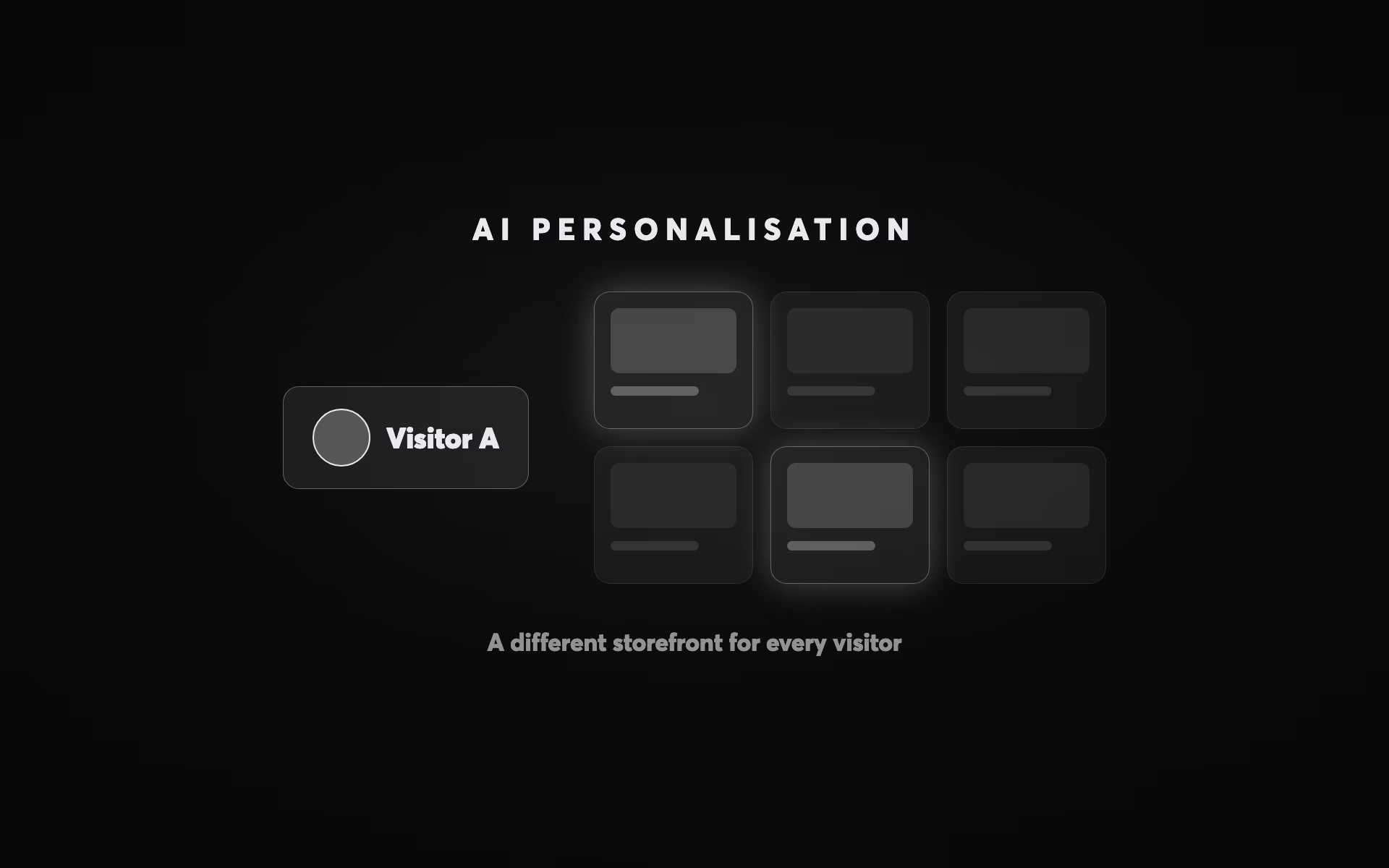
On-site personalisation goes beyond product recommendations. It means adapting the entire shopping experience — homepage layout, category page ordering, search results, banners, promotional overlays, and navigation — based on who is visiting and what they have done before. In 2026, this level of adaptation is achievable without enterprise-scale engineering resources.
Site search personalisation is one of the highest-impact on-site changes available. Site search users are 2.4x more likely to buy and spend 2.6x more than non-searchers — they are the highest-intent visitors on your site. Yet most ecommerce search returns results based on static keyword matching, with no personalisation based on the visitor's category affinity, price range preference, or browsing history. AI-powered search engines like Algolia (with neural search), Constructor, and Bloomreach Discovery reorder search results per individual based on personal browsing history and purchase behaviour. The conversion uplift from personalised search is consistently one of the fastest payback improvements available to ecommerce stores.
Dynamic landing page personalisation adapts the page a visitor lands on based on their traffic source. A visitor arriving from a Google ad for "running shoes" and a visitor arriving from a Facebook retargeting ad for a specific product they viewed last week have entirely different intents — yet most stores show them the same homepage. Personalisation platforms like Insider, Dynamic Yield, and Optimizely enable landing page content, hero images, and featured products to adapt based on traffic source, referring keyword, customer segment, and geographic location. The result: higher relevance on arrival, lower bounce rates, and more sessions progressing to purchase.
Personalised overlays and promotions are a more nuanced element of on-site personalisation. Exit-intent overlays offering a discount to first-time visitors who are about to leave have become ubiquitous — and consequently, less effective. AI-powered personalisation improves on this by targeting overlays based on customer value signals: showing loyalty rewards to recognised repeat customers, timing discount overlays based on individual price sensitivity (not showing discounts to customers who consistently pay full price), and personalising the offer based on what is in the cart.
AI-Powered Retargeting: Personalising the Paid Media Layer
Standard retargeting shows the same ads to everyone who visited your website in the last 30 days. AI retargeting moves beyond this to serve ads that reflect each individual's specific behaviour — the exact product they viewed, the category they spent most time in, the price range they were browsing, and how recently they visited. The impact on ROAS is substantial: one platform study showed personalised segmentation on retargeting ads delivered a 39% uplift in ROAS on Google and 38% uplift in conversions on Facebook.
The technical infrastructure for AI retargeting requires three elements to work effectively. First, accurate tracking: in a post-cookie environment, server-side tagging and first-party data collection are essential. Platforms like Elevar (Shopify) and Stape are the 2026 standard for maintaining tracking accuracy as browser-based tracking degrades. Second, product feed quality: AI retargeting platforms consume your product feed to serve dynamic creatives — the feed needs accurate pricing, inventory status, and high-quality images for every product. Third, audience segmentation: rather than one "website visitors" audience, AI retargeting works best with granular audiences — cart abandoners, category browsers by category, product viewers by product, past purchasers by purchase date and category.
For Shopify, Triple Whale has become a leading tool for unified attribution and retargeting intelligence — connecting ad spend, creative performance, and customer LTV in a single dashboard. Polar Analytics offers similar capability at a lower price point. For Google's AI retargeting, Performance Max with properly structured product feeds and customer match audiences achieves significantly better results than standard shopping campaigns, particularly when fed with first-party purchase data and AI-generated audience signals. For a broader strategy on Google advertising, see our Google Ads for ecommerce guide.
AI Email Personalisation: The 2026 Klaviyo Stack
Klaviyo has become the dominant email and SMS platform for ecommerce, and its AI capabilities in 2026 represent a meaningful step forward from basic segmentation. Understanding what is now available — and what requires additional tools — is essential for building the right email personalisation stack.
Klaviyo's native AI features include predictive analytics (expected next purchase date, predicted CLV, churn risk, and gender prediction based on purchase history), AI product recommendations (personalised product blocks in emails based on purchase and browse history), and send-time intelligence (automatically schedules campaigns and flows for the time each individual subscriber is most likely to engage). According to Klaviyo's own benchmark data, AI product recommendations lift email click rates to 3.75% on average — and 8.79% for top performers, while driving materially higher revenue per recipient.
For brands that want to push further, third-party AI tools integrate with Klaviyo to extend personalisation capabilities. Phrasee generates and optimises AI-written subject lines and preview text — eBay documented a 15.8% open rate lift and 31% click increase using Phrasee at scale. Recart and Postscript extend SMS personalisation with AI-driven timing and segmentation. Attentive offers AI-powered SMS personalisation with behavioural triggering comparable to Klaviyo's email capability for the SMS channel.
The practical benchmark gap between Level 1 (no personalisation) and Level 3 (behavioural personalisation with AI flows) in email is significant. Batch-and-blast campaigns average a 14.5% open rate and 1.3% click-through rate. Automated, behavioural sequences achieve a 42.1% open rate and 5.8% click-through rate. That is a 3x improvement in opens and 4.5x in clicks — translating directly to revenue for stores where email is a primary retention channel. Segmented campaigns generate 760% more revenue than non-segmented batch sends.
Building Your Personalisation Stack: Platform Selection by Business Stage
Not every personalisation investment makes sense at every stage. The tools that make sense for a $500k annual revenue Shopify store are different from those suited to a $5M+ ecommerce business. The following framework helps match investment to stage.
Startup / Sub-$500k annual revenue: Start with the fundamentals. Cart abandonment and welcome series automation in Klaviyo or Omnisend. Basic product recommendations via Shopify's built-in engine or a free/low-cost app like LimeSpot's starter tier. These two investments alone typically add 10–20% to revenue for stores that do not yet have them. Total cost: $0–$150/month for the email platform, $0–$50/month for basic recommendations. Focus on getting the data foundation right — tag every page, capture email at every touchpoint, start building purchase history.
Growth / $500k–$2M annual revenue: This is where personalisation investment begins to compound. Add Klaviyo's predictive analytics tier for replenishment timing and churn risk scoring. Implement Rebuy or LimeSpot for Shopify with AI-powered recommendations across the full customer journey (homepage, category pages, cart, post-purchase). Add browse abandonment flows. Begin building segmented retargeting audiences with dynamic creatives. Budget: $200–$800/month across platforms. The revenue uplift at this stage typically covers the tool cost within weeks.
Scale / $2M+ annual revenue: At this stage, personalisation is a competitive moat, not a nice-to-have. Implement a dedicated personalisation platform: Insider or Nosto for mid-market, Dynamic Yield or Bloomreach for enterprise. These platforms enable full cross-channel personalisation — unifying email, SMS, on-site, and ads under a single customer profile. Invest in AI site search (Algolia or Constructor). Implement server-side tracking for precise attribution. Budget: $1,500–$10,000+/month. The return at this revenue level is measurable in percentage points of total revenue — even a 5% lift on $5M annual revenue is $250,000.
For guidance on integrating these tools into a broader AI implementation strategy, see our guide to AI implementation for business and our overview of AI workflow automation.
| Metric | Benchmark / Uplift | Context |
|---|
The Personalisation Data Foundation: What You Need Before You Invest
Every AI personalisation system is as good as the data feeding it. Implementing a sophisticated recommendation engine on a store with inconsistent purchase data, poor tagging, and no behavioural tracking is one of the most common and expensive mistakes in ecommerce. Before investing in personalisation tools, the data foundation needs to be in place.
The minimum data requirements for effective AI personalisation are: comprehensive event tracking (pageviews, product views, add-to-cart, purchase events, at minimum), a customer identity layer (email capture strategy and customer accounts to link sessions to individuals), clean product data (accurate categories, attributes, and inventory status), and historical purchase data (ideally 3+ months of transaction history for collaborative filtering to work effectively).
Common data quality issues that break personalisation tools: anonymous session data that cannot be linked to customer profiles (solved by email capture strategy and customer accounts), product category taxonomy that is too broad ("clothing" rather than "men's running jackets"), missing product attributes (AI content-based filtering cannot distinguish similar products without structured attribute data), and purchase data stored in a separate system not connected to your email or personalisation platform.
For a comprehensive framework for data readiness before AI implementation, see our guide to building an AI-ready business. The personalisation data foundation sits at the intersection of AI implementation strategy and ecommerce operations — getting it right is what separates personalisation that compounds in value over time from personalisation that delivers flat results and erodes confidence in the investment.
Ready to map your ecommerce store's personalisation opportunities? Involve Digital's AI Implementation Discovery session identifies the highest-ROI personalisation investments for your specific store, platform, and customer base — with a prioritised roadmap from quick wins to advanced AI capability. Get your free growth plan with Involve Digital.
Get Started Using The Form Below
AI personalisation sits within a broader AI implementation strategy. For the full context, explore our complete AI implementation guide, our overview of AI tools for marketing teams, and our guide to AI workflow automation for scaling operations to match personalisation-driven demand. For advertising personalisation, see our Google Ads for ecommerce strategy guide.
Questions