Insightsbusiness growth consulting
Business Growth Consulting: What It Is & What to Expect
30 April 202629 min read
Direct answer
Business growth consulting services are structured engagements in which an external specialist diagnoses the constraints limiting a business's revenue growth, designs a strategy to remove them, and either executes that strategy or transfers a repeatable system to the client's internal team. Engagements typically span channel mix decisions, unit economics (CAC, LTV, payback period), attribution architecture, and conversion infrastructure. Outcomes vary by starting point: Involve Digital's agency work reduced Monster Group's cost per lead from $125 to $9.05 — a 92% reduction — in seven weeks; a separate campaign for Teachers Mutual Bank generated $200M+ in deposits against a 5090% ROI on a single term deposit vertical (Involve Digital internal case studies). Effective business growth consulting services are distinguished from generic strategy advice by their accountability to specific, pre-agreed commercial metrics — not activity reports or vanity dashboards.
Most businesses that hire a growth consultant are already past the point where a new campaign will fix things. The problem is structural — a broken CAC-to-LTV ratio, a channel mix built on habit rather than evidence, or attribution so fragmented that no one knows which spend is actually working. This article explains what business growth consulting services are, what a credible engagement looks like, and what numbers you should hold any consultant accountable to before you write the first invoice.
What Business Growth Consulting Services Actually Are
Business growth consulting services are structured engagements where an external specialist identifies the specific constraints on a business's revenue growth, builds a strategy to remove them, and either executes that strategy directly or installs a system the internal team can run.
That definition is narrower than most consultants will admit. Growth consulting is not:
- A rebrand
- A new website without conversion architecture behind it
- A media plan with no attribution layer
- A 90-page strategy deck with no execution path
It is a commercial intervention. The output is a measurable change in a specific metric — cost per lead, customer acquisition cost, revenue per channel, or payback period.
The scope of a real engagement typically covers four domains simultaneously:
- Unit economics — CAC, LTV, blended ROAS, and payback period. If these aren't established in week one, the engagement has no baseline.
- Channel mix — which channels are actually producing revenue (not just traffic), which are subsidised by last-click attribution, and where the marginal return is highest.
- Attribution architecture — how the business is measuring what's working. Most attribution stacks overweight bottom-of-funnel and underweight brand and assisted channels.
- Conversion infrastructure — landing pages, lead forms, CRM handoffs, and the gap between a click and a closed deal.
A consultant who focuses only on one of these without auditing the others will produce a local optimum, not a growth system.
Why Most Business Growth Consulting Engagements Fail to Move the Numbers That Matter
The majority of business growth consulting engagements underdeliver not because the strategy is wrong, but because accountability is structured around the wrong outputs.
Activity Reports vs. Outcome Accountability
Most consultants report on activity: campaigns launched, content published, ads served, impressions delivered. These are inputs. A business that is paying for growth consulting is buying a change in revenue trajectory — not a change in marketing activity.
The distinction matters because activity can increase while revenue declines. A business can run more campaigns, generate more impressions, and spend more on media while its CAC rises and its payback period extends. If the engagement is measured on activity, the consultant is protected from that outcome.
The fix is simple to describe and hard to negotiate: every engagement should define 2-3 commercial KPIs before work begins, and monthly reporting should lead with those KPIs — not with media metrics.
Solving the Wrong Constraint First
Growth has a bottleneck. In a constraint-limited system, fixing anything other than the bottleneck produces no net improvement — it just moves the queue.
A business with a 4% landing page conversion rate and a $120 CPL does not need more traffic. It needs a better conversion rate. Doubling the media budget will double the spend and the volume of wasted clicks before it doubles revenue.
A business with a strong conversion rate but a broken post-lead nurture sequence — where 70% of leads go cold before a salesperson contacts them — does not need better creative. It needs a CRM workflow.
Identifying the real bottleneck is the diagnostic phase. Consultants who skip it or compress it to a week are guessing at the constraint, then building a strategy on that guess.
What a Good Engagement Looks Like: Phase by Phase
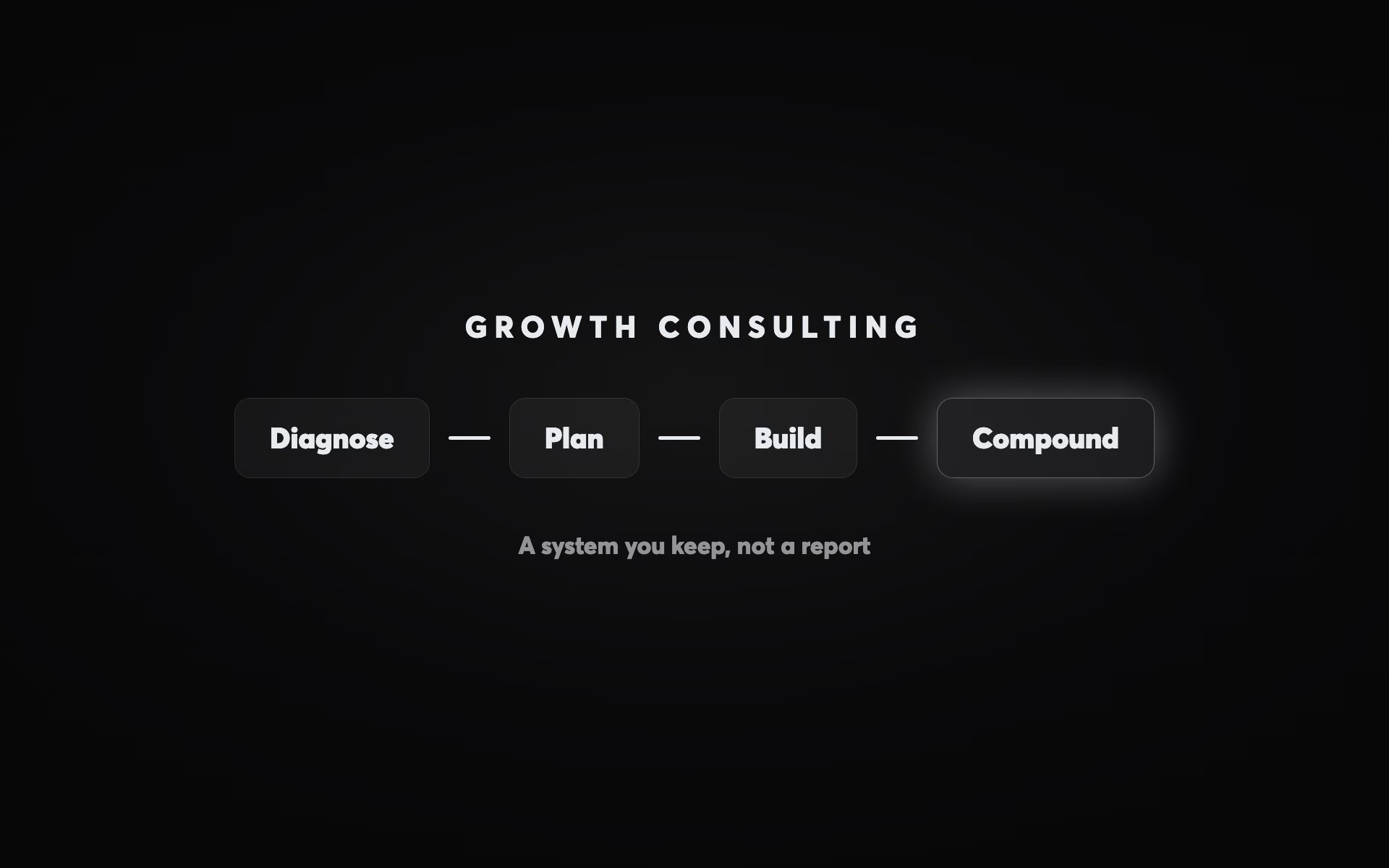
A credible business growth consulting engagement runs in four distinct phases. The duration of each varies by business size and complexity, but the sequence is not negotiable.
Phase 1 — Diagnostic (Weeks 1-4)
The diagnostic phase establishes the baseline. It produces three outputs:
- A current-state unit economics model — actual CAC by channel, actual LTV by cohort, actual payback period
- An attribution audit — how the business is currently measuring performance, where that measurement is wrong, and what the corrected numbers look like
- A constraint map — the single biggest lever between the business's current revenue and its target
The diagnostic is not a strategy. It is the evidence base for a strategy. Any consultant who arrives in week one with a strategy has skipped the diagnostic.
Phase 2 — Strategy and Channel Mix (Weeks 4-8)
With a validated baseline, the strategy phase answers one question: given our unit economics and our constraint, what is the highest-ROI sequence of interventions?
This is where channel mix decisions are made. The right channel mix is not the one the business has always used. It is the one that produces the lowest blended CAC at the required volume, given the business's LTV and margin structure.
For most Australian businesses in the $2M-$20M revenue range, this analysis produces at least one surprising finding — a channel that is significantly underweighted relative to its marginal return, or a channel that is consuming budget while producing leads that never convert to revenue.
Phase 3 — Execution and Iteration (Months 2-6)
Execution is where most consultants either prove their value or expose their limitations. A strategy document is not a growth outcome. The execution phase requires:
- Campaign build and launch across the agreed channels
- Weekly performance review against the pre-agreed KPIs
- Rapid iteration — creative testing, bid strategy adjustment, landing page optimisation — based on real data, not assumptions
- Clear escalation criteria: what triggers a strategy revision vs. a tactical adjustment
The Involve Digital agency team reduced Monster Group's cost per lead from $125 to $9.05 — a 92% reduction — in seven weeks of execution (Involve Digital internal case study). That pace is not typical, but it illustrates what focused execution against a validated constraint can produce.
Phase 4 — Transfer or Continuity (Month 6+)
A growth consulting engagement should end in one of two ways: either the consultant transfers a documented, repeatable system to the internal team, or the engagement evolves into an ongoing performance partnership with clear scope and accountability.
What it should not produce is dependency — a situation where the business cannot operate its own growth system without the consultant's ongoing involvement, and where the consultant has no incentive to change that.
The Unit Economics You Must Understand Before Engaging Anyone
Before any business growth consulting engagement begins, the business needs to know three numbers with confidence. If it doesn't, establishing them is the first task.
Customer Acquisition Cost (CAC) is the total cost — media spend, agency fees, tooling, internal time — divided by the number of new customers acquired in a given period. Most businesses calculate a blended CAC that mixes high-performing and low-performing channels, which obscures where growth is actually coming from.
The more useful number is CAC by channel. A business might have a blended CAC of $180 while its Google Search CAC is $90 and its display CAC is $420. The blended number suggests the business is viable. The channel-level numbers suggest it should move budget from display to search immediately.
Lifetime Value (LTV) is the net revenue a customer produces over the full duration of their relationship with the business. For subscription businesses, this is relatively straightforward. For transactional businesses — retail, financial services, professional services — it requires cohort analysis: tracking what customers who first purchased in a given month actually spent over the following 12, 24, and 36 months.
The LTV-to-CAC ratio is the single most important number in growth strategy. A ratio below 3:1 means the business is acquiring customers at a cost that leaves insufficient margin for operations, retention, and profit. A ratio above 5:1 typically means the business is under-investing in acquisition and leaving growth on the table.
Payback period is how long it takes for a customer's gross margin contribution to recover the CAC. For SaaS businesses, 12-18 months is standard. For e-commerce, 6-9 months. For financial services, it varies widely by product. A payback period that exceeds the average customer tenure means the business loses money on every customer it acquires, regardless of what the LTV model says.
Channel Mix: Why the Right Allocation Is Never Obvious
Channel mix is where most businesses make their most expensive mistakes — not because they choose the wrong channels, but because they allocate budget based on last-click attribution rather than incremental contribution.
Last-click attribution assigns 100% of the conversion credit to the final touchpoint before purchase. In practice, this systematically overweights branded search (because customers who have already decided to buy will often search the brand name as their last step) and underweights upper-funnel channels that created the intent in the first place.
The result is predictable: businesses cut brand awareness spend because it doesn't show up in last-click reports, then watch their branded search volume decline six months later as the awareness pipeline empties.
A more accurate picture requires at minimum:
- Multi-touch attribution — distributing credit across the full customer journey, not just the last click
- Incrementality testing — running holdout experiments to measure what would have happened without a given channel's spend
- Marketing efficiency ratio (MER) — total revenue divided by total marketing spend, measured at the business level rather than the channel level. MER captures the halo effects that channel-level ROAS misses.
The Involve Digital agency team's work with Teachers Mutual Bank illustrates what proper channel allocation produces. By restructuring campaign architecture across Google Ads and rebuilding the attribution model, the agency reduced Google Ad costs by 91% while simultaneously generating $200M+ in term deposits and achieving a Credit Card CPA that was 777% cheaper than the industry average (Involve Digital internal case study). The spend reduction and the outcome improvement happened simultaneously — which is only possible when the original allocation was wrong.
For businesses evaluating their own channel mix, the diagnostic question is not "which channel has the best ROAS?" It is "which channel, if we removed it entirely, would cause the largest drop in total revenue?" That channel deserves more investment, not less.
Attribution Is Where Growth Consulting Either Earns Its Fee or Wastes It
Attribution is the mechanism by which a business decides what is working. If the attribution model is wrong, every strategic decision downstream is built on false evidence.
The three most common attribution failures in Australian businesses are:
- Platform-reported ROAS as ground truth. Every ad platform — Google, Meta, LinkedIn — reports ROAS using its own attribution window, its own conversion tracking, and its own definition of a conversion. These numbers are not comparable across platforms and are not reconcilable with actual revenue. A business that optimises toward platform ROAS is optimising toward a number the platform controls.
- Ignoring the post-click journey. Attribution typically ends at the lead or the transaction. For businesses with a sales cycle — financial services, B2B, high-consideration retail — the more important number is the revenue that actually closes, not the lead that was generated. A channel that produces cheap leads that never convert to revenue has a negative contribution margin, regardless of what the CPL report says.
- No baseline for comparison. Without a pre-engagement baseline — actual CAC, actual conversion rates by channel, actual revenue by cohort — it is impossible to know whether a growth consulting engagement is producing improvement or just activity. The baseline is established in the diagnostic phase. If a consultant does not require it, that is a signal.
The fix is a unified measurement framework: a single source of truth that pulls revenue data from the CRM or payment system, maps it back to the channel and campaign that generated the original lead or visit, and reports on CAC and LTV rather than CPL and ROAS. This is not a complex technical build. It is a deliberate decision to measure what matters rather than what is easy to report.
For a deeper treatment of attribution architecture and AI-search visibility, see our article on Autonomous Growth Engine Evaluation: A CMO's 2026 Framework.
What Real Outcomes Look Like: Case Studies from Involve Digital's Agency Work
The following outcomes were delivered by Involve Digital's agency team using human-led performance marketing workflows. They are presented here not as guarantees, but as evidence of what structured, constraint-focused growth consulting produces when it is done properly.
Monster Group — 92% CPL Reduction in 7 Weeks
Monster Group needed to acquire leads across five verticals — energy, internet, solar, debt, and tax — at a lower cost than tier-one Australian providers including Origin Energy, Optus, and Telstra. Starting CPL was $125. After seven weeks of execution, CPL reached $9.05 — a 92% reduction that outperformed every named competitor (Involve Digital internal case study).
The mechanism was not a new channel. It was a restructured bidding strategy, tighter audience segmentation, and a conversion-focused landing page architecture that the previous setup lacked entirely. The constraint was not awareness — it was conversion efficiency.
- Starting CPL of $125 — unsustainable at scale
- Competing against tier-one telco and energy brands with large media budgets
- Five verticals running simultaneously with no unified performance architecture
- Conversion efficiency was the bottleneck — not channel reach or awareness
- Restructured bidding strategy across all five verticals
- Tighter audience segmentation to eliminate wasted spend
- Conversion-focused landing page architecture built from scratch
- Unified performance system replacing fragmented campaign setup
Teachers Mutual Bank — 5090% ROI on Term Deposits
Teachers Mutual Bank's internal team was running fragmented campaigns across five product verticals with an incumbent agency that could not demonstrate measurable results. Involve Digital's agency team restructured the campaign architecture, rebuilt the attribution model, and executed across Google Ads with a unified performance system.
Outcomes from the agency's work: 91% reduction in Google Ad costs, $200M+ in deposits generated, 5090% ROI on the term deposit campaign, Credit Card CPA 777% cheaper than the industry average, and Home Loan application performance 1714% above benchmark (Involve Digital internal case study).
Steadfast Group — 9.7X Lead Volume Over Four Years
Steadfast Group needed to increase 'Find a Broker' leads using the same annual media budget, benchmarked against results from the outgoing agency (Bohemia Group / M&C Saatchi). The Involve Digital agency team delivered 5X the lead volume within three months, scaling to 9.7X by year four — with no budget increase. Over the same period, Steadfast's market capitalisation grew by $5.27B (Involve Digital internal case study).
This case illustrates the compounding effect of proper constraint identification. The problem was not budget — it was that the previous agency was optimising for impressions rather than broker leads. Redirecting the same spend toward the actual commercial objective produced an immediate and sustained improvement.
Rakuten Securities — 64% CPA Reduction and 5X Funded Account Volume
Rakuten Securities had a sign-up volume problem that masked a deeper issue: sign-ups were not converting to funded accounts. The Involve Digital agency team diagnosed the constraint as a post-sign-up conversion gap, not an acquisition problem.
By restructuring the funnel and rebuilding the campaign architecture, the agency delivered: 80% reduction in cost per sign-up, 60% improvement in conversion to funded accounts, 5X funded account volume against forecast, and a 64% reduction in overall CPA (Involve Digital internal case study). The acquisition cost fell because the conversion rate improved — which meant the same media budget produced five times the commercial outcome.
Naked Wines — $20.67 CPA Against a $30 Target During Christmas
Naked Wines needed new customer subscriptions at under $30 CPA during the highest-risk advertising period of the year — Christmas and New Year — when CPAs typically spike and subscription fatigue peaks. The Involve Digital agency team delivered a final CPA of $20.67 against the $30 target, generating 4,362 sales despite a mid-campaign New Year spike to $90 CPA that was corrected through rapid optimisation (Involve Digital internal case study).
The Naked Wines engagement demonstrates the execution discipline that separates growth consulting from strategy consulting: the strategy was sound, but the outcome depended on real-time response to a CPA spike that would have destroyed the campaign's economics if left unaddressed for more than 48 hours.
How to Evaluate Business Growth Consulting Services Before You Sign
Evaluating business growth consulting services requires asking questions that most consultants are not expecting. The following criteria separate engagements that produce commercial outcomes from those that produce activity reports.
1. Do they require a diagnostic before proposing a strategy?
A consultant who arrives with a strategy in week one has not diagnosed your business. They have applied a template. The diagnostic phase — establishing actual unit economics, auditing attribution, and identifying the real constraint — is not optional. It is the evidence base for everything that follows.
2. What are the pre-agreed commercial KPIs?
Before signing, the engagement should specify 2-3 commercial KPIs — CAC, CPL, revenue per channel, payback period — that will be reported on monthly. If the consultant proposes reporting on impressions, reach, or engagement rate as primary KPIs, that is a signal about what they expect to be held accountable for.
3. Can they show channel-level CAC from prior engagements?
Case studies that cite CPL reductions, CPA improvements, or ROI figures at a channel level are more credible than aggregate revenue claims. Ask for the starting baseline, the intervention, and the outcome — in that sequence. If the baseline is missing, the improvement figure is unverifiable.
4. What is their attribution methodology?
Ask specifically: how do they reconcile platform-reported ROAS with actual revenue? If the answer is "we use Google Analytics" or "we trust the platform numbers", the attribution methodology is last-click by default. That is not wrong for every business, but it should be a conscious choice, not an oversight.
5. What does the engagement look like in month six?
A growth consulting engagement that has not produced a measurable improvement in at least one commercial KPI by month six is either solving the wrong constraint or executing poorly. Ask the consultant to describe what month six looks like — what they will have built, what they will have tested, and what the business will be able to operate independently after they leave.
6. Do they have sector-relevant experience?
Unit economics vary significantly by sector. A CAC of $200 is catastrophic for a $30/month SaaS product and irrelevant for a financial services business with a $15,000 LTV. A consultant with experience in your sector will have calibrated benchmarks. One without it will be learning your economics at your expense.
For businesses evaluating their current growth strategy and wanting a structured starting point, Involve Digital's free proposal generators and business-growth tools at Get your free growth plan allow you to model your CAC, payback period, and projected outcomes before any conversation begins.
Where Autonomous Systems Fit Into Growth Consulting in 2026
The structure of business growth consulting services is changing. Not because the underlying problems have changed — unit economics, attribution, and channel mix are as relevant as they were a decade ago — but because the tools available to diagnose and address those problems are becoming significantly more capable.
Involve Digital is building AOS — an autonomous performance-marketing operating system — grounded in the same playbooks that produced the agency's track record across Teachers Mutual Bank, Monster Group, Steadfast, and Rakuten Securities. AOS is designed to encode those diagnostic and execution workflows into a system that operates continuously, not in quarterly strategy cycles.
The distinction matters for businesses evaluating growth consulting services in 2026: the question is no longer only "who will build my growth strategy?" but also "what system will execute and iterate on it, and at what speed?" A strategy that takes six weeks to diagnose and three months to execute manually can, in principle, be compressed significantly when the diagnostic and execution layers are automated.
AOS does not yet have its own case-study outcomes — it is in active development. But the agency track record that informs its design is documented and verifiable. For a detailed treatment of how autonomous growth systems are being evaluated by CMOs in 2026, see our article on Autonomous Growth Engine Evaluation: A CMO's 2026 Framework.
For businesses that are not yet ready for autonomous systems, the agency's human-led consulting track remains the primary engagement model — with the same diagnostic rigour, the same accountability to commercial KPIs, and the same execution discipline that produced the outcomes documented above.
The Specific Next Step
If you are evaluating business growth consulting services and want to understand what your unit economics look like before any conversation begins, run your numbers through Involve Digital's get a free growth plan from our strategist at Get your free growth plan. It takes five minutes and produces a structured view of your CAC, LTV ratio, and the revenue impact of the CPL reductions the agency has achieved for comparable businesses.
If you already know your numbers and want to discuss a specific constraint — a channel that is underperforming, an attribution model that doesn't reconcile, or a CAC that has been rising for two quarters — contact Involve Digital's strategy team directly. The first conversation is diagnostic, not a sales pitch.
- Your current CAC — customer acquisition cost per channel if you have it, blended if not. Even a rough figure is useful.
- Your LTV or average client value — lifetime revenue per customer, or average contract/project value if LTV isn't tracked yet.
- The constraint you suspect — a channel underperforming, a rising CAC, a conversion rate that's stalled, or a growth ceiling you can't explain.
One focused conversation about your numbers.
Questions