InsightsMeta Ads for B2B Lead Generation
Meta Ads for B2B Lead Generation: The 2026 Guide
30 July 202623 min read
Direct answer
Meta ads for B2B lead generation is the practice of running paid campaigns on Meta's platforms — Facebook and Instagram — to acquire business buyers at a measurable cost per lead (CPL). When configured correctly, Meta outperforms the 'B2B belongs on LinkedIn' assumption on a cost-per-qualified-lead basis. The critical variables are signal quality (Conversions API rather than pixel-only tracking), audience architecture (layered interest plus CRM-seeded lookalikes), and creative that addresses a specific business pain point rather than a generic value proposition. Involve Digital's agency work for Nuance Communications — an enterprise AI software company — delivered B2B leads at CPLs ranging from $14.66 to $82.14 across regulated verticals including legal, finance, government, and healthcare. For Monster Group's multi-vertical lead generation, CPL dropped 92% — from $125 to $9.05 — in seven weeks using Meta as a primary channel (Involve Digital case study). Signal quality and creative specificity, not budget size, determine B2B Meta performance.
Most B2B marketers write Meta off before they test it properly. That is a budget allocation mistake — not a strategic insight.
The evidence: Involve Digital's agency work for Nuance Communications, an enterprise AI software company, delivered B2B leads across legal, finance, government, and healthcare verticals at CPLs as low as $14.66. Monster Group's multi-vertical lead generation saw CPL fall 92% — from $125 to $9.05 — in seven weeks, with Meta as a primary channel.
The platform is not the problem. Signal quality, audience architecture, and creative specificity are.
Why Most B2B Teams Waste Their Meta Budget — and What High-Performers Do Differently
The typical B2B Meta failure mode is not the platform — it is the configuration. Three structural errors account for most wasted spend.
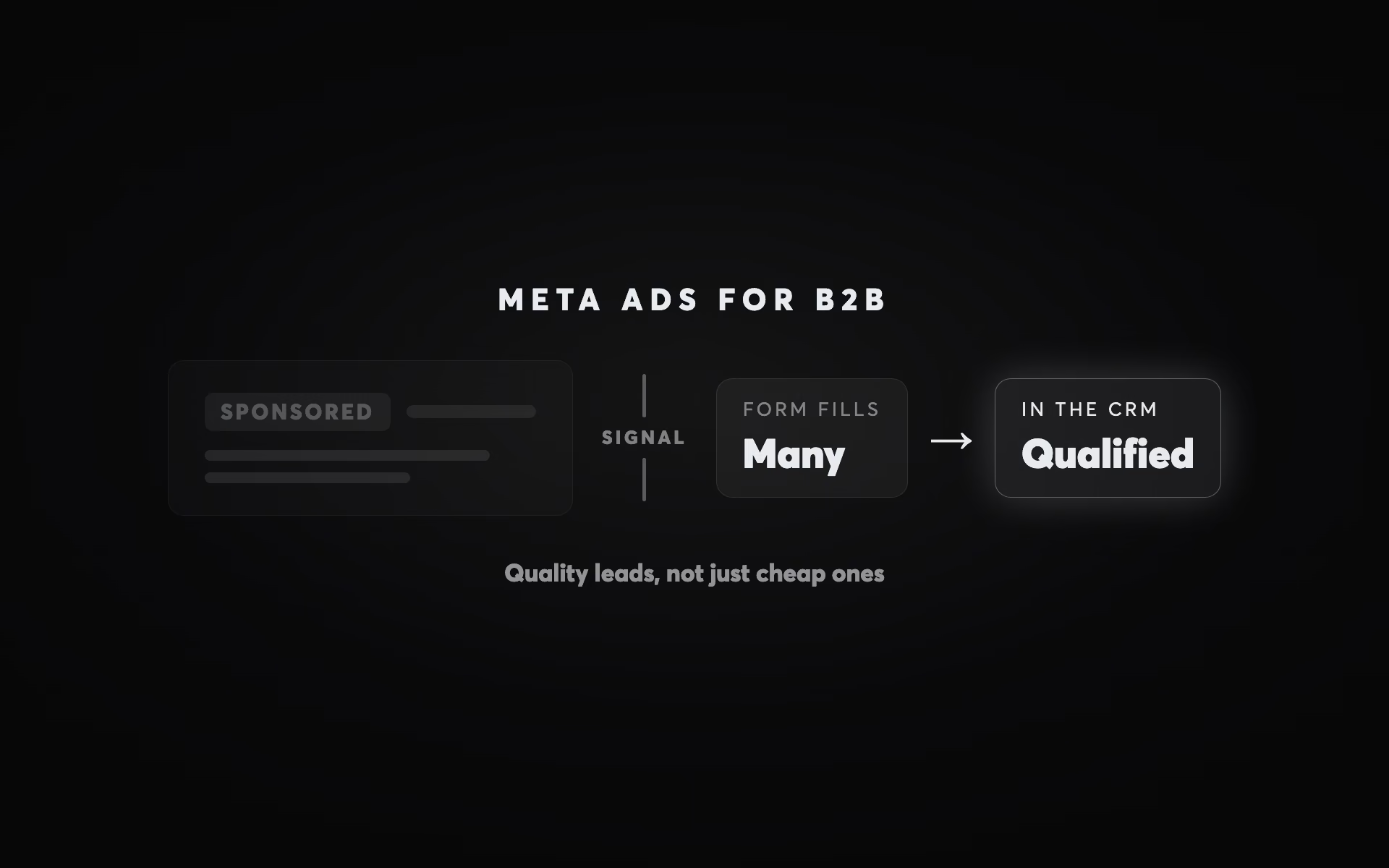
First: optimising for lead volume instead of lead quality. Meta's algorithm will find you leads. If your optimisation signal is "completed form", it will find the cheapest form completions — which in B2B are rarely your ICP. The algorithm needs downstream signal: qualified lead, booked meeting, or opportunity created.
Second: running pixel-only tracking in a cookieless environment. Browser restrictions and iOS privacy changes mean pixel-only setups now miss a material share of conversions. When Meta's algorithm is working from incomplete data, it bids blind. The result is inflated CPL and erratic delivery.
Third: using consumer creative logic for business buyers. A business buyer evaluating enterprise software does not respond to the same urgency triggers as a consumer. Generic "Book a Demo" creative with no specific pain point stated produces low CTR and low intent leads — even when targeting is sharp.
Fix these three and Meta becomes a viable B2B channel. In some verticals, it becomes the most cost-efficient one.
Signal Quality: Why CAPI Is Non-Negotiable in 2026
What CAPI Actually Does
The Conversions API (CAPI) sends conversion events directly from your server to Meta — bypassing browser-based tracking limitations entirely. Where a pixel fires only when a browser allows it, CAPI fires when your server records the event. The two run in parallel; CAPI fills the gaps the pixel misses.
Meta's own data (Meta Business Help Centre, 2024) shows that advertisers using CAPI alongside the pixel see an average 19% improvement in cost per result compared to pixel-only setups. In B2B, where conversion volumes are lower and each signal carries more weight in the algorithm, that gap widens.
For B2B specifically, the highest-value CAPI event is not the lead form submission — it is the downstream event: a qualified lead status updated in your CRM, a meeting booked, or a deal stage advanced. Passing these events back to Meta via CAPI (with a 7–28 day attribution window) trains the algorithm on your actual buyers, not your form completers.
CAPI Setup for B2B
A functional CAPI setup for B2B requires four things:
- Server-side event firing for all primary conversion events (form submit, meeting booked, MQL status)
- CRM integration to pass offline conversion events back to Meta (HubSpot, Salesforce, and most major CRMs have native Meta integrations)
- Event deduplication — if pixel and CAPI both fire for the same event, Meta double-counts without deduplication logic
- A consistent external ID or email hash to match Meta users to CRM records
Audience Architecture for B2B on Meta
Meta does not have LinkedIn's job-title targeting — but it has something LinkedIn does not: behavioural data at scale and the ability to find lookalikes from your actual customer list.
CRM-Seeded Lookalikes
The highest-performing B2B Meta audiences are built from CRM exports of closed-won customers — not website visitors, not email subscribers. You are seeding the algorithm with the people who actually bought, not the people who browsed.
Upload a customer list of at least 1,000 matched profiles (email, phone, name). Meta matches these to its user base and builds a 1–2% lookalike. In verticals where customer lists are smaller, supplement with high-value lead lists (SQLs, not all leads).
This approach outperforms interest-only targeting in most B2B tests because it captures real purchase behaviour — job title, industry, and seniority emerge as implicit signals rather than explicit filters.
Advantage+ Audiences: Where B2B Gets Complicated
Meta's Advantage+ audience automation expands targeting beyond your defined parameters when it predicts a conversion. For B2B, this is a double-edged feature.
Advantage+ can reduce CPL significantly when your conversion signal is downstream (qualified lead, opportunity). It struggles when optimising for top-of-funnel form fills, because it finds the easiest conversions — which in B2B are often outside your ICP.
The practical approach: run Advantage+ with a CRM-seeded lookalike as the audience suggestion, and optimise for a downstream event. This gives the algorithm room to explore while anchoring it to buyer-quality signal.
Creative Strategy: The Variable Most B2B Teams Get Wrong
Creative is the highest-leverage variable in Meta B2B campaigns — more impactful than audience refinement once basic targeting is sound.
Formats That Work for B2B
Three formats consistently outperform in B2B Meta campaigns:
Static image ads with a specific claim. Not "We help businesses grow" — "We reduced CPL by 92% for a multi-vertical lead gen business in 7 weeks." A specific, credible claim stops the scroll because it is relevant to a buyer with that problem.
Short-form video (15–30 seconds) leading with the problem. Open with the pain point, not the brand. "If your B2B leads look great on paper but never close, here's why." The Woolmark Company's Facebook campaign achieved a 39.77% view-through rate with problem-led video content — a benchmark that illustrates how well the format performs when the hook is specific (Involve Digital case study).
Testimonial or case study creative. A 20-second video of a real customer describing a specific outcome outperforms polished brand video in B2B because it carries social proof and specificity simultaneously. Text overlays make it watchable without audio — critical for feed placement.
A Practical Creative Testing Framework
Test one variable at a time. The most common B2B Meta creative testing mistake is changing the hook, the visual, and the CTA simultaneously — then not knowing what drove the result.
A disciplined framework for B2B:
- Phase 1 — Hook test: Same visual, same CTA, three different opening lines. Identify the highest CTR hook.
- Phase 2 — Format test: Winning hook in static vs. video vs. carousel. Identify the lowest CPL format.
- Phase 3 — CTA test: Winning hook + format with three CTA variants ("Book a Demo", "See How It Works", "Get the Case Study"). Optimise for lead quality, not volume.
Run each phase for a minimum of 50 conversion events before calling a winner. In B2B with lower conversion volumes, this may take 2–3 weeks per phase.
Lead Quality vs Volume: The Real Optimisation Problem
The most important metric in B2B Meta campaigns is not CPL — it is cost per qualified lead (CPQL), or better still, cost per opportunity.
A campaign generating leads at $15 CPL looks efficient. If 2% of those leads qualify, your CPQL is $750. A campaign at $80 CPL where 40% qualify produces a CPQL of $200 — four times more efficient on the metric that actually matters.
This distinction requires closed-loop reporting: Meta spend data connected to CRM pipeline data. Without it, you are optimising the wrong number.
Involve Digital's agency work for Nuance Communications — enterprise AI software across legal, finance, government, and healthcare — achieved CPLs ranging from $14.66 to $82.14 across different verticals and campaign types. The variation reflects vertical-specific buyer journey length and ICP specificity, not campaign quality. The right CPL benchmark is vertical-specific and pipeline-connected, not a platform average.
Bidding Strategy for B2B Meta Campaigns
Meta's bidding options for B2B lead generation break into three practical choices:
Lowest cost (automatic bidding): Meta spends your budget at the lowest available CPL. Use this in the learning phase (first 50 conversion events) to gather signal without constraining delivery.
Cost cap: You set a target CPL; Meta attempts to stay at or below it. Use this once you have a validated CPL target from at least one learning-phase campaign. Set the cap 20–30% above your actual target to avoid under-delivery — Meta needs headroom to find conversions.
Value optimisation: If you pass revenue or deal value back via CAPI, Meta can optimise for highest-value leads rather than most leads. This is the most powerful option for B2B but requires clean CRM-to-Meta data pipelines and sufficient conversion volume (Meta recommends 50+ value-optimisation events per week).
The common mistake is applying cost caps too early or too aggressively. A cost cap set below the natural CPL during the learning phase starves the algorithm of data and locks campaigns in a perpetual learning phase — the worst outcome for B2B where conversion volumes are already low.
What the Numbers Say: B2B Meta in Practice
The scepticism about Meta for B2B is understandable — but the case study data does not support writing it off.
Involve Digital's agency work for Monster Group, a multi-vertical lead generation business competing against Origin Energy, Optus, Telstra, and TPG, reduced CPL from $125 to $9.05 — a 92% reduction — in seven weeks. Meta was a primary channel in that result.
For Nuance Communications, enterprise B2B software leads were generated at $14.66 CPL in one vertical and $26.17 CPL in another — numbers that compare favourably to LinkedIn's average B2B CPL of $75–$150 (Metadata.io B2B Paid Social Benchmark Report, 2024).
The pattern across both: downstream conversion signals passed via CAPI, CRM-seeded lookalike audiences, and creative built around specific business outcomes — not generic brand messaging.
- Downstream conversion signals passed via Meta CAPI — not just pixel events
- CRM-seeded lookalike audiences built from existing qualified leads
- Creative built around specific business outcomes, not brand messaging
- Concurrent multi-vertical campaigns with vertical-specific ad copy
- Rapid creative iteration — underperforming ads cut within 72 hours
- LinkedIn average B2B CPL: $75–$150 (Metadata.io, 2024)
- $9.05 CPL is 88–94% below LinkedIn's B2B average
- Result sustained across multiple verticals simultaneously
- 7-week timeline demonstrates speed of Meta's learning phase when seeded correctly
- Comparable to Nuance Communications: $14.66–$26.17 CPL on enterprise B2B software
Where Meta Fits in Your Broader Paid Media Strategy
Meta ads for B2B lead generation work best as part of a channel mix — not as a standalone channel. The buyers you reach on Meta are typically in-market but not actively searching. That means Meta is strongest at the awareness and consideration stages, with Google Search capturing the bottom-of-funnel demand Meta helps create.
The practical architecture: Meta drives awareness and lead capture at scale; Google Search captures branded and category queries from buyers who have seen your Meta creative; retargeting on Meta closes the loop for visitors who engaged but did not convert.
This channel interplay is covered in detail in our Paid Media Strategy: The Complete Performance Guide for 2026 — specifically the section on channel mix and funnel stage alignment.
The short version: if Meta is your only B2B paid channel, you are leaving bottom-of-funnel conversion to chance. If you are not running Meta at all, you are paying Google Search prices for awareness-stage buyers who could have been reached at a fraction of the cost.
If you want a structured view of how Meta fits into your specific channel mix — with CPL targets built on your actual numbers — the strategist at https://www.involvedigital.com will produce a free growth plan in a single conversation.
Questions